

Claude Code and COBOL: When AI Touches the Invisible Foundations of the World
Anthropic's Claude Code promises to modernize COBOL, the language behind 95% of ATM transactions. But is it really safe to entrust 220 billion lines of critical code to an AI?
FIRST PAGENETWORKS AND DATA INFRASTRUCTURESINNOVATION AND EMERGING TECHNOLOGIESAI
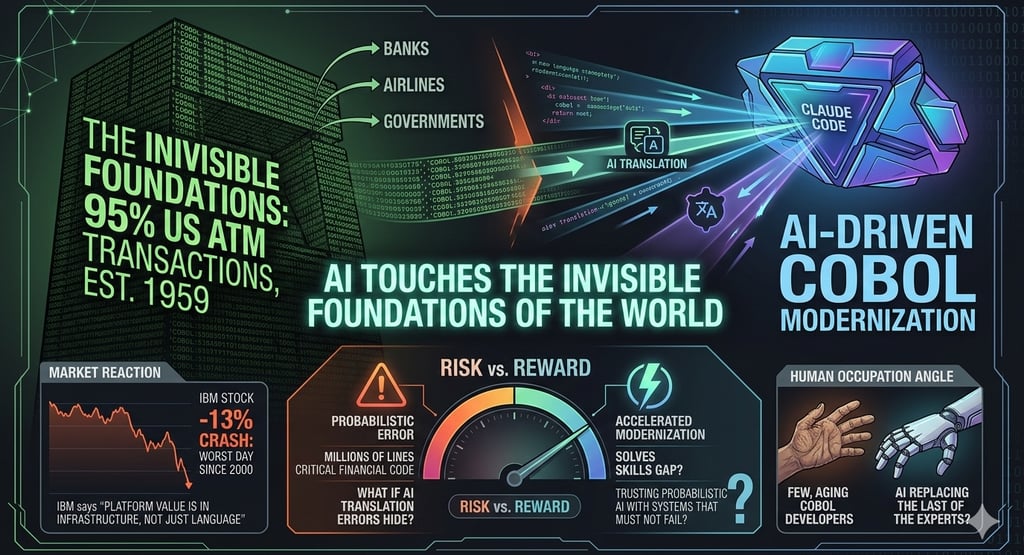
Claude Code and COBOL:
When AI Touches the Invisible Foundations of the World
"When I wrote this code, only God and I understood what it did. Now... only God knows."
Classic joke among COBOL programmers
On February 23, 2026, Anthropic published a blog post titled "How AI helps break the cost barrier to COBOL modernization." One sentence. One announcement. And $31 billion in IBM market capitalization evaporated in a single trading session.
Big Blue's shares plunged 13.2%, their worst day since October 18, 2000, because a San Francisco startup said its AI could do what armies of consultants had failed to accomplish in decades: modernize COBOL.
But behind the Wall Street numbers lies a far deeper story. A story about invisible foundations, knowledge vanishing with retirees, and the most uncomfortable question of the AI era: can we really trust a probabilistic system to comprehend code that must be correct 100% of the time?
1. What Is COBOL and Why Does It Still Run the World?
1.1 A Language Built to Last
COBOL, COmmon Business-Oriented Language, was conceived in 1959, during a conference at the Pentagon organized by CODASYL (Conference on Data Systems Languages). Among the key figures was Grace Hopper, the legendary computer scientist and US Navy officer who had already developed FLOW-MATIC, the first programming language to use English words instead of mathematical symbols. The principal architect of COBOL was Jean Sammet, a researcher at Sylvania Electric and later a manager at IBM.
The idea was revolutionary: a language that read almost like English, accessible even to non-technical staff. Where FORTRAN demanded mathematical notation, COBOL said things like MOVE BALANCE TO TOTAL-AMOUNT. A language designed for business, not science. For transactions, not orbital calculations.
But the real innovation was portability. For the first time, the same program could run on machines from different manufacturers. On December 6-7, 1960, the same COBOL program was executed on an RCA computer and a Remington-Rand Univac, proving cross-platform compatibility was achievable.
1.2 The Numbers Behind an Omnipresent Ghost
If COBOL were a person, it would be a 67-year-old retiree still carrying the entire global economy on its shoulders:
220 billion lines of COBOL code actively in use (Reuters estimate). A 2022 Micro Focus survey suggests the figure may have reached 800 billion
95% of US ATM transactions run on COBOL code
80% of in-person financial transactions are processed by COBOL systems
$3 trillion in daily commerce handled by COBOL
43% of global banking systems operate on COBOL
30 billion COBOL transactions per day (200 times more than Google searches)
45 of the world's top 50 banks use IBM mainframes
4 out of 5 major airlines depend on mainframes
COBOL manages airline reservations, healthcare systems, pensions, traffic lights, shipping container tracking, and virtually every financial transaction that touches your bank account.
1.3 Why Haven't They Replaced It Already?
The answer is a blend of engineering, economics, and pure fear.
Proven stability. COBOL systems work. They've worked for decades with reliability that would make any modern software blush. They've been optimized, tested, and debugged across generations. When a system correctly processes millions of daily transactions for 40 years, convincing a CTO to replace it requires very strong arguments.
Prohibitive cost. California alone allocated $220 million to replace its COBOL-based Medi-Cal system. The 10 most critical federal legacy systems cost $337 million per year in maintenance alone, consuming 80% of those agencies' IT budgets (GAO data).
Catastrophic risk. Every line of COBOL contains business rules accumulated over decades. Many are undocumented. Many exist only in the memories of programmers who have retired or passed away. Rewriting means risking the loss of critical logic hidden in millions of lines of code.
Technological lock-in. COBOL doesn't live alone. It lives inside an ecosystem: IBM mainframes, z/OS, CICS for transactions, VSAM for files, JCL for job scheduling. As IBM's Rob Thomas wrote, it's like the iOS-iPhone ecosystem: someone could build an alternative, but displacing a billion devices seems unlikely.
1.4 The COVID-19 Lesson: The Ghost Becomes Visible
The world brutally discovered COBOL's hidden fragility in April 2020, when the pandemic caused unemployment claims to explode across the United States. New Jersey, Kansas, Connecticut, systems built 40 years ago on COBOL mainframes, buckled under the load.
New Jersey Governor Phil Murphy made a public appeal: "We need volunteers with COBOL skills." He even mispronounced the language's name, calling it "Cobalt." The irony was bitter: in 2020, in the middle of a global pandemic, one of America's wealthiest states was desperately searching for programmers in a language that universities had stopped teaching in the 1980s.
The COBOL Cowboys, a group of retired COBOL programmers based in Texas, named after the Clint Eastwood film Space Cowboys, offered their help. But the episode exposed a systemic problem: the modern world depends on foundations that almost no one knows how to repair anymore.
2. The Announcement That Shook Wall Street
2.1 What Anthropic Said
On February 23, 2026, Anthropic published a blog post on Claude's website that hit the financial world like an earthquake.
The core message was clear: Claude Code can automate the exploration and analysis phases that consume most of the effort in COBOL modernization. Specifically, Anthropic claims its AI can map dependencies across thousands of lines of code, document lost workflows, identify risks faster than human analysts, translate COBOL logic into modern languages like Java or Python, create API wrappers around legacy components, and build scaffolding to run old and new code simultaneously.
The sentence that made the most noise: "Legacy code modernization stalled for years because understanding legacy code cost more than rewriting it. AI flips that equation."
2.2 The Market Reaction
Indicator Value IBM crash -13.2% in one day ($223.35 per share) Market cap lost ~$31 billion Record Worst day since October 18, 2000 IBM February decline -27%, worst month since 1968 Accenture ~-6% Cognizant ~-6% Dow Jones -820 points during the session
The sell-off wasn't limited to IBM. Accenture and Cognizant, which derive significant revenue from legacy modernization consulting, were dragged down. The pattern repeated: the previous week, after announcing Claude Code Security, cybersecurity stocks had crashed. Each new Anthropic AI capability announcement triggered an immediate reassessment of at-risk revenue.
2.3 IBM's Response: Translation Isn't Modernization
IBM didn't stay silent. Rob Thomas, SVP of IBM Software and Chief Commercial Officer, published a response blog post, without naming Anthropic directly, with a sharp message:
"Translating code is one thing. Modernizing a platform is something else entirely. The two are not the same, and the gap between them is where most enterprises run into trouble."
Thomas argued that mainframe value doesn't come from the language: it comes from the vertically integrated stack underneath: z/OS, transaction processing architecture, quantum-safe encryption, and decades of hardware-software optimization. He noted that 40% of COBOL doesn't even run on mainframes, much of what's framed as a "mainframe story" is actually a distributed systems problem.
2.4 The Irony: IBM Said the Same Thing First
As The Register noted with typical sarcasm, Anthropic didn't discover anything new. IBM itself launched "watsonx Code Assistant for Z" in 2023, an AI tool to convert COBOL to Java. CEO Arvind Krishna said in July 2025 that the tool had achieved "very wide adoption." And in its latest earnings report, IBM recorded its highest mainframe revenue in 20 years.
The difference? When IBM says "we use AI to modernize COBOL," markets applaud. When Anthropic says "our Claude Code can do it," markets see disruption and sell. Perception matters more than technical reality.
3. The Real Problem: Probabilistic AI on Deterministic Systems
3.1 The Accuracy Paradox
Here's what Wall Street ignored in the selling frenzy and what Anthropic elegantly sidestepped in its blog post.
COBOL governs systems where accuracy must be 100%. When a bank transfers money, when a healthcare system calculates a dosage, when a government processes pensions: there's no room for "almost correct." A penny off in a financial transaction, multiplied by billions of operations, becomes a catastrophe.
Language models like Claude are probabilistic systems. They don't "understand" code the way a human programmer does. They generate statistically plausible outputs based on learned patterns. They work brilliantly for many tasks. But translating mission-critical code is not "many tasks."
3.2 The Numbers That Should Give Pause
CodeRabbit's "State of AI vs Human Code Generation" report (December 2025) analyzed 470 open-source pull requests and found concerning data:
Metric AI vs Human
Total issues per PR 10.83 (AI) vs 6.45 (human) = 1.7x more issues
Critical issues 1.4x more frequent in AI code
Logic and correctness errors 1.75x more in AI code
Business logic errors 2.25x more in AI code
Concurrency errors 2.29x more in AI code
XSS vulnerabilities 2.74x more in AI code
Excessive I/O operations ~8x more in AI code
The most relevant figure for the COBOL context? Business logic errors are 2.25 times more frequent in AI code. Exactly the kind of error that, hidden in a COBOL-to-Java translation of a banking system, could go unnoticed for months before causing real damage.
The Cortex "Engineering in the Age of AI: 2026 Benchmark Report" confirms the trend: PRs per author increased 20% year-over-year, but incidents per PR grew 23.5%, and change failure rates rose approximately 30%.
3.3 The Implicit Knowledge Problem
There's an even deeper challenge. COBOL isn't just code. It's crystallized institutional knowledge.
Behind every IF ACCOUNT-TYPE = 'SAVINGS' AND BALANCE > 10000 THEN PERFORM INTEREST-CALCULATION-PREMIUM lies decades of business decisions, regulatory exceptions, edge cases discovered after real crises, manual adjustments made by programmers who are no longer around.
An AI can translate syntax. It can map dependencies. But can it understand why a certain rule exists? Can it distinguish between a temporary hack that became permanent and a critical business rule? Can it recognize that PERFORM SPECIAL-CALC-SECTION-42 hides a correction introduced after the 1987 crash?
As Anthropic itself wrote, with unintentional irony: "You're not just updating familiar code to better patterns, you're reverse engineering business logic from systems built when Nixon was president."
Exactly. And the question is: is a probabilistic system the right tool for reverse engineering logic that no living human fully understands?
4. The Programmer Crisis: Vanishing Knowledge
4.1 Demographics of a Dying Profession
The COBOL workforce numbers tell an unprecedented demographic story:
Average age of a COBOL programmer: 55 years old
10% of the workforce retires annually
68% of COBOL programmers expected to retire by end of 2025 (CodeAura estimate)
60% of organizations using COBOL cite finding skilled developers as their biggest operational challenge
Universities stopped teaching COBOL in the 1980s
4.2 The Human Debt
Beyond traditional technical debt lies human debt. Legacy COBOL applications often lack adequate documentation. The "how" and "why" behind decades of design decisions live exclusively in the minds of a few senior developers. When these people retire, that knowledge vanishes, along with the ability to safely maintain or modify the systems.
As LzLabs' Mark Cresswell observed: "The problem is not COBOL. COBOL is a programming language like any other which any self-respecting programmer could pick up and learn. The problem is the mainframe development environment, which really is unique. People with skills in the development environment are retiring and organizations are struggling to find people to replace them."
4.3 Does AI Solve the Problem or Create a New One?
Here's the dilemma. Anthropic's AI promises to bridge the knowledge gap: it can read the code, map dependencies, document workflows. It can accomplish in weeks what consultant teams took months to do.
But there's a paradox: AI makes modernization easier to start but not necessarily safer to complete. If AI accelerates the analysis phase but introduces subtle errors in translation, errors that no one has the expertise to identify, the result could be worse than the status quo.
The risk isn't that modernization fails visibly. The risk is that it appears to work: that translated code passes tests, runs in production for months, and then an unforeseen edge case, an uncaptured business rule, a rounding error in financial transactions emerges as a ticking time bomb.
Who will verify the translation? The COBOL programmers who no longer exist? The young Java developers who've never seen a mainframe? The AI itself, in a validation loop where the system that translates is also the one that checks?
5. The Bigger Picture: IBM, the Mainframe, and the Future
5.1 The Mainframe Isn't Dead (Quite the Opposite)
The greatest irony in this entire saga is that mainframes aren't dying. They're being reborn.
IBM reported its highest mainframe revenue in 20 years last quarter. According to Kyndryl (2025), more than half of organizations using mainframes are increasing their usage, with modernization ROI often exceeding 300%. And nearly 9 out of 10 are specifically using mainframes for generative AI workloads due to their superior performance.
The latest IBM Z mainframes are "full stack" systems capable of 450 billion AI inferences per day and 25 billion encrypted transactions daily, with built-in quantum-safe encryption and near-100% uptime.
5.2 The Real Question: Translation vs. Modernization
Futurum analyst Mitch Ashley nailed it: "Choosing the right AI tool for code discovery while skipping the other dimensions does not produce a successful migration. It produces faster discovery of a program that still fails."
Successful COBOL modernization requires business scoping, technical assessment, data migration planning, behavioral equivalence validation, observability and testing, compliance and audit trails, and organizational change management. Claude Code helps with analysis and documentation. But the dimensions where most projects fail: data migration, compliance, change management, all remain profoundly human.
5.3 The AI Disruption Pattern
A pattern is crystallizing in 2026: every Anthropic announcement triggers an immediate sector-wide reassessment. Claude Code Security crashed cybersecurity stocks. COBOL modernization crashed mainframe and consulting stocks. Claude Cowork crashed SaaS stocks. Markets are pricing disruption fear before disruption materializes.
As Evercore ISI analyst Amit Daryanani noted: "Clients already had the option to migrate from the mainframe, yet they are sticking with the platform."
The question isn't whether AI can help with COBOL modernization. The question is whether markets are confusing the ability to analyze code with the ability to replace an ecosystem.
6. Conclusions: The Invisible Foundations
There's something profoundly symbolic in the fact that the language holding up the world is also the one the world chose to forget.
COBOL is the perfect metaphor for the invisible foundations of our digital life. We don't see it, we don't teach it, we don't talk about it. But it's there every time we withdraw cash, book a flight, pay taxes, or receive a pension. It's the silent connective tissue of the global economy: $3 trillion in daily transactions, processed by code written when Kennedy was president.
Anthropic is right on one point: COBOL modernization is a demographic time bomb. Every year we lose 10% of the programmers who understand these systems. AI can and should help document, map, and analyze what we risk losing.
But IBM is right on another: translating code isn't modernizing a platform. And the distance between the two is a chasm where projects worth hundreds of millions of dollars have fallen.
And there's a third point that neither party has an interest in highlighting: entrusting a probabilistic system with the translation of deterministic, mission-critical code is an act of technological faith. An act of faith supported by data showing AI code contains 1.7x more errors, 2.25x more business logic errors, and a growing rate of production incidents.
COBOL reminds us that technology isn't just innovation. It's also maintenance. It's also memory. It's also respect for systems that have worked silently for decades, sustaining a world that has forgotten them.
Perhaps before asking whether AI can replace COBOL programmers, we should ask how we allowed this knowledge to become so rare. Why universities stopped teaching the language that processes 95% of ATM transactions. Why we treated maintenance as a second-class job and innovation as the only thing that matters.
Modernization will come. But it must be gradual, incremental, validated at every step, not a "big bang" driven by market enthusiasm. Because when you touch the foundations, every error propagates upward.
And the foundations of the digital world, whether we like it or not, are still written in COBOL.
Bibliography:
Anthropic - How AI helps break the cost barrier to COBOL modernization, February 23, 2026
Anthropic - The Code Modernization Playbook, 2026
IBM, Rob Thomas - "Lost in Translation: What the AI code debate keeps getting wrong", blog post, February 23, 2026
CNBC - IBM is the latest AI casualty, February 23, 2026
The Register - Anthropic touts AI for COBOL, IBM stock takes a hit, February 23, 2026
Motley Fool - I'm Not Convinced Anthropic's New COBOL Coding Tool Is an Actual Threat to IBM, February 27, 2026
VentureBeat - Anthropic says Claude Code transformed programming, February 25, 2026
Futurum Group - IBM vs. Anthropic: A Tale of the COBOL Modernization Tape, February 26, 2026
PYMNTS - Anthropic's COBOL Bet Shakes Mainframe Economics, February 23, 2026
Reuters - COBOL statistics: 220 billion lines, 95% ATM transactions, $3 trillion daily commerce
Micro Focus Survey (2022) - 800 billion lines of COBOL in daily use
Pragmatic Coders - 2025 Legacy Code Stats
GAO Report - 10 critical federal legacy systems, $337M annual maintenance
CodeRabbit - State of AI vs Human Code Generation Report, December 2025
The Register - AI-authored code needs more attention, contains worse bugs, December 2025
Cortex - Engineering in the Age of AI: 2026 Benchmark Report
PBS NewsHour - Decades-old unemployment systems can't handle record demand, April 2020
CNN - Wanted: People who know a half century-old computer language, April 2020
The foundations hold, for now. But every year, fewer people know how to repair them. Before trusting AI to translate the code that moves the world, let's make sure we understand what we're translating. Because some errors don't return an "Error 500." They return a wrong bank balance.
s