

Piracy Shield: Anatomy of an Announced Failure
FIRST PAGENETWORKS AND DATA INFRASTRUCTURESDIGITAL CULTURE AND PHILOSOPHY
Piracy Shield:
Anatomy of an Announced Failure
When those who write the laws don't understand what they're regulating
The Moment the Emperor Had No Clothes
Saturday, October 19, 2024, 6:56 PM. As Juventus and Lazio face off at the Allianz Stadium, millions of Italians suddenly discover they can no longer access Google Drive.
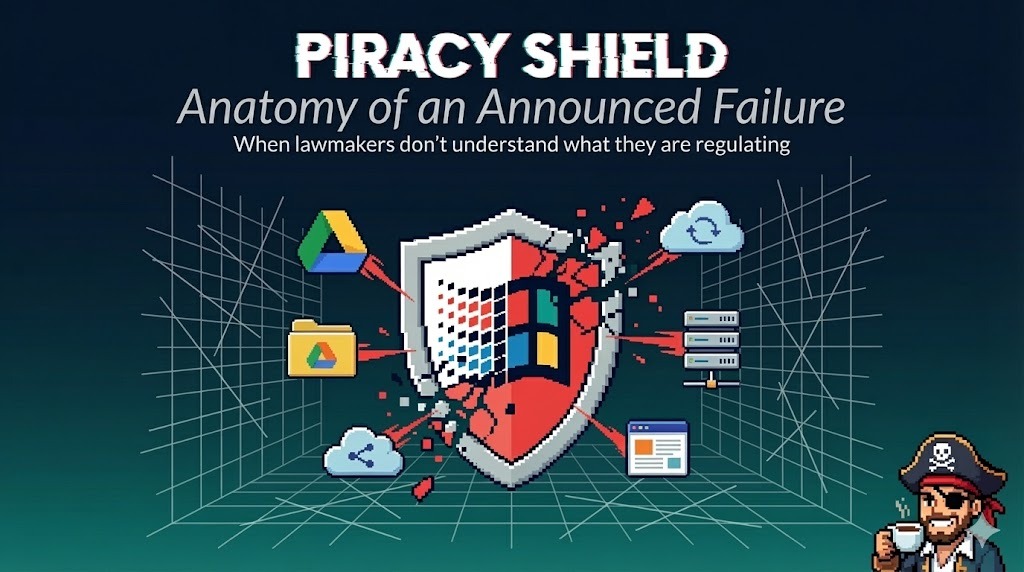
There was no hacker attack. There was no interruption of Google's services. There was Piracy Shield: Italy's anti-piracy platform, in attempting to block an illegal stream of the match, mistakenly blocked drive.usercontent.google.com, the domain required to download any file from Google Drive.
For nearly six hours, students, professionals, businesses, and public institutions using Google Workspace were cut off from their documents. The only silver lining? It was a Saturday evening. Had it happened on a Monday morning, the economic damage would have been incalculable.
That incident occurred over a year ago. Since then, what has changed? Essentially nothing. Or rather: the system has been extended, enhanced, and has continued to cause damage. The European Commission has formally challenged Piracy Shield's compatibility with EU law. Technology companies have abandoned the Italian market. And the legislators? They've doubled down.
This article is an attempt to explain—to those who decide and those who suffer the consequences—why Piracy Shield is not an imperfect system to be improved, but a conceptually flawed system that demonstrates a profound misunderstanding of how the Internet works in 2025.
What Is Piracy Shield and How It Works (In Theory)
Piracy Shield is an automated platform managed by AGCOM (the Italian Communications Regulatory Authority) to combat online piracy, particularly illegal streaming of sporting events—what Italians colloquially call "pezzotto."
The operation, on paper, is simple:
A rights holder (DAZN, Sky, Lega Serie A) identifies an illegal stream
They report the offending IP address or domain on the platform
Italian Internet Service Providers receive the blocking order
Within 30 minutes, access is blocked at the DNS and/or IP level
The platform was developed by SP Tech, a Milan-based startup connected to the Previti Law Firm, commissioned by Lega Serie A. It was then "donated" to AGCOM in July 2023, which made it operational from February 1, 2024.
The legal basis is Law 93 of July 14, 2023, approved—not an irrelevant detail—unanimously by both the Chamber of Deputies and the Senate. Not a single vote against. Zero.
Throughout 2024 and 2025, the system was progressively extended: first only live sporting events, then films, TV series, music, and entertainment programs. By December 2025, Piracy Shield had blocked over 55,000 resources between domains and IP addresses.
Why It's Technically and Conceptually Flawed
For anyone working in IT, Piracy Shield's critical issues were evident from its conception. This isn't about debatable technical details: it's about a fundamental misunderstanding of how the Internet works in 2025.
The IP Address Problem: It's Not What You Think
Whoever wrote this law seems to imagine that an IP address is like a street number: one address, one building, one occupant. Reality is completely different.
No serious site uses "one IP." Any professional infrastructure—from an e-commerce site to an online newspaper, from a bank to a cloud service—uses:
Subnets: blocks of IP addresses (a /24 contains 256 addresses, a /16 contains 65,536). Large services use thousands.
Anycast: the same IP address is announced from different datacenters worldwide. When you connect to 8.8.8.8 (Google DNS), you're not reaching a single server but one of many geographically distributed nodes.
Load balancing: traffic is distributed across server pools with multiple IPs that change dynamically.
CDNs with rotating IPs: Cloudflare, Akamai, Fastly assign and reassign IPs continuously based on load and geography.
When Piracy Shield blocks "a Cloudflare IP," it's blocking an address that could be shared by tens of thousands of completely legitimate sites. It's like bombing an entire neighborhood to hit one apartment.
High Availability: The Block Is Already Obsolete When Applied
Any serious infrastructure, legal or illegal, implements High Availability (HA). This means:
Automatic failover: if a server/IP becomes unreachable, traffic is automatically redirected to another
DNS with low TTL: DNS records can be updated in minutes or seconds
Geographically distributed infrastructure: servers in different countries, different providers, different subnets
Piracy Shield's 30 minutes is an eternity. A minimally competent IPTV operator can:
Detect the block in real time
Switch to a backup IP
Update DNS records
Be back online before the block has fully propagated
The result? Piracy Shield blocks IP A, the pirate is already on IP B, legitimate users who were using services on IP A remain blocked. Maximum collateral damage, zero effectiveness.
IPv6: The System Is Already Obsolete
And here we come to the point that none of the legislators seem to have considered: IPv6.
IPv4, the protocol on which Piracy Shield is based, has a space of about 4.3 billion addresses. That's a lot, but finite—and in fact they're practically exhausted, which is why NAT and shared IPs exist.
IPv6 has a space of 2^128 addresses. To give you an idea: a single /64 subnet (the standard allocation for an end user) contains 18,446,744,073,709,551,616 addresses. Eighteen quintillion.
With IPv6:
Every device can have its own unique public IP address
Subnets are so vast that blacklists become technically impossible to maintain
A pirate operator can generate new addresses faster than any system can block them
Address rotation techniques make tracking practically impossible
IPv6 adoption in Italy is steadily growing. Italy is investing resources in an IPv4-based blocking system while the world migrates to IPv6. It's like building a network of highway toll booths while everyone starts using drones to get around.
DNS Blocking: A 1990s Solution
DNS blocking—preventing the "translation" of a site name into its IP address—was already a weak measure twenty years ago. Today it's nearly useless.
Bypassing it takes 30 seconds: just configure alternative DNS servers (Quad9, OpenDNS, NextDNS, or any of the non-Italian public DNS providers). In 2025, even after Google agreed to cooperate with AGCOM by applying blocks on their 8.8.8.8 DNS, there's still an ocean of alternatives.
But there's more: modern applications often use DNS-over-HTTPS (DoH) or DNS-over-TLS (DoT), protocols that encrypt DNS requests making them invisible to ISPs. Firefox, Chrome, Android, and iOS all support these technologies natively. Piracy Shield's DNS blocking can't even see these requests, let alone block them.
The Absence of Human Control: The Real Scandal
But the most serious problem isn't technical: it's procedural. Blocks are executed automatically, without any prior verification. The algorithm doesn't distinguish between a pirate site and Google Drive. It doesn't verify whether the reported IP address also hosts legitimate services. There's no human being checking before pressing the button.
The reason? The 30 minutes. To comply with the time window required by law, there's no time for verification. Block first, think later—if at all.
No serious Security Operations Center would operate this way. No system administrator with a minimum of experience would agree to block network resources without verifying what they're blocking. But Piracy Shield does it thousands of times, automatically, without supervision.
In Summary: A System Designed by Those Who Don't Understand the Internet
Piracy Shield is based on flawed technical premises:
It assumes IPs are static and unique (false)
It assumes one site = one IP (false—subnets, HA, load balancing exist)
It assumes blocks are effective over time (false—failover happens in minutes)
It assumes IPv4 is the future (obsolete)
It assumes DNS can't be bypassed (ridiculous in 2025)
It assumes 30 minutes is enough for pirates but not for verification (absurd)
This isn't an imperfect system. It's a conceptually flawed system, built on an understanding of the Internet that might have been valid in 1998. In 2025, it's the digital equivalent of trying to stop emails by banning carrier pigeons.
The Catalog of Disasters: Nearly Two Years of "Collateral Damage"
The Google Drive incident wasn't the first, nor the last. Here's a chronology of the main documented erroneous blocks in nearly two years of operation:
February 2024: Cloudflare
Less than a month after activation, Piracy Shield blocks Cloudflare's IP address 188.114.97.7. Result: tens of thousands of legitimate sites suddenly inaccessible—charities, schools, forums, small businesses.
Cloudflare responds by sending emails to all affected clients, inviting them to file formal complaints with AGCOM to document the damages.
AGCOM's reaction? Commissioner Massimiliano Capitanio calls reports of erroneous blocks "fake news." President Lasorella declares that "no complaints have been received." Only to later admit during a hearing at the Chamber of Deputies that there have been "operational difficulties."
February 2024: Zenlayer
Also in the first month, IP addresses of the US-based CDN Zenlayer are blocked. As of October 2024, some of these were still blocked.
August 2024: The Blocked Block Pages
The situation reaches Kafkaesque levels when Piracy Shield blocks the IP addresses hosting TIM and Tiscali's warning pages. Those pages that should appear to inform users that a site has been blocked? Also blocked.
It's as if a traffic officer had placed a barrier on the road leading to the police station.
October 2024: Imperva
On October 19, 2024, the same day as the Google Drive block, an IP from Imperva was also blocked—a website protection service used by some of Italy's largest companies and institutions: Vodafone, Open Fiber, Mediolanum, Banca Ifis, Generali, Enel, Ticketmaster.
October 2024: Google Drive
The most glaring incident, already described. The cause? An erroneous report from DAZN. AGCOM issued a warning against DAZN, but the block happened anyway. The system worked exactly as designed—and that's the problem.
Who's Behind It: A Web of Conflicts of Interest
To understand how such a technically inadequate law could pass unanimously, we need to look at who wrote it and who benefits from it.
Claudio Lotito: Senator, President, Legislator
One of the main authors of Law 93/2023, as well as subsequent amendments, is Senator Claudio Lotito of Forza Italia. The same Claudio Lotito who is president of Lazio and who has been a federal councilor of Lega Serie A.
During the Senate debate, Lotito declared that the law "will bring significant revenues." He was right: it will bring significant revenues to the football clubs of which he himself is part. It's hard to imagine a more explicit conflict of interest.
In May 2025, during a press conference on fighting piracy, Lotito claimed: "There's a law promoted by yours truly that's delivering great results."
SP Tech and the Previti Law Firm
The platform was developed by SP Tech, a startup under the Previti Law Firm—the same firm known for its specialization in copyright and intellectual property, and for its historical ties to the Fininvest/Mediaset world.
In essence: the beneficiaries of the law (Lega Serie A) commissioned the platform, had it developed by a law firm connected to their interests, and got the law approved by a parliamentarian who is simultaneously president of a Serie A team.
The European Commission, in its June 2025 letter, explicitly flagged the "potential conflict of interest related to the company SP Tech, developer of the system and controlled by subjects holding audiovisual rights."
The "Trusted Flaggers"
Who can upload reports to Piracy Shield? Only "trusted flaggers" accredited by AGCOM. Currently, these include DAZN, Sky, Lega Serie A, Lega Serie B, RTI (Mediaset), and FAPAV (Federation for the Protection of Audiovisual Content Industries).
The same private companies that benefit from blocks are those authorized to request them. There's no prior control by AGCOM. There's no effective liability for flaggers in case of error. There's no proportionate sanction for overblocking.
Europe Intervenes: "It Violates the Digital Services Act"
On June 13, 2025, the European Commission sent a formal letter to Foreign Minister Antonio Tajani, signed by Director General Roberto Viola. The content is unequivocal: Piracy Shield may not be compliant with the Digital Services Act (DSA).
The issues raised by Brussels are multiple:
Lack of proportionality: blocks are executed in 30 minutes, but unblocking procedures take days. Those who suffer an erroneous block have 5 days to file a complaint, and AGCOM has 10 days to evaluate it. Meanwhile, the block remains active.
Absence of prior controls: there are no adequate mechanisms to prevent overblocking. The system doesn't provide for human verification before execution.
"Crude and rough" method: the Commission described DNS and IP-level blocking this way, emphasizing that it doesn't meet DSA procedural requirements.
Risk to freedom of expression: rapid and automatic blocks can amount to a denial of service, with repercussions on the freedom of information guaranteed by the EU Charter of Fundamental Rights.
Dubious legal basis: the DSA doesn't provide a legal basis for unilateral blocking orders issued by national administrative authorities without adequate procedural safeguards.
Christian Dawson, executive director of i2Coalition, summarized: "The number of issues we're seeing with Piracy Shield is remarkable. We want the rest of Europe to see it as a model of what not to do."
Italy will have to notify Brussels of the final text of the legislation to demonstrate it has addressed European concerns. At the time of writing, this has not yet occurred.
The Collateral Victims: Who Has Already Left Italy
Piracy Shield's impact goes beyond specific incidents. The system is making Italy a hostile environment for technology companies.
AirVPN: Goodbye
On February 19, 2024, just days after Piracy Shield's activation, AirVPN announced the suspension of service for residents of Italy. The reason, posted on their official forum:
"The requirements are too onerous for AirVPN, both economically and technically. They are incompatible with our mission. They pave the way for widespread blocks in all sectors of human activity and possible interference with fundamental rights. While in the past every single block was carefully evaluated by both the judiciary and authorities, now all control is completely lost."
AirVPN wasn't a service used primarily for piracy. It was one of the most respected VPNs for privacy and security, used by journalists, activists, and professionals. Its exit from the Italian market is a disturbing signal of how the legislation is making Italy a hostile environment for services that protect user privacy.
Cloudflare: The Complaint to the USA
In November 2025, Cloudflare formally reported Piracy Shield to the USTR (Office of the United States Trade Representative), asking that the system be recognized as a barrier to international trade.
In its report, Cloudflare describes Piracy Shield as a mechanism that "disproportionately affects US technology providers" and creates "an unstable digital environment that discourages foreign businesses."
The Cost to ISPs: 10 Million Per Year
Italian Internet Service Providers have presented the bill: 10 million euros per year. This is the estimated cost to comply with Piracy Shield obligations: infrastructure upgrades, dedicated personnel, legal risk management.
Costs that are not reimbursed. Costs that will inevitably be passed on to end users through rate increases.
Meanwhile, the platform was funded with public money: 2.64 million euros in 2024 for cloud infrastructure alone, plus AGCOM management costs. A system paid for by taxpayers to protect the economic interests of Lega Serie A.
The Real Problem: The Digital Illiteracy of Decision-Makers
Piracy Shield isn't an incident. It's a symptom.
It's a symptom of a ruling class that legislates on technologies it doesn't understand. That approves laws written by the lobbyists of the very industries those laws should regulate. That confuses repression with solutions.
When a legislator proposes blocking IP addresses without understanding that an IP can be shared by millions of sites, they demonstrate they don't know what an IP address is. When they design an automated system without human control to block Internet resources, they demonstrate they don't understand what the Internet is. When they ignore the existence of IPv6, HA, failover, DoH, they demonstrate they're living in a technological world that hasn't existed for twenty years.
The problem isn't just technical ignorance. It's the presumption of being able to apply physical world logic to the digital world. Blocking a site isn't like closing a shop. Blocking an IP address isn't like seizing a warehouse. The Internet doesn't work that way.
And when this ignorance is combined with private economic interests, blatant conflicts of interest, and a total absence of technical debate, the result is Piracy Shield.
The Pattern Repeats
It's not the first time Italy has produced inadequate digital regulations. It won't be the last—and it would be naive to think the problem is only Italian.
Europe itself lives on regulations disconnected from reality. The AI Act is a regulation written by lawyers who have never trained a model, with arbitrary risk categories and requirements that risk suffocating European innovation while the US and China race ahead. Chat Control, the proposal for automatic scanning of all private messages in 1984 style, demonstrates that Brussels too can produce regulatory monsters worthy of a surveillance state. Automotive sector regulation has crippled European industry with ideological targets disconnected from industrial reality, handing market share to China.
The pattern is always the same, at all levels: those who write the laws don't understand what they're regulating.
In the case of Piracy Shield, Italy has produced a law that even Europe—with all its problems—considers potentially illegal. It's an almost impressive achievement: managing to be rejected by those who birthed Chat Control.
The difference? Europe at least pretends to consult experts before ignoring them. In Italy, experts aren't even invited to the table. The law is written by lobbyists, approved unanimously, and when it's discovered that it doesn't work, they double down.
What Should Happen (But Probably Won't)
If the goal were truly to combat piracy effectively, solutions exist:
Make content accessible and affordable: Piracy thrives where legal offerings are fragmented, expensive, or inconvenient. In countries where legal streaming is accessible and reasonably priced, piracy is marginal. In Italy, you need 4-5 different subscriptions to watch all sports. This isn't a technological problem: it's a market problem.
Target the criminal organization, not the infrastructure: Illegal IPTV networks are criminal organizations. They should be countered with investigations, arrests, seizures—not with DNS blocks that last 30 minutes before pirates change servers.
Consult those who understand technology: Before approving laws about the Internet, it would be appropriate to listen to engineers, security experts, network operators. Not pay-TV lobbyists. Not senators who own football teams.
Introduce liability for overblocking: If a flagger causes the blocking of legitimate services, they should be financially accountable. This would incentivize more accurate verification.
But none of this will happen. Because it would require admitting that the current law is wrong. It would require contradicting Lega Serie A's interests. It would require technical competence and political will.
Conclusion: The Price of Incompetence
By December 2025, Piracy Shield is nearly two years old. It has blocked over 55,000 resources. It has caused documented damage to legitimate services used by millions of people. It has pushed technology companies to abandon the Italian market. It has attracted formal objection from the European Commission. It has repeatedly demonstrated its inability to distinguish between a pirate site and Google Drive.
And the legislators' response? Extend the system to more content. Increase sanctions. Double down on an already lost bet.
Aaron Swartz, the programmer and activist quoted on Network Caffè's homepage, wrote in his Guerilla Open Access Manifesto: "Information is power. But like all power, there are those who want to keep it for themselves."
Piracy Shield is exactly that: an attempt to control information through infrastructures they don't understand, with inadequate tools, for the benefit of a few.
The fight against piracy is legitimate. But not at any cost. Not by sacrificing the reliability of digital infrastructure. Not by granting private entities the power to censor the Internet without judicial oversight. Not by pretending that DNS and IP blocks can solve a problem that is first and foremost economic and cultural. Not by building systems that are already obsolete the moment they're activated.
Italy doesn't need more repressive laws. It needs more competent legislators.
And until those who write laws about the Internet understand how the Internet works, we'll continue to pay the price of their incompetence. One erroneous block at a time.
Bibliography:
Contrini, M. (2024). "The Dangerous Anti-Piracy Law, Simply Explained." matteosonoio.it
European Commission (2025). Letter to Italian Foreign Minister Antonio Tajani on the Digital Services Act, June 13, 2025
AGCOM (2024-2025). Decisions and communications on Piracy Shield
Valigia Blu (2024). "The Piracy Shield Case and the Ambiguous Links Between Serie A and the Government"
Calcio e Finanza (2024). "Piracy Shield Effect: AirVPN Service Leaves Italy"
TorrentFreak (2024). "Piracy Shield Cloudflare Disaster Blocks Countless Sites"
Giornalettismo (2024). "More IPs Blocked by Piracy Shield, Imperva Among Them"
Pagella Politica (2024). "The Piracy Shield Mess Is the Fault of an Adverb"
Il Sole 24 Ore (2025). "Piracy: Crackdown on End Users: First 2,266 Fines Issued"
Zeus News (2025). "Piracy Shield: Italian Providers Present the Bill: 10 Million Euros a Year"
CCIA - Computer & Communications Industry Association (2025). Observations to the European Commission
Cloudflare (2025). Report to USTR on Digital Trade Barriers