

Right to Repair: The Tractor, the Farmer, and the War for Digital Ownership
When owning an object no longer means being allowed to fix it. The FTC takes John Deere to court, Canada legalizes jailbreaking, Europe prepares new rules: a chronicle of a global war for the right to repair.
FIRST PAGEINNOVATION AND EMERGING TECHNOLOGIESDIGITAL CULTURE AND PHILOSOPHY
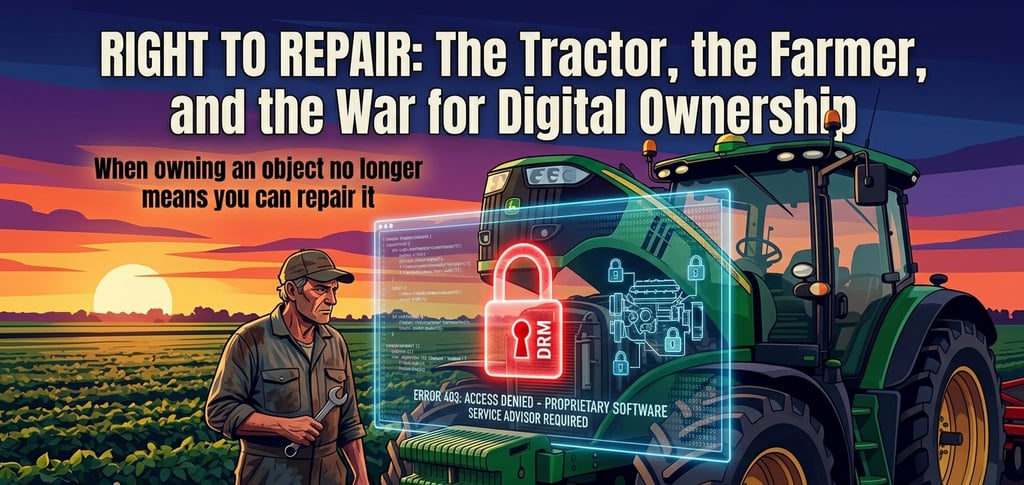
Right to Repair:
The Tractor, the Farmer, and the War for Digital Ownership
When owning an object no longer means being allowed to fix it
In December 2024, the United States Department of Agriculture included in an official report a sentence that should never need to be written: "Farmers should be able to repair their own equipment." Seven words. Obvious. Yet the result of a decade-long battle involving the Federal Trade Commission, the EPA, five US states, the Canadian Parliament, and the European Parliament.
The reason that sentence is necessary is as simple as it is unsettling: in 2026, buying a $300,000 tractor does not give you the right to repair it.
This is not a metaphor. It is the contractual reality facing millions of farmers who own John Deere machinery, the company that has taken to its logical extreme a business model increasingly common across the digital economy: selling a physical object while retaining control over the software that determines how it functions. The buyer pays full price. The manufacturer keeps the keys.
The phenomenon was effectively described by Matteo Flora in a recent episode of Ciao Internet, where he detailed the community of farmers who share firmware and repair guides through online forums and groups, bypassing manufacturer restrictions to keep working during harvest season. The topic was later explored on Eta Beta (RAI Radio1), where host Massimo Cerofolini discussed it with Flora and Jacopo Franchi, author of L'uomo senza proprietà (Egea, 2024), the essay that best captures the transition from ownership to licensing in the age of connected objects.
At Network Caffè, we want to dig deeper: into the FTC's court filings, the EPA's guidance, Canadian legislation, and the European directive that must be transposed by July 2026. Because this case is the laboratory where a concept we took for granted is being redefined: what does it truly mean to own an object in the age of embedded software.
Aaron Swartz wrote that "information is power, and like all power, there are those who want to keep it for themselves." The Right to Repair extends that battle from the digital to the physical: it is no longer just information that is locked away, but the very ability to keep the objects you own in working order.
1. John Deere: Anatomy of a Post-Sale Monopoly
1.1 The model: sell the iron, control the brain
To understand what is happening, you need to understand the business model. John Deere manufactures some of the most advanced tractors in the world. But the company's value does not end with the sale of the machine: it extends to permanent control over the software ecosystem that makes it run.
A modern John Deere tractor is a computer on wheels. Sensors, electronic control units, engine management software, precision GPS systems, real-time telemetry. All technology that has made farming more efficient and productive. But there is a catch: the software governing all of this is not yours. It is licensed. And that license stipulates that only the manufacturer and its authorized dealers may intervene.
The result? You own a machine worth hundreds of thousands of dollars that, without the manufacturer's authorization, cannot be diagnosed, calibrated, or repaired independently. The hardware is yours. The brain that runs it is not.
The key tool in this system is called Service ADVISOR, a proprietary diagnostic tool that connects to the tractor to identify errors, calibrate components, and authorize repairs. In its full version, it is available exclusively to authorized John Deere dealers. A stripped-down version exists for farmers, the Customer Service ADVISOR, but as the FTC states in its complaint: it is "an inferior repair tool that is not capable of enabling all repairs."
In practice: if your tractor has an electronic problem (and in 2026 nearly all problems have an electronic component) you cannot diagnose it yourself. You cannot take it to the independent mechanic in town. You must take it to the John Deere dealer, the only one with the full tool, who uses original John Deere parts (more expensive than alternatives), and charges rates between $150 and $180 per hour.
1.2 The numbers behind the monopoly
IndicatorDataJohn Deere revenue~$40 billion/yearAverage large tractor cost$300,000 - $500,000+Average tractor lifespan20+ yearsUS market share (large tractors)Dominant positionAuthorized dealersExclusive network, US and CanadaDealer hourly repair rate$150-$180/hourEstimated savings from independent repair~$33,000 (SBA estimate)
According to the FTC, 100% of repairs requiring the Full-Function Service ADVISOR go through authorized dealers. Not because they are better. Not because they are faster. But because they are the only ones with the tool.
1.3 The framing: safety and the environment as a shield
For years, John Deere presented these restrictions as a necessary safeguard. The corporate narrative was: "If we make diagnostic tools available to the public, someone could tamper with emission control systems or compromise vehicle safety."
This is what communication strategists call framing: defining the boundaries of the debate before the debate even begins. If the topic becomes "environmental and food safety versus unauthorized tampering," the conversation starts from a point favorable to the manufacturer. The reality, a post-sale monopoly built through software restrictions, stays out of the frame.
The framing worked for nearly a decade. Until institutions began dismantling it piece by piece.
2. The American Institutional War
2.1 FTC vs. John Deere: the antitrust case
On January 15, 2025, the Federal Trade Commission, together with the Attorneys General of Illinois and Minnesota, filed a lawsuit against John Deere. The charge: monopolistic practices in violation of the Sherman Act (Section 2) and the FTC Act (Section 5).
The complaint is a 37-page document that systematically dismantles the Deere model. Key points:
Monopoly over the repair market. The FTC argues that by making the Full-Function Service ADVISOR exclusive to dealers, Deere created and maintained a de facto monopoly over repairs for its large tractors and combines. Farmers have no viable alternatives.
Inflated costs and unacceptable delays. Dealers predominantly use original Deere parts instead of cheaper generic alternatives, increasing costs for farmers. In rural areas, reaching the nearest dealer can mean hours of travel, critical time during planting and harvest.
The Customer Service ADVISOR is inadequate. The "public" version of the diagnostic tool is not functionally equivalent to the dealer version. The FTC explicitly calls it "inferior" and "not capable of enabling all repairs."
Broken promises. In 2023, Deere signed a Memorandum of Understanding with the American Farm Bureau Federation, committing to making tools and documentation available for autonomous repair. At the time of the lawsuit, those promises had not materialized.
The vote was 3-2 along party lines. The three Democratic commissioners from the Biden era voted in favor. The two Republican commissioners, including Andrew Ferguson, who would later become FTC chair under Trump, voted against.
2.2 Deere's response: "meritless"
Denver Caldwell, Vice President of Aftermarket and Customer Support, called the lawsuit "based on flagrant misrepresentations of the facts and fatally flawed legal theories." In parallel, Deere announced yet another plan to expand self-repair tools.
The pattern is familiar to anyone who follows regulator-regulated dynamics: promises of self-reform that arrive right on time when legal pressure becomes unsustainable.
2.3 The court says: proceed to trial
In June 2025, John Deere asked the court to dismiss the case through a motion for judgment on the pleadings. The federal judge rejected the request, declaring the FTC's allegations "plausible" and worthy of trial.
Michigan, Wisconsin, and Arizona have since joined the lawsuit. Five states now fight alongside the FTC. The states have publicly declared they will proceed even if the FTC withdraws.
2.4 The EPA and the Clean Air Act bluff
On February 2, 2026, the EPA issued a historic guidance letter to manufacturers clarifying that the Clean Air Act does not prohibit independent repairs of agricultural and off-road diesel machinery.
For years, manufacturers (John Deere foremost) had interpreted the Clean Air Act's anti-tampering provisions as a de facto ban on making repair tools available to the public. The argument: "Providing access to diagnostic tools could enable tampering with emission controls. So we cannot do it."
A line of reasoning that, in plain terms, means banning anyone from opening the hood because someone, in theory, might tamper with the exhaust. The Clean Air Act contains a written exception: emission control systems may be temporarily disabled for the purpose of repair.
The irony? It was John Deere itself that asked the EPA to clarify the matter, in June 2025. The EPA responded unequivocally: yes, temporary overrides are permitted. And no, manufacturers can no longer use the Clean Air Act as a pretext to restrict access to repair tools and software.
The Small Business Administration estimated savings of approximately $33,000 per repair and an additional $3,000-$4,000 in time saved for farmers.
2.5 The limit: guidance is not law
But here is the point farmers' unions immediately raised: an EPA guidance is not a law. It has no enforcement mechanisms. It compels no one to do anything.
As the National Farmers Union put it: a rule with no enforcement is "a normative decoration." Elegant, but toothless.
The difference is subtle but crucial: the difference between "you no longer have an excuse" and "you are required to change." For now, we are at the first stage.
3. The Canadian Precedent: When Legislation Actually Works
While the United States fights in court, Canada took a different path. And it works.
In late October 2024, the Canadian Senate passed two bills that received Royal Assent shortly after:
Bill C-244 amends the Canadian Copyright Act to allow individuals and independent technicians to bypass digital locks (Technological Protection Measures, TPM) for the purposes of diagnosis, maintenance, and repair.
Bill C-294 goes further and guarantees interoperability: digital locks may also be bypassed to make programs, devices, and components from different manufacturers compatible with each other.
Together, the two laws do something neither the United States nor Europe has yet accomplished: they remove the copyright objection from the table. In the US, Section 1201 of the Digital Millennium Copyright Act (DMCA) makes it illegal to bypass digital locks, even if you are repairing an object you own. Canada said: no, copyright cannot be weaponized against repair.
As Alissa Centivany, a professor at Western University and advisor on the legislation, commented: the new laws "prevent manufacturers from misusing this small piece of copyright law to control the repair of the products they produce."
At the provincial level, Ontario is going further with Bill 91 (Right to Repair Act), currently under discussion, which would require manufacturers to provide repair manuals, tools, software updates, and parts to both consumers and independent repair shops.
4. Europe Enters the Game: The Right to Repair Directive
4.1 Directive 2024/1799
On June 13, 2024, the European Union adopted Directive 2024/1799, commonly known as the "Right to Repair Directive." It entered into force on July 30, 2024, and Member States must transpose it into national law by July 31, 2026, roughly four months from the time of writing.
The directive has three pillars:
Obligation to repair for manufacturers. For products covered by the directive (listed in Annex II: washing machines, refrigerators, vacuum cleaners, smartphones, tablets and others), manufacturers are required to repair even after the legal guarantee has expired, within reasonable time and at a reasonable price.
Guarantee extension. If during the guarantee period the consumer chooses repair instead of replacement, the guarantee is automatically extended by 12 months.
Ban on anti-repair practices. Manufacturers cannot use contractual clauses, hardware, or software techniques to obstruct repairs. They cannot prevent the use of second-hand or 3D-printed spare parts by independent repairers.
4.2 The European platform and repairability labels
The directive also provides for the creation of a European online repair platform (an extension of the "Your Europe" portal) where consumers can find local repairers and sellers of refurbished products. The platform should become operational in 2027.
Since June 2025, repairability labels for smartphones and tablets are already in effect, a classification system from A to E. This is the first practical application of Right to Repair principles in the EU.
4.3 Italy: late, as usual
Italy is transposing the directive through the European delegation law, approved by the Council of Ministers on July 22, 2025. The text must still be debated and approved by both chambers of Parliament. Given that the deadline is July 31, 2026, time is tight. And anyone who follows Italy's track record on transposing EU directives on time knows that "tight" is an optimistic euphemism.
4.4 The limits: narrow scope and no tractors
The EU directive has a significant limitation: its scope is still narrow. It covers household appliances, smartphones, and tablets, but does not cover agricultural machinery, automobiles, or medical devices. These are precisely the sectors where the proprietary software problem is most acute.
Right to Repair Europe, the coalition that pushed for the directive, called the result "a partly missed opportunity" to create a truly fair repair market.
5. Comparative Overview: Where We Stand
USA Canada European Union
Primary instrument FTC lawsuit + EPA guidance Federal laws (C-244, C-294) Directive 2024/1799
Status Lawsuit ongoing; guidance without force of law Law in effect since late 2024 Transposition by July 2026
Scope Agricultural machinery (Deere case) All devices with digital locks Household appliances, smartphones, tablets
Digital lock bypass Illegal (DMCA Sec. 1201, with temporary exemptions) Legal for repair and interoperability Not directly addressed
Enforcement Federal court + states Full force of law Depends on national transposition
Agricultural machinery covered Yes (specific case) Yes (general law) No
Weak point EPA guidance toothless; lawsuit outcome uncertain Manuals and tools not yet mandatory at federal level Narrow scope; vague formulations
Canada is today the most advanced country on the legislative front. The US has the most aggressive lawsuit but the most uncertain outcome. Europe has the most ambitious framework but the slowest implementation.
6. From Ownership to Licensing: The Silent Transition
6.1 The man without property
The John Deere case is not an anomaly. It is the most visible symptom of a transformation that Jacopo Franchi, in his essay L'uomo senza proprietà (Egea, 2024), describes as a rupture in the relationship between people and everyday objects: "No object, once digitized, remains the exclusive property of a specific person: control over it can be revoked remotely at any time."
What was once a dynamic limited to software (program licenses, ebooks, streaming music) has extended to physical objects. The car you drive, the fridge in your kitchen, the thermostat on your wall: the moment they contain connected software, the boundary between ownership and license blurs. And the power to redefine that boundary remains in the manufacturer's hands.
As the description of the Eta Beta episode (RAI Radio1) dedicated to the topic put it: "We no longer buy objects, but temporary licenses. Behind every good there is software, and behind every software the control of some large corporation."
6.2 The automotive sector: the laboratory of conditional ownership
The automotive industry has become the most aggressive testing ground for the ownership-as-a-service model.
BMW in 2020 introduced in select markets (South Korea, UK, Germany, never the US) an $18/month subscription to activate heated seats already physically installed in the vehicle. Consumer backlash was fierce. BMW withdrew the option in 2023, admitting in February 2026 through product communications head Alexandra Landers that it was "probably not the best way to start." But the retreat was only partial: BMW continues to offer subscriptions for the 360-degree camera, remote start, high-beam assist, and adaptive suspension (Jalopnik, February 2026). Features that require no data connection to function, but that software blocks until you pay.
Audi followed suit. The new 2024 A3 put adaptive cruise control, high-beam assist, Apple CarPlay/Android Auto, and even dual-zone climate control behind a subscription paywall (CarBuzz, March 2024). The hardware is all already on board. The software decides what you can use.
Tesla practiced software-limited batteries: the 2016-2017 Model S and Model X sold as "60kWh" physically contained 75kWh batteries, with the additional 15kWh unlockable via software update for $8,500 (later reduced to approximately $2,500). In 2024, some Model Y Standard Range units were also found to have larger-than-declared batteries, with unlocks at $1,000-$1,600 (FindMyElectric).
Ford in 2021 filed a patent (USPTO, "Systems and Methods to Repossess a Vehicle," published February 2023) describing a system to remotely disable air conditioning, radio, cruise control, central locking, and, for autonomous vehicles, to drive the car to an impound lot if the owner missed payments. Ford stated it had no plans to implement it and subsequently abandoned the patent in October 2023 (The Record/Recorded Future News). But the fact that an automaker invested resources to design and patent a remote punishment system reveals the direction the industry is heading.
6.3 The recurring pattern
Beyond individual cases, the pattern is structural and replicates across every sector where a physical object contains a chip and a connection.
In medical devices, hospitals and clinics find themselves bound to exclusive maintenance contracts for equipment like ventilators, scanners, and diagnostic devices. In printers, cartridges with DRM chips prevent the use of compatible replacements, and updated firmware blocks third-party cartridges; HP has been sued multiple times for these practices. In smart appliances, the manufacturer's decision to end software support can render devices perfectly functional in hardware terms completely unusable.
The common denominator is an economic model where revenue does not end with the initial sale, but continues through ongoing control over the product's functionality. Software becomes the lever: it is what allows functions to be added, removed, or conditioned after the object is already in the buyer's hands.
7. Enshittification: The Lens to Understand the Pattern
Cory Doctorow, Canadian-British writer and activist, coined the term enshittification to describe the cycle through which digital platforms progressively degrade their service to maximize value extraction: first they attract users with an excellent offering, then they lock them in, then they exploit them.
The concept, which won the Macquarie Dictionary Word of the Year 2024, applies with precision to physical goods as well. The cycle is the same: the farmer buys a tractor technologically superior to any alternative. The technology makes them dependent on the manufacturer's ecosystem. And once dependency is established, the manufacturer can extract additional value through exclusive repairs, proprietary parts, and features conditioned on recurring payments.
The system works because every single element reinforces the others. Proprietary software requires exclusive diagnostic tools. Exclusive tools funnel all repairs toward the authorized network. The authorized network uses original parts at full price. The result is a closed ecosystem where the exit cost for the customer is prohibitive.
Paradoxically, the system was disrupted not by hackers or digital activists, but by the farmers themselves, who developed informal networks for sharing technical knowledge, alternative diagnostic tools, and modified firmware. Communities that operate with the same logic as agricultural cooperatives: pool what you know, because no one can make it alone.
As we analyzed in our article on Piracy Shield, the pattern repeats: those who design digital control systems tend to underestimate users' ability to find alternatives. The difference is that in the Piracy Shield case, the bypass was an act of consumption (watching a match via streaming); in the John Deere case, it is an act of economic necessity (not losing a harvest worth tens of thousands of dollars).
8. The Historical Precedent: From Railroad to Firmware
For anyone interested in the history of technology, the John Deere case is not new. It is the updated version of a conflict that recurs whenever an infrastructural technology becomes pervasive enough to generate dependency.
In the late 19th century, American railroad companies controlled not just the tracks, but tariffs, schedules, and conditions of access to freight transport. Midwest farmers (the same states where today's Right to Repair battle is being fought) organized into the Granger movement to demand public regulation. The result was the Interstate Commerce Act of 1887 and then the Sherman Antitrust Act of 1890: the first antitrust laws in American history.
The parallel is structural, not merely narrative. Railroads controlled market access through physical infrastructure. John Deere controls access to machinery functionality through software infrastructure. In both cases, the mechanism is the same: an intermediary inserts itself between the producer (the farmer) and their productive capacity, extracting value without adding any.
The difference is that software makes lock-in far more granular and harder to circumvent than a railroad. A rail line is visible, physical, understandable. A digital lock on an electronic control unit is invisible, protected by copyright, and requires specialized knowledge even to identify.
It works this way because someone designed it this way. And dismantling that design requires what the railroads required 140 years ago: political will, organized pressure from below, and legislation with real enforcement power.
9. Conclusions: The Hidden Cost of Convenience
Looking at the big picture.
On one side, a $40 billion company that built a closed ecosystem where owning a tractor does not mean being able to repair it. On the other, an improbable coalition of farmers, EPA bureaucrats, state attorneys general, Canadian legislators, and Brussels technocrats who, each in their own way, are saying the same thing: this is not acceptable.
The FTC brought Deere to court, and the court said the charges hold. The EPA dismantled the Clean Air Act shield. Canada legalized the bypass. Europe is about to implement the new rules. But none of these developments, alone, is decisive.
The real test will come in the next two to three years. We will find out whether American institutions are willing to take on an industry worth billions in post-sale revenue. Whether Europe will extend the directive's scope to the most critical sectors. Whether the Canadian model will inspire similar legislation elsewhere.
But there is a deeper lesson here, one that goes beyond tractors and lawsuits.
Every time we buy an object with embedded software, we are implicitly accepting a deal: convenience and functionality in exchange for control. We accept it with the smartphone, the car, the washing machine, the thermostat. We accept it because alternatives are few and the cost of attention is high. Who actually reads the terms of service?
The John Deere case matters because it makes that deal visible. When the cost of surrendered control becomes a lost harvest, a shuttered business, a weeks-long wait for a basic repair, the deal stops being abstract. It becomes concrete, measurable, contestable.
Henry Ford, quoted on the Network Caffè homepage, said: "Real progress happens only when the advantages of a new technology become available to everybody." The John Deere case shows us the other side: when the advantages of a technology become a tool for extracting rents in the hands of those who sell it, progress reverses. Innovation stops serving those who use it and starts serving those who control it.
The answer is not to reject technology. It is to demand that those who sell it cannot use it as a lever for post-sale monopoly. It is to insist, through voting, institutional pressure, and purchasing choices, that owning an object still means being allowed to work on it.
Because a routine maintenance job should never require an act of civil disobedience.
Bibliography:
Federal Trade Commission (January 15, 2025). "FTC, States Sue Deere & Company"
FTC, Complaint, Case No. 3:25-cv-50017, full document
John Deere (January 15, 2025). "Deere & Company Responds to FTC Complaint"
U.S. EPA (February 2, 2026). "EPA Advances Farmers' Right to Repair"
Parliament of Canada, Bill C-244 and Bill C-294
European Parliament, Directive 2024/1799
NPR (January 16, 2025). "John Deere faces U.S. lawsuit over farmers' ability to repair tractors"
CNBC (January 16, 2025). "FTC sues Deere, alleging equipment repair 'monopoly'"
National Agricultural Law Center (2025). "FTC Files Suit Against John Deere"
Iowa Capital Dispatch (February 2, 2026). "EPA: Clean Air Act supports right to repair"
TechSpot (February 5, 2026). "BMW admits heated seat subscriptions were a mistake"
Jalopnik (February 6, 2026). "BMW Keeps Pushing Subscriptions Even After Heated Seat Debacle"
CarBuzz (March 12, 2024). "Audi A3 Subscription-Based Features"
The Record (August 1, 2024). "Ford drops attempt to patent remote vehicle access"
FindMyElectric (2024). "Tesla Battery Upgrade Guide"
Matteo Flora, "Ciao Internet" (2026). Video on Right to Repair and John Deere.
Jacopo Franchi, L'uomo senza proprietà, Egea, 2024
Eta Beta, RAI Radio1. Episode on the ownership-to-licensing transition, with Massimo Cerofolini, Matteo Flora, and Jacopo Franchi.
Next time you buy a connected device, ask yourself: what happens when it breaks? Who has permission to fix it? And what happens if that permission is revoked? The answers might change your mind about the purchase.