

The Epic Saga of Computer Viruses: From Research Labs to Global Cyber Threats
In this article, we trace the fascinating and sometimes tumultuous history of computer viruses – from the first benign "worms" at Xerox PARC to destructive malware like ILOVEYOU, MyDoom, Stuxnet, Conficker, WannaCry, and many others – weaving together technical evolution with social context, underground hacker culture, and shifts in cybersecurity paradigms.
FIRST PAGEDIGITAL CULTURE AND PHILOSOPHY

The Epic Saga of Computer Viruses:
From Research Labs to Global Cyber Threats
In the 1970s, in rooms filled with cabinet-sized computers, pioneering programmers were inadvertently giving birth to a new digital creature: the computer virus. What began as curious experiments in research laboratories would become, over the decades, a global phenomenon capable of bringing governments and multinational corporations to their knees.
In this article, we trace the fascinating and sometimes tumultuous history of computer viruses – from the first benign "worms" at Xerox PARC to destructive malware like ILOVEYOU, MyDoom, Stuxnet, Conficker, WannaCry, and many others – weaving together technical evolution with social context, underground hacker culture, and shifts in cybersecurity paradigms.
The Origins: Theories, Science Fiction, and Early Experiments (1970s)
Long before the word "virus" was used for computers, the idea of self-replicating programs was already in the air. Mathematician John von Neumann, in 1949, had theorized the possibility of "automata" capable of reproducing autonomously, laying the theoretical foundations for the concept. Science fiction soon picked up on this idea: in the 1972 novel "When HARLIE Was One," writer David Gerrold used the term "virus" for the first time to refer to a malicious computer program. A few years later, in 1975, John Brunner's novel "The Shockwave Rider" introduced the idea of a digital "tapeworm" spiraling out of control, ominously foreshadowing what would happen in the real world.
The first concrete example came in 1971: an experimental program called Creeper appeared on the ARPANET network, the ancestor of the Internet. Creeper hopped from one computer to another (large DEC PDP-10 mainframes) and displayed a playful message: "I'm the creeper, catch me if you can!" It caused no damage, but demonstrated that software could spread autonomously. To "catch" it, an antidote program called Reaper was even written, considered the first antivirus in rudimentary form.
Meanwhile, in the late 1970s, Xerox PARC laboratories in California became the stage for innovative experiments. Researchers John Shoch and Jon Hupp coined the term "worm" there in 1979, inspired by the digital monster imagined by Brunner. They developed a series of worms for the lab's internal Ethernet network, designed to be useful: their purpose was to exploit unused processor cycles during nighttime hours, distributing workloads across multiple machines. These worms weren't malicious at all – in fact, they had a programmed short lifespan and could be stopped by sending a "kill packet." However, even in a controlled environment, the first warning signs emerged: one of PARC's worms malfunctioned and, out of control, ended up crashing several network computers. It was a warning of how even a benevolent experiment could get out of hand.
Those early years were a period of innocence and discovery. The "viruses" (actually autonomous worms) born in laboratories were closer to proofs of concept and games among programmers than criminal threats. But they laid both lexical and technical foundations: the biological vocabulary of viruses and worms entered computing, and soon others would pick up the torch for less innocent purposes.
The First Wild Viruses: From Lab Pranks to Reality (1980s)
At the dawn of the 1980s, computers were emerging from laboratories alone to reach companies, schools, and the homes of some enthusiasts. With the spread of microcomputers and floppy disks, the idea of self-replicating programs found fertile ground to spread "in the wild" – that is, outside controlled research environments. It was in this decade that computer viruses, officially baptized as such by computer scientist Fred Cohen in 1983, made their first real-world appearances.
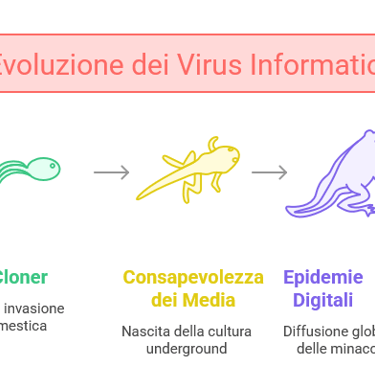
An emblematic case was Elk Cloner. In 1982, a 15-year-old high school student, Rich Skrenta, wrote this virus as a prank for the Apple II – one of the first personal computer viruses to spread significantly. Elk Cloner nested in floppy disks and, after a certain number of boots, activated a small poetic surprise: on the screen appeared a rhyming verse that began with "It will get on all your disks / It will infiltrate your chips / Yes, it's Cloner!" It was more a sophomoric prank than a destructive attack: the virus caused no permanent damage, but demonstrated how a teenager with sufficient ingenuity could play with the new frontier of viral programming.
In 1986, another historic moment occurred: Brain appeared, commonly recognized as the first virus for IBM-compatible PCs (MS-DOS systems). Brain infected the boot sector of floppy disks and spread every time an infected diskette was inserted into another computer. Its origin surprisingly led to a small computer shop in Lahore, Pakistan, run by brothers Amjad and Basit Farooq Alvi. The two, twenty-something software entrepreneurs, had apparently created the virus to protect one of their programs from piracy (a "creative" ploy to track unauthorized copies). Brain wasn't designed to destroy data; in fact, it contained a hidden message inside with the name of their company Brain Computer Services and even the address and phone numbers to contact for anti-virus "vaccination." In practice, the creators had inserted their real contacts into the virus, almost as if it were a business card inadvertently distributed worldwide! This surreal detail – discovered by analysts when they inspected the code – well illustrated the pioneering (and somewhat naive) spirit of the early days: the authors of Brain declared they had no malicious intentions, and didn't imagine their code would spread so widely.
After Brain, the virus phenomenon began to spread. Other programmers, often young tinkerers fascinated by the challenge, began creating viruses of all kinds. Many circulated on floppy disks exchanged among users, in school and university computers. Examples like Jerusalem (first identified in Israel in 1987, known for activating on Friday the 13th to delete files) or Vienna (1987) showed more destructive intent, pushing early security companies to react. Precisely in response to these threats, an entirely new industry was born: antivirus software. As early as 1987, companies like McAfee, Sophos, and the nascent Norton published the first tools capable of detecting and removing known viruses. It was a miniature arms race: each new virus pushed for a new antidote, and vice versa.
Toward the end of the 1980s, a true underground underworld dedicated to viruses also emerged. In some BBS (Bulletin Board Systems) – the electronic bulletin boards of the era – viruses circulated as curiosities to exchange and analyze. Even "crews" of virus writers were born, often anonymous informal groups that created viruses almost as if it were an art form or challenge with antiviruses. Countries like Bulgaria became infamous hotbeds of viruses (Sofia was nicknamed the "Mecca of viruses" for the high number of local creators, like the mysterious Dark Avenger). In parallel, the word "hacker" began to appear in the media linked to these events: although it originally indicated the creative programmers of MIT, by now public opinion tended to paint even the authors of viruses and other "bad guys" of computing with the same term. A clash of cultures was taking shape: on one side the positive hacker ethic of knowledge sharing, on the other the dark side of those who used ingenuity to sabotage and infect. Very often, however, the virus writers of the era weren't aiming to steal money or secrets, but only to leave their signature in digital history – perhaps in the form of a hidden message on an infected computer screen.
An emblematic episode closed the decade by even linking viruses to political activism: in October 1989, a worm called WANK (provocative acronym for "Worms Against Nuclear Killers") attacked NASA and U.S. Department of Energy computers, displaying pro-peace and anti-nuclear messages on terminals. It was the first time malware was used to launch a clear political message, a prelude to what we would later call hacktivism. The underground culture of viruses thus had many facets – from the sophomoric, to the malevolent, to the militant – reflecting the anxieties and passions of the emerging connected society.
The 1990s Boom: Between Media Myths and Underground Cultures
With the 1990s, PCs became increasingly common in offices and homes, and the Internet began its exponential growth. This combination acted as a catalyst for a true explosion of computer viruses, some of which made front-page news and captured public attention. In this decade we see two worlds converging: on one side the media and society, increasingly aware (and frightened) of the phenomenon; on the other the hacker communities and virus authors, who developed increasingly sophisticated techniques and began to organize.
In 1992, the Michelangelo virus caused a sensation, so named because it was programmed to activate on March 6, the birthday of Michelangelo Buonarroti. Experts discovered the virus in advance and raised the alarm: some adventurous estimates hypothesized it might have infected millions of computers worldwide and that on March 6 it would wipe their hard drives in one fell swoop. Collective psychosis was unleashed, fueled by media that spoke of "announced catastrophe" and rushed to interview antivirus experts as if they were virologists before a pandemic. When the dust settled, Michelangelo proved to be a flop: actual damage was limited to a few thousand cases (about 10,000 affected computers). Nevertheless, that episode marked a turning point: for the first time global public opinion had become aware of the existence of computer viruses and the devastating potential inherent in our growing dependence on computers. Michelangelo was defined as "the media virus" – more famous for the articles it generated than for the files it deleted – but served as a dress rehearsal for what could happen with more virulent threats.
Meanwhile, the underground "virus culture" was thriving. Virus construction toolkits spread, allowing even non-experts to create viruses (the so-called virus construction sets), further democratizing the phenomenon. Increasingly ingenious viruses appeared: polymorphic viruses, for example, which mutated their code with each infection to evade antivirus signatures; or stealth viruses, capable of actively hiding from checks. A legendary figure among insiders was Dark Avenger, a Bulgarian virus writer who in the 1990s released very advanced viruses for the time (e.g., the MtE virus that provided polymorphic capabilities to other viruses) and inspired an entire generation of "malicious programmers." Electronic fanzines dedicated to viruses were born and proliferated – amateur digital magazines in which groups like 29A, VLAD, or CDC (Cult of the Dead Cow) published their malicious code and exchanged ideas. It was a strange, semi-hidden but global community that lived in fidonet networks, IRC, and early forums: a mixture of creative genius, taste for technical challenge, and sometimes destructive impulses.
The other side of the coin was security companies and professionals who refined their defenses. Antiviruses became widespread software on all business PCs, and figures like John McAfee – founder of the eponymous antivirus company – became known to the general public almost as sheriffs of the digital Wild West. Each new famous virus brought lessons that changed the security paradigm: people began to understand the importance of regularly updating software (to patch vulnerabilities exploited by some viruses), backing up important data, and being careful about what was executed on computers.
Toward the end of the decade, with the widespread advent of the Internet, viruses found an even faster vehicle for propagation than floppy disks: email and telecommunications networks. An emblematic virus was Melissa (1999), which marked the transition to macro viruses and the first major email worms. Melissa was technically a mix between virus and worm: it appeared as a Microsoft Word document containing an infected macro. When users opened the file (enticed by an intriguing subject promising "spicy" content), the macro-virus exploited Word and Outlook functionalities to automatically send itself to 50 contacts in the address book. In three days it infected over 100,000 computers and forced companies and organizations (even some government agencies) to shut down their mail servers to stop the epidemic. Melissa demonstrated two things: first, that social engineering (human curiosity to open a promising attachment) could be exploited as effectively as or more than a technical flaw; second, that the Internet allowed malware to run with a speed never seen before – in a matter of hours, not months.
In those same months, at the end of 1999, other worms like Happy99 and ExploreZip began spreading as email attachments, disguised as friendly New Year's greetings or fake utilities, inaugurating a pattern that would become sadly familiar in years to come. The end of the millennium thus brought a paradigm shift: viruses no longer necessarily required the "physical" action of a user inserting an infected floppy; they could travel from one end of the world to the other with a careless click, exploiting the network of networks. The ground was prepared for the global "super viruses" of the early 2000s.
The Internet Era: Record-Breaking Viruses and Lightning Attacks (2000s)
At the beginning of the new millennium, the world witnessed a series of viral attacks unprecedented in speed of spread and impact. With more and more people connected to the Internet, computer viruses found an ideal environment to propagate like true digital pandemics. In this phase, the nature of viruses changed rapidly: from curiosities and hacker pranks, they became weapons sometimes used for profit, sometimes for vandalism, and in some cases unwitting tools of commercial battles. At the same time, cybersecurity had to chase frantically: firewalls, emergency patches, incident response teams (CERTs) became everyday terms.
The year 2000 opened with a bang: in May, millions of users worldwide found in their mailbox an apparently innocent email titled "ILOVEYOU" (I love you). At the time, few things could arouse greater curiosity than a mysterious love declaration via email, perhaps from an unknown sender. The attachment was a file called LOVE-LETTER-FOR-YOU.TXT.vbs. Many, with hindsight naively, opened it – after all, the name suggested a simple text file. In reality, it was a virus/worm written in VBScript, destined to become infamously known as ILOVEYOU or "Love Bug." Once opened, the malware sent itself to all contacts in the victim's Outlook address book, infinitely replicating the viral love chain.
Within 24 hours, ILOVEYOU had circled the globe: it's estimated to have infected about 45 million Windows computers and in total 10% of computers connected to the Internet worldwide were hit. Economic damage, between cleanup costs and service interruptions, amounted to billions of dollars (estimates range from $5 to $15 billion) and even the Pentagon, British Parliament, and major companies like Ford had to shut down their email systems to stem the epidemic. The author, a young Filipino programmer named Onel de Guzman, was tracked down shortly after; he declared he had accidentally released what was supposed to be a test, and thanks to a legal loophole in his country at the time wasn't even prosecutable. ILOVEYOU dramatically showed the world how vulnerable the new interconnected society was: a teenager armed with a PC and creativity was enough to unleash global chaos. From then on, every time a suspicious email with an attachment arrived, millions of users began to think twice before clicking – the digital equivalent of suspiciously looking at an unknown letter in the mailbox.
In the same period, worms began to appear that directly exploited vulnerabilities in systems connected to the Internet, without even requiring human naivety of clicking on an attachment. An example came in 2001 with the infamous Code Red. This worm attacked Microsoft IIS web servers exploiting a buffer overflow vulnerability: it was sufficient for the server to be connected to the network and vulnerable, and Code Red penetrated autonomously, without human intervention, infecting it and then propagating to other servers. On July 19, 2001, Code Red struck hard: about 359,000 servers were infected in less than 14 hours, generating an enormous amount of traffic and bringing down part of the Internet. The worm then attempted to launch a DDoS attack against the White House website. While not causing permanent data damage, Code Red exposed another weakness in our digital ecosystem: the slowness in applying security updates (the patch for the IIS vulnerability had already existed for a few weeks, but many administrators hadn't yet installed it) and the lack of network segmentation, which allowed a single worm to spread unchecked.
A few weeks later, in September, another worm called Nimda raised the bar even higher: it combined five different distribution methods (email, open network shares, websites, exploits of old vulnerabilities, and ports left open by Code Red) and infected about 450,000 computers in 12 hours. Nimda was defined as "multipartite" for its versatility and showed how much malevolent creativity lurked in the underground scene.
2003 was remembered as the black year of Internet worms. In January came SQL Slammer, a tiny worm (a few hundred bytes of code) that exploited a Microsoft SQL Server vulnerability: it was so fast that in 10 minutes it had infected most vulnerable servers worldwide, causing serious Internet slowdowns. Its peculiarity was residing entirely in a single UDP network packet, traveling light and fast; it generated such a volume of congestion traffic that it knocked out ATMs, airline flights, and various services dependent on the network.
In August, then, two twin worms hit common users' Windows systems: Blaster and Sobig.F. Blaster (also known as "Lovesan") spread by exploiting a flaw in the RPC service of Windows XP and 2000, and contained in its code a mocking message directed at Bill Gates ("Billy Gates, why do you make this possible? Stop making money and fix your software!" was hidden among the instructions). Sobig.F instead was a mail-worm that generated an immense volume of spam emails: at its peak it was calculated to be responsible for 60% of emails circulating worldwide at that moment, clogging mailboxes and servers (an absolute record at the time).
The combination of Blaster and Sobig in the same month brought corporate networks, providers, and home users into crisis; it was the moment when it became clear that the security of Windows and the Internet in general needed to be rethought. Microsoft rushed to fix things: in addition to releasing emergency patches (the famous MS Blaster bulletin, developed in a hurry), they undertook the Trustworthy Computing initiative, slowing down the development of new features to focus on making Windows XP (Service Pack 2) much more resistant to malware. Bounties and rewards were also offered to help identify the authors of major worms. The situation took on emergency health overtones: with increasingly medical metaphors, people spoke of epidemics, outbreaks, contagion, incubation. After all, as with biological viruses, prevention (keeping systems updated, using antiviruses, firewalls, and a bit of common sense) proved to be the most effective weapon.
In 2004 a new player arrived on the scene, breaking all previous records: MyDoom. This worm, spread in January via infected emails, was so fast that it's estimated it alone generated 16% to 25% of all emails sent globally during its peak days. In practice, almost a quarter of global email traffic consisted of copies of MyDoom bouncing from one mailbox to another! The effect was to greatly slow down communications and force many companies to close their mail servers to clean them. MyDoom also carried a payload: it launched targeted DDoS attacks against the sites of SCO Group (a company involved in controversies over the Linux operating system) and Microsoft, probably for cyber-protest or vandalism reasons. The result was that SCO had to close its site for days, suffering substantial economic losses. MyDoom, in addition to being remembered as the fastest email virus ever, marked the evolution toward malware with targeted objectives and sometimes connected to economic interests or commercial rivalries.
Also in 2004 emerged Sasser, a worm written by a German teenager, which exploited a Windows XP/2000 bug (LSASS service) to propagate automatically. Sasser caused the continuous crash of thousands of PCs worldwide, and was famous because its impact also involved critical infrastructure: Delta Airlines had to cancel several flights due to system problems, some rail networks suffered disruptions, and in Britain even about a hundred post offices were forced to close temporarily. The author of Sasser was later arrested (thanks also to the reward offered by Microsoft) and belonged to that new generation of young hackers for whom malware creation was becoming almost a reckless game, often without full awareness of the consequences.
In these 2000s, the cultural context around computer viruses had changed compared to the '80s: there was no longer any romantic or "artistic" aura in the major epidemics causing millions of dollars in damage. The image of the lone hacker who writes viruses for glory was giving way to that of the cybercriminal. Many worms in fact installed backdoors and trojans to control infected computers and exploit them to send spam or steal data. Thus the first large botnets were formed, networks of zombie PCs under criminal control, which rented them out to commit fraud, attacks, or spam campaigns. The economic motive became increasingly predominant: creating and spreading a virus was no longer just an act of ego or vandalism, but could be part of an underground business (credit card number theft, extortion, industrial espionage). Hacker culture split: on one side those who claimed traditional hacker ethics and despised these criminal uses, on the other a growing number of individuals willing to put their skills at the service of illegal gain.
From Hacktivism to Cyberwar: Viruses in the Contemporary Era (2010-Present)
Past the mid-2000s, computer viruses (and malware in general) had already demonstrated they could cause enormous economic disruption. But the subsequent evolution would bring these threats to an even higher level, intertwining with geopolitical scenarios, espionage, and actual wars fought with code. At the same time, the contemporary era has seen the advent of a particularly odious new genre of malware: ransomware, capable of encrypting victims' files and demanding a ransom. In this landscape, traditional "file infector" viruses have almost disappeared (replaced by more sophisticated worms and trojans), while the term "virus" remains in common use to indicate any malicious software. Let's trace some key events of the last fifteen years.
In 2008, Conficker made its appearance, a worm that quickly infected millions of Windows PCs by exploiting a system vulnerability and spreading both via local network and through USB devices. Conficker is remembered for its resilience: it infected millions of computers in over 190 countries, becoming the largest worm epidemic since Slammer. It created a vast botnet and used advanced techniques (like an algorithm for generating random domains each day) that made it very difficult for researchers to stop. Despite widespread distribution, its authors – probably cybercriminals from Eastern Europe – never fully exploited that destructive potential, perhaps fearing attracting too much attention. The Conficker case was however a wake-up call for governments and companies: it highlighted the need for international collaboration to counter botnets (a global coalition of experts called the Conficker Cabal was born to counter it) and showed how many systems still remained exposed due to failure to apply patches.
2010 marked a true watershed in virus history: it was the year Stuxnet was discovered, the first known malware designed not to steal money or information, but to sabotage industrial plants. Stuxnet was an extremely sophisticated worm, so much so as to be defined as the first cyber-weapon in history. Its specific objective was the industrial centrifuges used by Iran for uranium enrichment in the nuclear program. To hit them, Stuxnet exploited four unknown Windows vulnerabilities (zero-days), was able to propagate also via USB sticks (to infiltrate isolated networks) and, once it reached industrial control systems (SCADA), furtively altered the speed of centrifuges bringing them to breakdown, while falsifying monitoring data to delay discovery of the sabotage.
It's estimated that Stuxnet destroyed about one-fifth of Iranian nuclear centrifuges, infected over 200,000 computers and caused the physical degradation of about 1,000 machines. Expert analyses revealed that such sophisticated malware required resources and skills typical of state agencies, not simple hackers. Although no government has ever claimed authorship, many analysts attributed Stuxnet to a joint operation between the United States and Israel (code name "Olympic Games"), aimed at slowing down the Iranian nuclear program without resorting to conventional military attacks. Stuxnet thus inaugurated the era of cyber warfare between states: computer code had officially transformed into a weapon of war.
In subsequent years, the trend consolidated with other presumably state-origin malware: Flame (2012), a complex espionage toolkit that again hit Iran; Duqu, considered a "cousin" of Stuxnet; and Shamoon (2012), which destroyed data and systems of Saudi oil company Saudi Aramco, probably in response to regional tensions with Iran. In 2016, a cyber attack knocked out part of the Ukrainian electrical grid for several hours – the first documented case of a blackout caused by malware. The attack, attributed to groups linked to Russia, confirmed fears of experts who had been warning for years about the vulnerability of critical infrastructure.
Simultaneously, the criminal virus landscape underwent a radical transformation with the advent of a new business model: ransomware. In 2013 CryptoLocker emerged, progenitor of a new generation of malware that encrypted the victim's documents making them inaccessible, then demanded a ransom (in Bitcoin or other cryptocurrencies) in exchange for the decryption key. The simplicity of the model and astronomical profits pushed cybercriminals to perfect this technique, creating increasingly aggressive variants like Locky, TeslaCrypt, Cerber, and especially WannaCry.
On May 12, 2017, WannaCry spread like a global fire, infecting in a few hours over 230,000 computers in 150 countries. It exploited a Windows vulnerability called EternalBlue (ironically developed by the U.S. NSA and then leaked online) to propagate autonomously like a worm, combining the spread speed of classic viruses with the extortion capabilities of ransomware. The impact was devastating: British hospitals had to cancel operations and divert ambulances, Renault factories in France stopped production, railways and banks in Russia suffered disruptions. Total costs were estimated in the billions of dollars.
In 2017 also appeared NotPetya, a malware that presented itself as ransomware but was actually designed primarily to cause irreversible damage to affected systems (wiper). It initially targeted Ukraine, but spread rapidly worldwide, severely hitting multinationals like Maersk (which suffered losses of $300 million), FedEx, and pharmaceutical giant Merck. As ascertained by subsequent investigations, NotPetya was almost certainly part of Russian military operations against Ukraine, with global collateral damage.
Recent years have seen further specialization of the malware market, with the rise of professional groups like Maze, REvil, and Conti, which have developed the "Ransomware-as-a-Service" (RaaS) model: malicious software provided on subscription with technical support, profit sharing, and effectiveness guarantees. These groups have also perfected "double extortion" techniques, stealing sensitive data before encrypting it and threatening to publish it if the ransom isn't paid.
The apex of this evolution occurred with attacks on critical infrastructure, such as the May 2021 attack on Colonial Pipeline, which interrupted fuel flow to much of the American East Coast, causing panic and lines at gas stations. The company paid $4.4 million in ransom (part of which was later recovered by the FBI), but the case pushed the Biden administration to declare the fight against ransomware a national security priority.
In this digital arms race, defenses have also evolved: artificial intelligence applied to cybersecurity, sandboxes to isolate suspicious executions, behavior analysis techniques, and zero-trust approaches have become essential tools. The awareness that no system is invulnerable has led to the spread of ransomware-proof backup solutions and sophisticated disaster recovery plans.
Today, looking at the evolution of computer viruses over half a century of history, we can trace a path that goes from the innocent university experiments of Creeper to the cyber weapons of Stuxnet, from the adolescent pranks of Elk Cloner to the sophisticated criminal operations of REvil. It's an evolution that reflects the changes in society itself, increasingly dependent on the digital world. As often happens with frontier technologies, what is born as scientific curiosity can transform into an instrument of power, weapon, or commodity.
As we venture into the era of the Internet of Things, with billions of connected devices, and artificial intelligence, with algorithms making autonomous decisions, we wonder what the next metamorphoses of these "digital organisms" will be. Will we be able to combine innovation with security, or will we have to learn to coexist as we do with biological viruses, in a precarious balance between threat and adaptation? The history of computer viruses teaches us that, in the digital world as in the natural one, every complex system can be manipulated – and it's precisely this malleability that makes it both so powerful and so vulnerable.
Bibliography:
Cohen, Fred.
Computer Viruses: Theory and Experiments. IFIP-Sec, 1984. Pioneering study that formalizes the concept of computer virus and demonstrates its practical feasibility.
Gerrold, David.
When HARLIE Was One. Novel, 1972. First use, in a science fiction context, of the idea of computer virus as a self-replicating malicious program.
Shoch, John F., and Jon A. Hupp.
"The 'Worm' Programs – Early Experience with a Distributed Computation." Communications of the ACM, vol. 25, no. 3, 1982, pp. 172-180. Study at Xerox PARC that coined the term "worm" and described the first experiments with self-reproducing programs.
Alvi, Basit and Amjad Farooq.
Documentation and interviews related to Brain Virus, 1986. The first known virus for IBM-compatible PCs (MS-DOS) in real environment, containing the authors' contact data (Lahore, Pakistan).
Computerworld (Editorial Staff).
Chronicle articles on Michelangelo Virus, March 1992. Analysis of media alarm and estimated infection predictions before March 6, 1992.
Trend Micro (Internal Research).
Reports on macro-viruses and famous cases like Melissa (1999) and ILOVEYOU (2000). Technical analysis and global impact of the "Love Bug" worm.
CERT/CC (Computer Emergency Response Team).
Security bulletins on Code Red, Nimda, and other 2001 worms. Detections and guidelines to mitigate Microsoft IIS and email server vulnerabilities.
Microsoft Security Bulletins.
Documentation related to vulnerabilities exploited by worms like Blaster, Sasser, and emergency patches released between 2003 and 2004. Includes notes on Windows XP Service Pack 2 focused on security.
F-Secure (Research Team).
Analysis and chronicles on MyDoom epidemic, 2004. Data on email spread and related DDoS attacks. Study of post-Sobig worm evolution.
Conficker Working Group.
"Lessons Learned from Conficker." Internal report, 2009. Description of spread techniques and global coordination strategies to contain the Conficker worm.
Symantec Security Response.
White paper and analysis on Stuxnet, 2010. First sophisticated malware targeting SCADA industrial systems, considered a cyber-weapon prototype.
Kaspersky Lab (Research Reports).
Studies on WannaCry (May 2017) and the ransomware phenomenon in general. Statistical detections, infection modes with EternalBlue exploit, and impact on corporate and healthcare networks.
ESET Threat Intelligence.
Technical report on NotPetya, June 2017. In-depth analysis of wiper characteristics, differences from common ransomware, and assessments of global losses suffered by multinationals and critical infrastructure.
Ars Technica, Wired, and other specialized journalistic sources.
Chronicles and in-depth articles on famous malware campaigns (e.g., ILOVEYOU, MyDoom, Stuxnet, WannaCry) and the cultural and hacker context in which such viruses developed.