The Latest News in Artificial Intelligence and Programming: Tools, Challenges, and the Transformation of the World of Work
In recent years, the fields of Artificial Intelligence (AI) and programming have experienced rapid evolution, with advances that until recently seemed like science fiction. We've moved from specialized AI systems to generative and multimodal models capable of performing complex tasks, including software development and the creation of all types of content. In parallel, "AI-first" code editor tools (such as Cursor) and AI-based low-code/no-code platforms (such as lovable.dev) are lowering the barrier to adopting digital technologies, allowing a wider audience to develop applications or integrate AI into workflows.
FIRST PAGEINNOVATION AND EMERGING TECHNOLOGIESDIGITAL CULTURE AND PHILOSOPHY
The Latest in Artificial Intelligence and Programming:
Tools, Challenges, and the Transformation of the World of Work
1. Introduction and Context
In recent years, the fields of Artificial Intelligence (AI) and programming have experienced rapid evolution, with progress that until recently seemed like science fiction. We've moved from specialized AI systems to generative and multimodal models capable of performing complex tasks, including software development and content creation of all kinds. In parallel, tools like "AI-first" code editors (e.g., Cursor) and AI-based low-code/no-code platforms (e.g., lovable.dev) are lowering the barrier to adopting digital technologies, allowing a broader audience to develop applications or integrate AI into workflows.
This transformation is not merely technological: new trends in AI have profound ethical, security, governance, and work organization implications. In the software world, some basic coding tasks are being progressively automated, while the concept of "skills democratization" becomes increasingly evident: even people without technical experience can produce web applications, create prototypes, or experiment with new ideas at unprecedented speed.
This article examines precisely these factors of change, seeking to offer an overview of the most relevant innovations: from generative and multimodal AI, through the rise of autonomous AI agents, to the explosion of low-code/no-code development platforms. Emerging challenges will also be discussed, including ethical aspects, security and privacy, and consequences for the world of work and IT professionals. Finally, we'll look at the concrete impact AI is having in various sectors (healthcare, finance, manufacturing, etc.), ultimately outlining the future prospects of a rapidly moving ecosystem.
2. Main Trends in Artificial Intelligence
The innovations shaping the present and future of AI are numerous, but some stand out for their relevance and diffusion.
2.1 Generative AI as a Dominant Force
Generative AI refers to that category of algorithms capable of creating "new" content: texts, images, code, music, product designs, and so on. The rise of models like OpenAI's ChatGPT or DALL-E has brought automatic content generation within reach of millions of people.
Wide Accessibility: tools like ChatGPT, integrated into everyday applications (web browsers, messaging applications, office suites), have opened generative AI even to users without technical knowledge. This has favored the emergence of creative solutions in the fields of marketing, design, prototyping, and production of textual or multimedia content.
Impact on Various Sectors: marketing, for example, can automate copywriting, naming, and slogan creation. Design benefits from the generation of visual proposals, mockups, and color palettes. Programming itself sees the creation of boilerplate code and example code snippets through natural prompts.
Continuous Model Evolution: GPT-4, Anthropic's Claude, Google's PaLM 2, and the upcoming GPT-o1/GPT-o3 (cited in some recent research) are examples of increasingly sophisticated models. As they improve, their revolutionary potential in the programming field also grows: a "super-competent" model can in fact automate large portions of code, redefining the role of programmers.
All this translates into a lowering of the necessary skill threshold: ordinary users, startups, and even small businesses can exploit generative AI intuitively and immediately. At the same time, more structured companies see opportunities for rapid innovation, accompanied however by fears of excessive AI dependence or possible large-scale layoffs (a topic we'll address later).
2.2 Multimodal AI and Advanced Understanding
Another crucial trend is represented by multimodal AI, capable of simultaneously handling text, images, audio, and even video. This brings AI closer to a more holistic form of understanding compared to models specialized in a single type of input.
Real Examples: modern smartphones can now identify objects, people, locations in photos and connect this information to text searches to organize albums, suggest posts, or activate voice assistants. In professional settings, multimodal AI allows analyzing complex documents that include text, images, and tables, providing integrated summaries.
Convergence with Software Development: for programmers, being able to rely on AI that simultaneously understands code, images (e.g., interface screenshots), and text documentation means simplifying workflows, from debugging to writing user manuals.
Next Developments: many experts predict that multimodal models will become a standard, integrating with browsers, operating systems, and cloud platforms. The goal is to make the AI interaction experience similar to dialogue with a human collaborator, capable of processing information from multiple sources (visual, textual, audio) simultaneously.
2.3 Agent AI and Autonomous Systems
Agent AI (or autonomous AI) represents a further evolution. In this mode, AI doesn't just provide answers or generate content, but can autonomously perform actions to achieve a defined goal.
Practical Examples: filling out forms, making travel reservations, sorting emails, managing automatic invoicing, even organizing calendars and sending communications within a team. Some experimental platforms show AI agents interacting with web services, APIs, and databases without constant human supervision.
Impact on Work: such agents offer great automation opportunities. However, the absence of supervision raises questions about legal responsibility, quality of decisions made, and security. The idea of an AI that actually "acts," not just "advises," can redesign entire administrative, logistical, and service tasks.
Control and Governance: the autonomy of agent AI must be balanced with precise rules and constraints, to prevent abuse and ensure that AI objectives are always aligned with the user's or organization's interests. There's talk of human oversight and human-in-the-loop mechanisms that allow intervention in case of errors or unexpected behaviors.
2.4 Other Relevant Trends
Besides these macro-trends, there are several others:
Explainable AI (XAI), to increase transparency of decision-making processes
Increasingly evolved artificial vision and NLP
Reinforcement learning, applied to robotics and complex decision-making
Edge AI, i.e., model execution directly on local devices
Composite AI, combining different specialized models within a single pipeline
AI for healthcare, cybersecurity, sensitive data management
The resulting mosaic is that of pervasive AI, with the potential to touch every aspect of daily life, software development, and industrial production.
3. Recent Innovations in Programming
In the same years, the programming field hasn't stood still. Rather, it has undergone a strong transformative push, largely driven or amplified by AI itself.
3.1 AI Integration in Programming Tools
The diffusion of Code Editors with integrated AI (e.g., GitHub Copilot, Replit Ghostwriter, Cursor) and the adoption of language models for code writing assistance are rapidly growing phenomena. In practice, modern development environments (IDEs) integrate AI agents that:
Suggest predictive code lines
Offer automatic error corrections
Answer questions about the codebase in natural language
Generate complete code portions, like functions or classes
This approach, often called "AI-augmented development," not only speeds up writing and debugging, but allows programmers to focus on higher-level design and architecture aspects, delegating repetitive tasks to AI. We'll discuss Cursor in detail in the next section.
3.2 Rise of Low-Code/No-Code Platforms
Another disruptive trend is the rapid growth of low-code/no-code tools. The goal is to allow anyone to create software with minimal (low-code) or no (no-code) use of traditional code. Platforms combine graphical interfaces, drag-and-drop, and now also the power of generative AI to translate prompts into working applications.
Developer Base Expansion: people with backgrounds in design, marketing, HR, logistics, etc., can develop prototypes and custom solutions without waiting for expensive IT interventions.
Time-to-Market Reduction: startups and small businesses can create MVPs (Minimum Viable Products) in a few weeks, saving time and resources.
Rapid Evolution of Programming Languages: AI models dedicated to code generation have pushed the creation of new languages and frameworks optimized for human-machine collaboration, with syntax that facilitates interaction with AI assistants.
This phenomenon of development "democratization" will be analyzed in a dedicated section, where we'll examine in particular lovable.dev, a platform pushing the frontier of no-code/AI application.
4. Analysis of Two Key Tools: Cursor and lovable.dev
To better understand the ongoing revolution, it's worth focusing on two products that fully embody the integration between AI and programming: Cursor and lovable.dev.
4.1 Cursor:
The AI Code Editor
Cursor presents itself as a fork of Visual Studio Code (VS Code), one of the most popular code editors. Thanks to native integration with AI models (OpenAI GPT, Anthropic Claude, etc.), it aims to offer a programming experience enhanced by AI on multiple fronts.
Main Features
Code Completion (Tab): AI predicts the next line or block of code as you type
Integrated Chat: in a side panel, you can dialogue with AI about the codebase, ask questions, request suggestions or refactoring
Natural Language Editing (Ctrl+K): just highlight a code section and provide instructions like "optimize this function" or "add an input parameter." AI applies changes and shows differences
Composer (Cmd+Shift+I or Ctrl+I): to act on multiple files simultaneously and implement coordinated changes (e.g., general refactoring)
Agent Mode: an "autonomous" mode where AI can carry out broader activities (generate new files, connect different parts of the project)
Integrations and custom context (.cursorrules, terminal integration, integrated web search, etc.)
Recent Updates
Cursor's changelog shows continuous improvements: reduced memory consumption, introduction of new models (Claude 3.7 Sonnet, MAX mode), improvements to completion speed and accuracy. Features like Linter (AI bug scanner) or Interpreter Mode (to execute scripts and receive real-time feedback) are being added.
User Feedback
Numerous developers at companies like Instacart, Figma, Notion, Weights & Biases, Google emphasize Cursor's ability to accelerate daily work. Direct integration into the workflow of a familiar IDE (VS Code) facilitates adoption. Some reviews note that, on very complex projects, sometimes multiple iterations are needed to "guide" the AI toward the desired solution. But in general, the experience is described as "a step forward from Copilot," especially thanks to multi-file management and contextual chat.
Use Cases
Boilerplate code generation
Bug detection and correction (Linter, AI debug)
Adding functionality across multiple files
Rapid creation of front-end and back-end components
Legacy code refactoring
Terminal support (automatically generated commands)
In summary, Cursor exemplifies how an "AI-first" code editor can redefine development practice: AI becomes a constant partner, providing suggestions, assisting in modifications, and lightening repetitive tasks.
4.2 lovable.dev:
Democratizing Web Development
lovable.dev instead adopts a complementary approach: focusing on creating full-stack web applications from natural language prompts, to bring development closer even to non-technical users.
Objective and Purpose
Allow building web apps (frontend + backend) without the user having advanced coding skills
Reduce development costs and times, making it unnecessary to hire developers for simple projects
Facilitate rapid iterations and continuous validation of ideas, in line with lean startup philosophy
Main Features
Prompt-based Creation: the user describes the desired app (e.g., "I want a table reservation system for a restaurant, with registration and email notification"), and lovable generates the related code
Visual Editing and Figma Integration: you can import designs and automatically convert them into React/Tailwind interfaces
One-Click Deployment: the generated application can be published in seconds, without complex hosting configurations
Versioning 2.0 and Dev Mode: those with more advanced skills can act directly on the code, while the platform saves revisions and allows rollbacks
Integration Support: native connections to Supabase (database, authentication), and other services (Resend, Clerk, Make, Replicate)
Chat-Only Mode: ability to design and test ideas without modifying the app in real-time (ideal for brainstorming)
Recent Updates and Development
The team releases frequent updates, improves stability and usability, introduces new pricing options and collaborative features. All to make lovable.dev a mature solution, capable of supporting complex projects and not just experimental MVPs.
User Stories
Creation of 3D environments (integration with specialized libraries)
SaaS prototypes with login pages and payment integrations
Customized landing pages for marketing campaigns
Analysis dashboards connected to cloud databases
Applications combining React/Tailwind front-end and Supabase backend
The common denominator is democratization: anyone, from designers to product managers, can build web services with AI assistance that handles generating, optimizing, and proposing code modifications. lovable.dev thus positions itself in the "no-code powered by AI" trend, particularly popular in recent years.
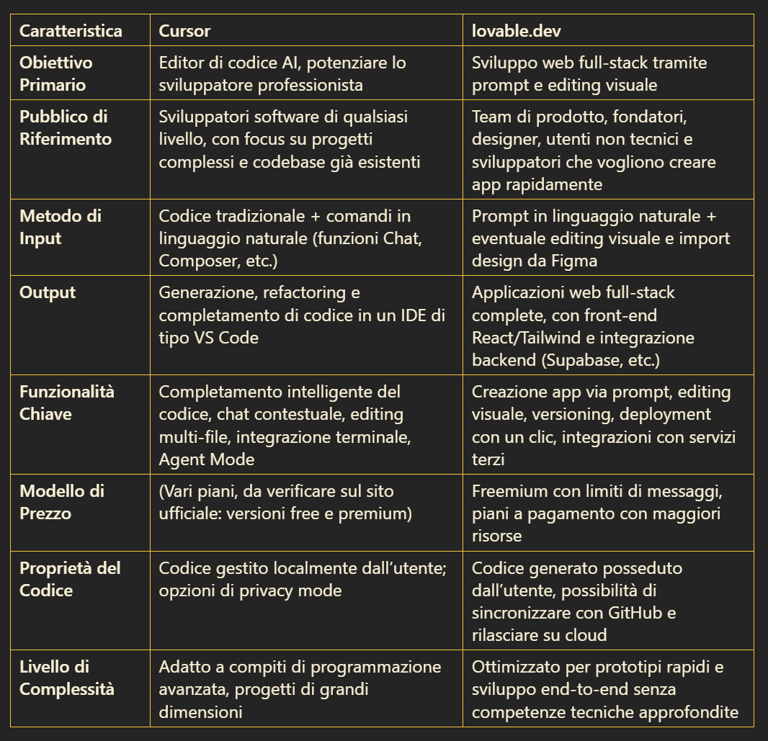
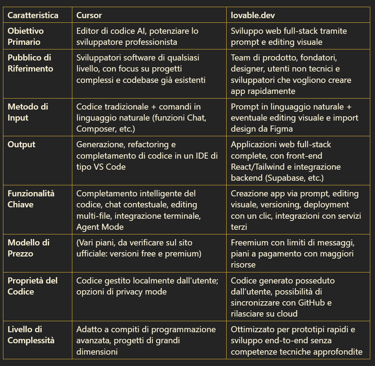
Cursor vs. lovable.dev
5. Emerging Challenges in AI and Programming
So much innovation also brings challenges of various kinds, ranging from ethical issues to privacy, from security to computing power management.
5.1 Ethical Considerations and Responsible Development
The most cited concerns include:
Bias and Equity: if training data is skewed, AI models can perpetuate discrimination (for example, excluding certain groups of people from job or credit offers).
Transparency and Accountability: AI systems often function as "black boxes," making it difficult to understand how a certain decision was made. There's growing demand for explainable AI (XAI), to account for choices made and attribute responsibility in case of damage.
Privacy and Data Protection: generative models, to function, absorb enormous amounts of data. Ensuring these data (often sensitive) aren't used improperly is a central theme, also in light of strict regulations like GDPR in Europe.
Misuse and Security: powerful AI could be employed for malicious purposes (deepfake creation, phishing attacks, electoral manipulation, malware development). Companies and institutions must establish guidelines to prevent abuse.
Governments and international organizations are beginning to legislate, but the pace of politics struggles to keep up with technological innovation. Meanwhile, many tech organizations adopt codes of conduct and develop internal governance frameworks for ethical and secure AI.
5.2 Privacy, Security, and Data Governance
Most AI systems rely on colossal datasets. This raises issues such as:
Breach Risk: training data archives and models themselves can be targets of hackers (intellectual property theft, service disruption, blackmail).
Data Fragmentation: by integrating AI into many different services, the amount of data collected and processed grows exponentially, with effects on corporate data governance.
Regulations and Compliance: regulations like European GDPR or California CCPA establish obligations for transparency and secure management of personal data. Companies using AI on a large scale must ensure compliance, under penalty of severe sanctions.
5.3 Computational Power Demand
Training and executing AI models (especially generative ones) require substantial computing resources, often based on GPUs or TPUs. This has:
Environmental Implications: large models consume significant amounts of energy. The sustainability argument becomes increasingly pressing.
Barriers to Entry: the necessary hardware and infrastructure aren't economically accessible to everyone, risking creating a gap between those who can afford computing power (tech giants) and those excluded from it.
Research on Alternative Solutions: edge computing, quantum computing, specialized hardware, and more energy-efficient architectures.
5.4 Integration into Existing Systems
AI doesn't operate in a vacuum but must be grafted onto existing stacks and infrastructures. Challenges include:
Compatibility with legacy databases, ERP, CRM, etc.
Training personnel who must learn to act in a "humans + AI" context
Resistance to change and fears of workforce replacement
6. Skills Democratization: Meaning and Impact
The concept of skills democratization indicates the possibility, for a wide audience of individuals, to access tools and knowledge previously the preserve of a few specialists. AI and low-code/no-code platforms constitute a strong driver of this democratization.
6.1 How Is AI Democratizing Development?
User-Friendly Access: natural language interfaces (text prompts) and simplified graphical interfaces break down traditional programming requirements.
Widespread Training: countless online courses, open-source resources, and AI-assisted development communities allow anyone to start experimenting.
Cost Reduction: many platforms (even paid ones) have free tiers with basic functionality, allowing projects to be created and distributed without substantial initial investments.
6.2 Impact on IT Professionals
"Classic" developers see their role change:
Decrease in Routine Activities: with AI generating boilerplate, programming shifts to architectural design aspects, advanced problem-solving, and validation of AI results.
New Skills: figures like prompt engineers, data specialists, technical product owners with strong focus on AI, governance, and security emerge. Programmers who can adapt to this transformation will become more strategic within companies.
Collaboration with Non-Technical People: IT professionals will often be called upon to act as "facilitators" for citizen developer teams and business stakeholders who create prototypes through no-code platforms.
6.3 Opportunities and Challenges for Non-Technical People
For those who aren't professional programmers, democratization tools open unexpected doors.
Opportunities: launching entrepreneurial ideas without depending on expensive development teams, digitalizing internal processes, creating customized solutions.
Challenges: no-code platforms often have limitations in terms of scalability and customization; it's possible to take wrong paths due to lack of engineering awareness; oversight regarding security and regulatory compliance remains crucial.
6.4 Broader Implications: Future of Work and Economy
As AI becomes standard and DIY software (no-code) spreads, the job market could undergo polarization:
On one hand, low technical content or repetitive tasks decrease, replaced by automation
On the other, specialized figures and domain analysts with cross-cutting skills grow
A "bottleneck" might also emerge in areas like security, ethical AI, and data management. Many professions, however, will be reskilled rather than disappear, with a more creative and strategic role. Governments and companies focusing on continuous upskilling could gain a competitive advantage, enabling a workforce capable of using new digital tools with ease.
7. Real Impact: AI and Programming Applications in Various Sectors
Let's now look at some concrete examples showing how AI is profoundly modifying different areas, bringing with it a convergence between programming, data science, and automation.
Healthcare
Diagnostics: AI for tumor recognition, radiological image analysis, patient pre-screening
Drug Discovery: learning algorithms to accelerate research of new molecules
Personalized Medicine: analysis of genetic and clinical data to propose tailored therapies
Finance
Fraud Detection: analysis of anomalous patterns in payments and transactions
Risk Management: AI systems that evaluate customer solvency or suggest investment strategies
Banking Chatbots: 24/7 customer service with immediate response to account questions or product suggestions
Manufacturing
Predictive Maintenance: IoT sensors and AI models detect signs of wear and imminent failure
Supply Chain Optimization: real-time demand forecasting and supply
Advanced Robotics: robotic arms with artificial vision algorithms and continuous learning
Retail
Personalized Recommendations: behavioral analysis to suggest products and offers
E-commerce Chatbots: virtual customer assistance, post-sale follow-up
Inventory Management: automatic monitoring and just-in-time replenishment
Transportation
Autonomous Vehicles: assisted driving and subsequently completely self-driving
Logistics Optimization: dynamic route planning, delivery time reduction
Traffic Management: predictive models to regulate traffic lights and vehicle flows
Cybersecurity
Threat Detection: AI to identify intrusions and attack patterns
Vulnerability Analysis: continuous scanning of code and networks
Automated Response: scripts and agents that block phishing attempts or malware in real-time
Education
Virtual Tutors: e-learning platforms with AI that adapts educational material to student needs
Automatic Assignment Correction: texts or open-answer tests evaluated by NLP models
AI-based Plagiarism Control: verification of written content authenticity, with detection of passages generated by AI models
In all these areas, AI-supported programming simplifies development of new applications and integration of complex algorithms. Low-code/no-code platforms allow domain specialists (doctors, bankers, teachers) to participate in tool creation, enhancing innovation even where IT resources are scarce.
8. Future Perspectives and Recommendations
What to expect in the coming years, especially in a 2024-2027 horizon? Some predictions and trends now seem to be taking shape clearly.
8.1 Future Trends and Predictions
Coding Automation: manual code writing could reduce up to 90-99% by the end of the decade, with AI capable of generating entire software projects based on textual specifications or diagrams.
Widespread AI Agents: conversational agents and autonomous systems integrated into a growing number of apps and devices (from smartphones to CRMs).
Focus on Applications: as AI models become standardized (and open-source), attention will shift to building integrated vertical solutions, rather than creating the model itself.
LLM Specialization: a boom in "domain-specific" language models is expected (healthcare, legal, finance, manufacturing), trained on targeted datasets, capable of providing deeply contextualized knowledge.
New Work Roles: AI ethicist, AI security specialist, prompt designer, data governance manager. In parallel, the "classic" programmer figure will evolve to include AI orchestration skills and high-level problem solving.
8.2 Adaptation of Professionals and Companies
For IT Professionals:
Lifelong Learning: constantly updating on new AI tools, languages, and methodologies
Soft Skills: communication, teamwork, ability to interpret business needs and translate them into AI prompts/projects
Ethics and Security: at least basic training on governance and responsibility issues
For Companies:
Internal Training: courses and workshops on generative AI, low-code/no-code, security, data privacy
Adoption Strategy: define a clear plan on where AI can add value (e.g., process automation, product improvement, new service creation) and how to mitigate ethical or security risks
Innovation Culture: encourage experimentation with rapid prototypes, adopt agile methodologies and multidisciplinary teams (fusion teams)
8.3 Long-Term Impact on Innovation and Productivity
Increased Creativity: freeing time from repetitive tasks, AI allows focusing on ideation and design aspects, with potential growth of innovation.
Decreased Entry Barriers: startups and creative individuals can compete with large companies, reducing the gap in financial and technical resources.
New Market Opportunities: AI applied to complex problems will inevitably create products and services that don't exist today, generating jobs and investments.
Risk of Inequalities: however, we must be vigilant about the possibility that the digital revolution leaves behind segments of the population without skills or access to IT infrastructure.
9. Conclusions
From the rapid evolution of generative AI to the impetuous growth of low-code/no-code platforms and AI-first programming editors, a picture of profound transformation emerges in the software world and, by reflection, in numerous economic sectors. Tools like Cursor and lovable.dev are the spearhead of this revolution: on one hand, they provide professional developers with an integrated AI assistant capable of speeding up code writing and maintenance; on the other, they open the doors of software creation to a much broader audience, thanks to natural interfaces and automatic generation processes.
However, along with these extraordinary opportunities, crucial challenges emerge: ethics and responsibility in AI development, data security and prevention of malicious use of automation, reskilling and management of work impact. Skills democratization has the potential to make the software world more inclusive and dynamic, but also requires investments in training and governance to avoid risks.
The real impact in the most disparate sectors (healthcare, finance, manufacturing, education) shows how AI is already revolutionizing processes and products, bringing the global economy closer to a new paradigm where intelligent automation and widespread innovation are the order of the day. The future perspective seems inevitably projected toward greater AI centrality, with increasingly specialized and integrated models, and programmers and IT professionals transforming into "solution designers," "AI system orchestrators," and compliance guarantors, rather than mere producers of lines of code.
Ultimately, the current landscape (2024-2025) is just a taste of what could happen in the coming years. If predictions seeing 99% automation of coding come true by 2027, then we'll truly be facing a new era of software, where the human-machine relationship will be completely redefined. Preparing for this transformation – ethically, technically, and culturally – is the greatest and most fascinating challenge that awaits us.
Bibliography
"14 AI Trends Transforming Tech in 2025," DigitalOcean
"25 New Technology Trends for 2025," Simplilearn.com
"5 AI Trends to Watch in 2025," Coursera
"The Impact of AI on Low-Code/No-Code Platforms," Coforge
"Cursor AI: An In Depth Review in 2025," Engine Labs Blog
"Changelog | Cursor - The AI Code Editor," www.cursor.com/changelog
"FAQ - Lovable Documentation," docs.lovable.dev/faq
"Top 15 Challenges of Artificial Intelligence in 2025," Simplilearn.com
"How the Democratization of AI Impacts Enterprise IT," Intellias
"OpenAI's Shocking Prediction: Superhuman AI Coders By 2025," YouTu