

Virtual Machine or Container? (Part.4)
Blog post description.
NETWORKS AND DATA INFRASTRUCTURESINNOVATION AND EMERGING TECHNOLOGIES
13. Integration with DevOps and Cloud-Native
The growing adoption of containers and automation solutions in virtualization is closely tied to the spread of DevOps methodologies and cloud-native approaches. Let's examine how these technologies integrate into this new paradigm.
13.1. DevOps Culture vs Traditional Technologies
DevOps represents much more than a set of tools: it's an organizational philosophy and a framework of practices aimed at:
Shortening the cycle between development and production
Promoting synergy between development and operations teams
Automating repetitive processes in the software lifecycle
Traditional VM-based virtualization was born in a pre-DevOps era, characterized by predominantly manual IT provisioning and slow, rigid release cycles. This doesn't mean VMs are incompatible with DevOps, but it requires implementing automation layers (scripts, hypervisor APIs, Infrastructure as Code, configuration management tools) to accelerate provisioning, configuration, and management times. However, even with solid automation, VM creation and destruction times generally remain longer than containers.
13.2. Continuous Integration/Continuous Deployment (CI/CD)
Pipelines with Virtual Machines
In a VM-based environment, a typical CI/CD pipeline unfolds as follows:
Code compilation and test execution (often in temporary VMs)
Artifact publication to a repository
Application deployment by updating existing VMs, through configuration management tools (Ansible, Puppet, Chef) or deployment scripts
Optionally, using Packer to generate an updated "golden image" VM to distribute across clusters, approaching the concept of "immutable" servers
Pipelines with Containers
With containers, the flow is notably more streamlined and standardized:
Build: creation of the container image that encapsulates the application and its dependencies
Test: execution of automated tests on the containerized image
Push: publication of the validated image to the registry (Docker Hub, ECR, Artifactory)
Deploy: orchestration (typically with Kubernetes) of a rolling update that gradually replaces existing containers
The container paradigm introduces a fundamental principle: immutability. Patches aren't applied at runtime; instead, the entire image is rebuilt, guaranteeing consistency between environments and facilitating instant rollbacks.
13.3. Infrastructure as Code (IaC)
Infrastructure as Code allows defining the entire infrastructure (compute, network, storage, configurations) through versioned descriptive files applicable through automation:
Terraform: can orchestrate cloud resources, but also vSphere, Proxmox environments, and even Kubernetes clusters
Ansible: beyond configuration, supports VM creation on KVM/Proxmox and container management and Kubernetes orchestration
Cloud-Init: de facto standard for first-boot VM configuration, with broad cross-platform support
In the container context, specialized paradigms emerge:
Helm and Kustomize for Kubernetes deployment management
GitOps: an approach where application configuration resides in Git repositories, with tools like Argo CD or Flux CD that automatically synchronize cluster state
These tools embody the DevOps philosophy of eliminating manual configurations, minimizing human errors, and guaranteeing repeatability in every environment.
13.4. Monitoring/Logging/Tracing (Observability)
Implementing a DevOps/cloud-native strategy requires a complete observability ecosystem:
VM Monitoring
In VM environments, monitoring typically relies on:
Installed agents (Zabbix, Nagios, vRealize Operations, SCOM)
Third-party enterprise solutions (Datadog, Dynatrace)
Log collection through specialized agents
Container Monitoring
In the container world, the approach is significantly different:
Application logs are directed to stdout/stderr and centralized via ELK/EFK
Metrics are exposed and acquired by Prometheus with visualization through Grafana
Distributed transaction tracing occurs with tools like Jaeger or Zipkin
Kubernetes natively integrates health check mechanisms (liveness/readiness probes) and metrics for autoscaling. The DevOps ecosystem favors "self-service" monitoring where development teams can create dashboards and alerts specific to their applications.
13.5. Hybrid Cloud and Multi-cloud Deployments
VMware
The VMware ecosystem offers:
VMware Cloud on AWS: transparent federation between on-premise environments and AWS cloud, facilitating bi-directional VM migration
Tanzu: native Kubernetes integration in vSphere, allowing management of containers and traditional VMs from the same control plane
Microsoft
Microsoft proposes:
Azure Stack HCI: extension of Azure cloud into on-premise data centers through Hyper-V clusters
AKS on Azure Stack: managed Kubernetes portability in private environments
Proxmox + Public Cloud
While lacking native proprietary integration, Proxmox can operate in hybrid scenarios through:
Replication and backup solutions toward cloud storage
Automation with Terraform for consistent provisioning between on-premise and cloud
Parallel service deployments on on-premise Proxmox and Kubernetes in cloud
Multi-cluster Kubernetes
Kubernetes intrinsically offers high portability:
Federation of clusters distributed across different clouds
Unified management through fleet management tools
Containerized application portability between cloud providers
13.6. Examples of DevOps in Practice
Traditional Scenario
Considering a legacy .NET application on Windows VMs:
Jenkins pipeline that compiles code and generates an MSI package
PowerShell scripts that orchestrate deployment with maintenance windows
High availability implemented at load balancer level with WNLB cluster
Updates characterized by minutes of planned downtime
Cloud-native Scenario
For a Node.js application based on microservices:
GitLab CI pipeline that compiles, tests, and creates the container image
Automatic update of Helm charts in dedicated Git repository
Argo CD that synchronizes changes applying rolling updates in the Kubernetes cluster
Zero downtime during updates and instant rollback capability
13.7. Modern Trends: Infrastructure as Code for Everything
API-driven Infrastructure
All major hypervisors (VMware, Hyper-V, KVM, Proxmox) expose programmatic interfaces that enable complete automation even of traditional virtualization environments.
Platform Engineering
The concept of internal platform emerges: dedicated teams that build abstraction layers on VMs and/or Kubernetes, offering developers self-service environments with built-in guardrails.
Micro-VMs and Serverless Containers
Innovation continues with projects like Firecracker, Kata Containers, and gVisor that blur the boundary between VMs and containers, offering the best of both worlds: VM-like isolation but container-like lightness.
Ultimately, containerization and Kubernetes orchestration were conceived precisely to enable DevOps practices and support cloud-native architectures. VMs are evolving with API integrations and platforms (VMware Tanzu, Hyper-V with Azure DevOps), but remain more aligned with traditional provisioning models. In most enterprise scenarios, we witness strategic coexistence: VMs as infrastructure foundations and Kubernetes as application platform.
14. Final Considerations and Best Practices
After thoroughly exploring virtualization and containerization technologies, let's synthesize the key points to guide enterprise choices.
14.1. Summary of Strengths and Weaknesses
VMware ESXi
• Mature enterprise features (vMotion, HA, DRS)
• Complete integrated ecosystem (NSX, vSAN, Tanzu)
• Certified enterprise support and vast community• High TCO
• Potential technology lock-in
• Strategic uncertainties post-Broadcom acquisition
Hyper-V
• Native integration in Microsoft ecosystem
• Advantageous licensing model with Windows Datacenter
• Synergy with Azure and System Center• Lower market adoption than VMware
• Less developed third-party ecosystem
• Windows host requirement
KVM/oVirt
• Open source, reduced TCO
• Minimal overhead, kernel optimizations
• Flexibility and customization• Requires advanced Linux skills
• Less refined interfaces and tools
• Paid enterprise support (Red Hat, SUSE)
Proxmox VE
• Open source with intuitive web interface
• Out-of-box integration with LXC, Ceph, HA
• Contained support costs• Lower enterprise recognition
• Limited commercial ecosystem
• Community dependency for some extensions
Containers (Docker)
• Fast deployment, negligible overhead
• Alignment with DevOps and CI/CD methodologies
• Cross-platform portability
• Vast CNCF ecosystem• Less robust isolation than VMs
• Need for orchestration for enterprise deployment
• Technical-cultural learning curve
Kubernetes
• De facto standard for container orchestration
• Advanced resilience and scalability mechanisms
• Universal support (cloud and on-premise)
• Operational complexity
• Sophisticated storage and networking management
• Rapid ecosystem evolution
14.2. Decision Guidelines
Nature of workload
Legacy, monolithic applications or those with specific operating system constraints will find VMs the most adequate environment
Greenfield projects with cloud-native architecture will benefit more from container adoption
Isolation requirements
Multi-tenant scenarios with high segregation needs require VM isolation guarantees
Most enterprise applications can operate securely on properly configured containers
Economic considerations
With significant budget constraints and internal Linux competencies, KVM/Proxmox offer economically advantageous alternatives
In contexts where stability and vendor support are priorities, commercial solutions like VMware maintain their value
Evolution speed
Projects requiring frequent releases, dynamic scalability, and microservices architectures find containers and Kubernetes the optimal solution
Team competencies and organizational culture
Containerization requires a paradigm shift: Infrastructure as Code, CI/CD, distributed monitoring
If the organization isn't ready for this transformation, VMs represent a more consolidated approach
Long-term technology strategy
Many organizations adopt an evolutionary hybrid model, with VMs hosting Kubernetes clusters, combining the advantages of both worlds
14.3. The Future of Virtualization and Containerization
Technological convergence
Hybrid technologies like Kata Containers and Firecracker are blurring boundaries between VMs and containers, offering VM isolation with container lightness
Serverless evolution
Continued abstraction toward Function-as-a-Service (FaaS) models, where infrastructure becomes completely transparent to the developer
Market dynamics
VMware's acquisition by Broadcom could accelerate adoption of alternatives like KVM/Proxmox, but VMware could differentiate with multi-cloud and Kubernetes-centric solutions
Hardware innovation
Intel and AMD are evolving virtualization extensions to support both VMs and containers with ever-decreasing overhead and improved security
Distributed computing
Edge computing growth favors container adoption for efficiency, but also requires lightweight virtualization solutions for isolation
14.4. General Conclusion
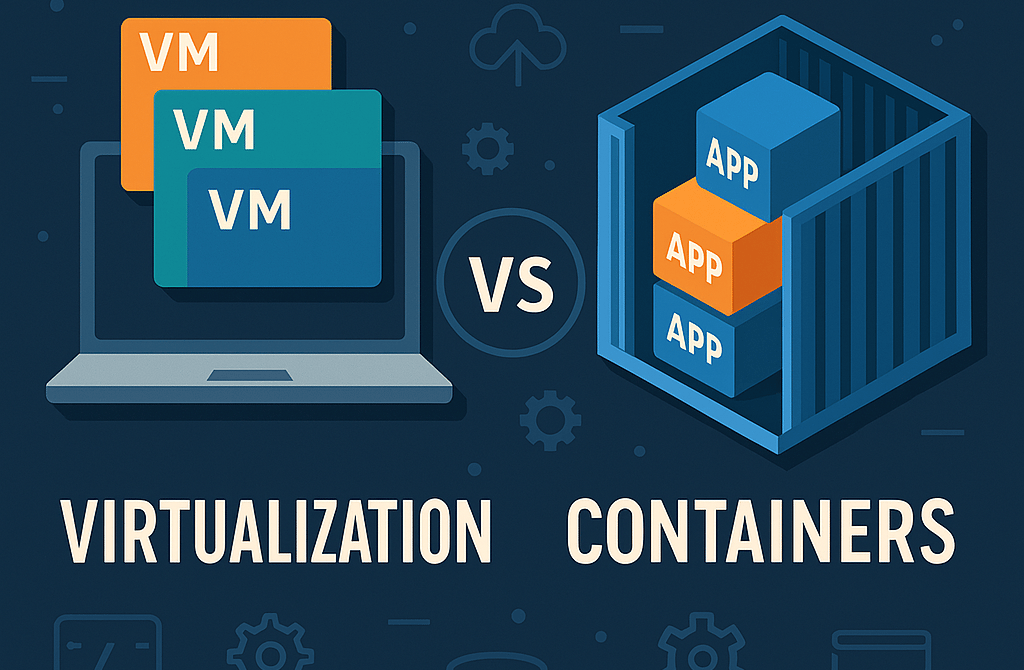
Virtualization and Containers are not antagonistic but complementary technologies:
VMs provide hardware abstraction: ideal for legacy workloads, multi-OS environments, robust isolation requirements
Containers offer application abstraction: optimal for microservices, DevOps, cloud-native approaches
In numerous organizations they coexist strategically: VM infrastructure (VMware, Hyper-V, KVM/Proxmox) hosting Kubernetes clusters for containers
The optimal choice depends on specific context (regulatory, performance, economic requirements, competencies). The general trend sees growing container adoption for innovative projects, while traditional virtualization continues to represent the fundamental infrastructure for consolidated and legacy services.
15. Appendices, Summary Tables, and References
To complete this in-depth analysis, we include appendices with detailed comparative tables, technical glossary, and authoritative references.
15.1. Glossary
Hypervisor: software layer that enables creation and execution of virtual machines on physical hardware
Container: isolated execution unit at the process level that shares the host operating system kernel
Orchestrator: system that automates deployment, scalability, and lifecycle management of containers across node clusters
DevOps: cultural and technical approach that unifies development and operations through automation and collaboration
IaC (Infrastructure as Code): practice of managing infrastructure through versionable descriptive files
Microservices: architectural paradigm based on decomposing applications into autonomous and specialized services
CI/CD: Continuous Integration/Continuous Deployment - methodology for automating development, testing, and release processes
Article Conclusion
Having reached the end of this in-depth analysis journey on virtualization and containerization technologies, with particular focus on VMware, Hyper-V, Proxmox/KVM and the Docker/Kubernetes ecosystem, we can synthesize the main insights that emerged:
Virtualization (VM)
Guarantees complete isolation at the hardware level
Represents the ideal solution for legacy environments, multi-OS, and scenarios with stringent regulatory requirements
Involves greater overhead and license costs (particularly for enterprise solutions like VMware)
Offers mature high availability and workload mobility features
Containers (Docker/Kubernetes)
Implements process-level isolation with shared kernel
Excels in terms of efficiency, portability, and deployment speed
Requires sophisticated orchestration to manage distributed enterprise deployments
Aligns perfectly with DevOps methodologies and cloud-native architectures
Adoption Strategy
Most organizations implement a hybrid approach: VMs for traditional applications and core infrastructure, containers for greenfield development and modernization initiatives. This coexistence represents not a compromise, but a deliberate strategy that capitalizes on the strengths of both paradigms.
The comparative tables, concrete use cases, and technical considerations presented in this article provide a solid foundation for developing a virtualization and containerization strategy aligned with your specific enterprise context requirements, balancing technical, economic, and organizational factors.
The choice between traditional virtualization and containerization is not binary, but a continuum of options that reflects the growing sophistication of modern digital infrastructure.