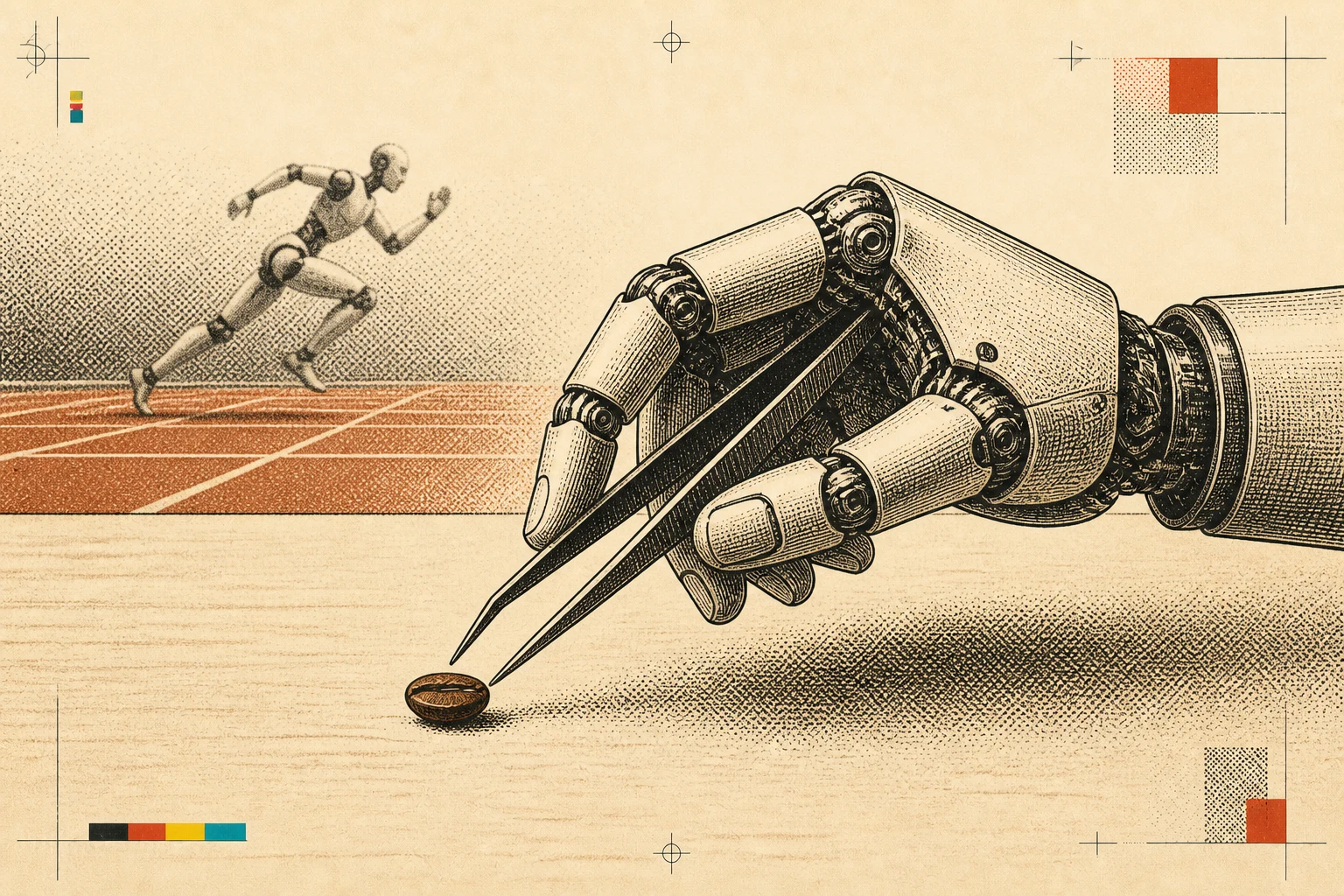
Tiangong Ultra crosses the 100-meter finish line in 8.64 seconds. The clock stops almost a full second below the 9.58 set by Usain Bolt as the human world record in 2009. The crowd applauds, phones record, and the headline is already waiting: a machine has beaten the fastest man in history.
Then the machine has to stop.
In the World Humanoid Robot Games final in Beijing, several competitors crash into the padding beyond the finish line. Sparks fly from some of them. Staff arrive with fire extinguishers. Almost every robot is carried away on a stretcher, an object that takes on an unintentionally theatrical quality in a stadium populated by metal bodies with two arms and two legs. The result remains impressive. But the braking tells us something the time alone does not: speed on a straight track covers only part of the problem.
The robot still has to ration its energy so it reaches the end intact, understand that the race is over, adapt to a changing space and recover when the perfect movement fails. Above all, it still has to perform the actions that other robots attempted a few sections away with almost exasperating slowness: insert a cable into a socket, place rubbish in a bin, build with small blocks, or use tweezers to pick up a bean.
This is where the Games become more interesting than a collection of records and falls. A machine can cross a track faster than Bolt and struggle enormously with a task that a human performs without considering it a test of intelligence. The paradox is almost forty years old. It bears the name of roboticist Hans Moravec, and it has never been easier to see.
The Olympics Where a Room Matters More Than the Stadium
The second World Humanoid Robot Games took place from August 22 to 26, 2026, at Beijing's National Speed Skating Oval, the “Ice Ribbon” built for the 2022 Winter Olympics. The official figures describe a leap in scale: 666 teams from 16 countries, 2,056 registered robots, 51 events and 1,301 competition sessions. In 2025 there had been 280 teams.
The spectacle was designed to travel. Robots playing football, boxing, jumping, dancing, lifting weights and racing produce images that are instantly understandable. They have bodies that resemble ours, repeat gestures we recognize and fall in ways that invite us to attribute distraction, fear or clumsiness to them. Anthropomorphism does half the promotional work.
But the program was not merely an imitation of the Olympics. Alongside the sporting events were tests organized around domestic, hotel, industrial, hospital, commercial and emergency scenarios. That distinction is crucial. A stadium measures how far a machine can push a capability under defined conditions. A simulated room asks whether that capability can become work.
A fast-running robot demonstrates progress in motors, actuators, dynamic balance, mechanical design and control algorithms. A robot picking up an object that is out of place must combine far more elements: see the object, separate it from the background, estimate its position, bring its hand closer, choose a grip, apply enough force without applying too much, notice slippage and correct it without starting over.
To us, the second list sounds more modest than the first. In robotics, the opposite is often true.
That is why a test involving tweezers may tell us more than a race. It is not because running is easy, or because a falling robot deserves ridicule. The tweezers force us to notice a kind of intelligence we usually ignore, accumulated in fingers, eyes, balance and corrections performed before we are even aware that something was going wrong.
Moravec's Paradox Is Not a Joke About Robots
Hans Moravec published Mind Children in 1988. The book belongs to a period in which artificial intelligence had already alternated between sweeping promises and sharp retrenchment. Computers could prove theorems, play games and solve formalized problems. Yet machines struggled terribly to see, move and orient themselves with the ease of a child.
Moravec framed the contrast provocatively. It was relatively easy to make computers perform at an adult level on intelligence tests or in checkers, but difficult or impossible to give them the perceptual and motor skills of a one-year-old child.
This is the origin of what we now call Moravec's paradox. Activities we consider elevated, conscious and difficult, such as calculation, symbolic reasoning or chess, can become tractable when a problem has clear rules and a representable state. Activities we dismiss as elementary, such as recognizing a cup from a new angle, crossing a cluttered room or grasping a fragile object, conceal an immense amount of processing.
The paradox does not claim that abstract thought is easy. It should be read as a difference in perspective, not a law that assigns every task a permanent rank or guarantees that tweezers will remain unbeatable forever. Its point is subtler: the difficulty we perceive does not match the cost of reproducing a capability in a machine.
We call difficult what demands conscious attention. An equation forces us to stop. Grasping a cup does not. But a skill's transparency to consciousness does not make it simple. It may mean that evolution and learning have embedded it so deeply that its operation is hidden from us.
For millions of years, survival required organisms to distinguish surfaces, judge distance, coordinate muscles, predict trajectories, control force and react to the unexpected. Writing, formal mathematics and chess are much more recent arrivals. We do not have an organ evolved to play the Sicilian Defense. We do have a perceptual and motor system built around not falling, not breaking what we touch and not losing our grip.
When a child picks up a bean, the movement is not poor in intelligence. It is an immense computation the child cannot describe.
Why a Track Can Be Simpler Than a Cable
Saying that running can be simpler than inserting a cable sounds absurd because we look at the movement rather than the problem.
A track is a highly structured environment. It has an even surface, a known direction, visible boundaries and a goal that can be reduced clearly: move forward as quickly as possible without falling. Unexpected events still occur, but the number of relevant variables can be contained. Engineers can build models, repeat thousands of attempts in simulation and let an algorithm explore gaits that no human coach would have designed.
The result can look strange. Some robots run in postures unlike those of an athlete because their bodies are not ours and optimization has no reason to respect our sense of elegance. If a configuration lowers the risk of falling or prevents a component from overheating, the system can adopt it without embarrassment. Simulation is particularly effective when the essential dynamics can be modeled and the task is repeated.
None of this diminishes Tiangong Ultra's 8.64 seconds. Making a biped run at that speed requires powerful actuators, rapid control, a structure that can withstand impacts and balance renewed at every step. At the first edition of the Games in 2025, the best time was 21.50 seconds. The improvement in one year shows a supply chain learning quickly.
The comparison with Bolt still needs the right frame. A robot and an athlete are not competing in the same category. They do not share anatomy, nutrition, physiological constraints, rules, starting procedures or homologation criteria. The time is an effective image of the machine's speed, not a new athletics record. Saying that the robot was faster on the clock is accurate. Saying that it defeated Bolt as an athlete confuses the metaphor with the measurement.
The barrier after the finish line is a reminder that an optimized capability can be narrow. The system has solved “get there quickly” very well. The real world immediately appends another sentence: “then stop without catching fire, without hitting anyone, and remain available for the next task.”
Useful competence often lives in that second sentence.
The Tweezers Contain More Physics Than They Seem To
Picking up a bean with tweezers begins before contact. The robot must locate two small objects, understand their orientation relative to one another and bring the tip of the tool to the right point. A tiny error in depth estimation can displace the grasp. The hand and tweezers may hide the bean at the very moment it is most important to see it. Lighting changes the image, and the object's edge can merge with the surface beneath it.
Then contact begins, and reality stops being an image.
Friction is not perfectly known. Surfaces yield, vibrate and slip. Too little force loses the object. Too much can push it away, damage it or deform the tool. The bean is not identical to the one used in the previous attempt. Even when the geometric path is correct, a grain of dust, a slight rotation or a mechanical tolerance can change the outcome.
Humans manage this chaos through a network of sensations and corrections. We do not only look. We perceive pressure, force distribution, vibration and the first indication of slippage. We change the grip while the movement is underway. If we miss the object by a few millimeters, we do not declare the whole plan a failure. We adjust the wrist.
The value of this capability is visible precisely because it is not spectacular. At home, in a hospital or in a warehouse, the perfect task is rare. Objects are not always in the same place. Packaging deforms. A cable bends. A handle offers more resistance than expected. A person crosses the route. Physical intelligence is not merely the execution of a plan. It is continuously determining whether the plan is still working.
Brown University roboticist Stefanie Tellex identified the Beijing tests as a direct example of Moravec's paradox. A somersault may look more impressive than a cable inserted into a socket, but the second action forces a machine to contend with friction, slipping, touch and adaptation at a tiny scale.
It would be wrong to attribute “more intelligence” to the cable in every possible sense. The action requires a different capability distributed across perception, body and environment, precisely the kind that digital systems have trained us to undervalue.
Autonomous, Teleoperated, Automated: Three Different Words
A video of a robot performing an action is not enough to establish who made the decisions.
It may be fully autonomous, receiving an initial command and then perceiving, planning and acting without intervention. It may be teleoperated, with a human controlling movements or goals from a distance. Or it may occupy an intermediate zone, where an operator issues commands while an automated system maintains balance, avoids collisions or completes parts of the action.
These modes demonstrate different achievements. A robotic hand using tweezers under human guidance shows that the mechanics, sensors and low-level control can support that action. It leaves open whether the machine can recognize the task, choose a strategy and recover from an error on its own. Conversely, an autonomous robot may make sound decisions but have a body too imprecise to turn them into action.
The published rules for the 2026 Games accounted for this distinction. Only fully autonomous operation was allowed in the 100 meters. Some longer races, including the 400 and 1,500 meters, also permitted remote control, but the resulting time was multiplied by a penalty coefficient. The official rules presentation also required autonomy in scenarios and other competitive tests, with exceptions for the specified running events.
WIRED's coverage nevertheless noted operators visible in images and video of various activities. That is another reason not to transfer the label “autonomous” from one race to the whole event. There can be distance between the rules, the category, the demonstration and the execution. Each performance must be understood according to what it actually measures.
Teleoperation also serves a less visible industrial purpose: collecting data. A person guides the robot while the system records images, positions, forces, trajectories and outcomes. Those demonstrations can become examples from which it learns. The Stanford Emerging Technology Review observes that both the quality and quantity of data, including data obtained through teleoperation, will be decisive in improving robotic accuracy, dexterity and autonomy.
Physical data are expensive. A language model can be trained on enormous collections of existing text. A robot has to produce experience through real or simulated bodies. Someone must prepare the environment, perform the task, record the sensors, inspect the quality and, when the machine fails, put back whatever it dropped. The world cannot be copied and pasted as easily as a web page.
Before the Tweezers, There Was an Ordered Room and a Trembling Robot
To understand why the tweezers are harder than the track, we need to go back sixty years, when intelligent robotics was taking shape in environments much simpler than a home.
Between 1966 and 1972, the Stanford Research Institute developed Shakey. It was a tall wheeled cart equipped with a camera, sensors and a connection to external computers. SRI describes it as the first mobile robot able to perceive and reason about its environment. It could plan routes, reach locations and move simple objects.
Shakey was revolutionary precisely because it connected components that had previously lived apart: perception, representation, planning and action. But its world was arranged to be legible. Walls, blocks, ramps and rooms had clear shapes. Its slowness was not an accidental defect. Every step required calculation, interpretation and communication with computers that would now be outperformed by a phone.
The project produced foundational tools for automated planning. It also left a question robotics has never stopped pursuing: how much intelligence belongs to the program, and how much emerges from the relationship between a body and an environment?
During the same decades, much of artificial intelligence achieved better results by moving away from matter. If the world could be converted into clear symbols, the computer no longer had to worry about friction, light, noise or gravity. A chessboard is complex, but it is clean: finite squares, defined pieces, legal moves and complete information.
In May 1997, Deep Blue defeated Garry Kasparov in a match played at standard tournament time controls. IBM recalls that the system could evaluate 200 million positions per second. The victory was historic and demonstrated the power of parallel computing, search and evaluation functions. It also showed how a well-defined benchmark can focus investment and progress.
RoboCup was founded in the same year. Its stated objective is even more theatrical than the Robot Games: by the middle of the twenty-first century, a team of fully autonomous humanoid football players should defeat the human World Cup champions under FIFA rules.
RoboCup's official account explains why football succeeded chess as a challenge. In chess, the environment is static, play proceeds in turns, information is complete and the state can be read symbolically. In football, the environment is dynamic, everything happens in real time, information is incomplete and sensors must translate the world into an intelligible situation. Choosing the move is not enough. The system needs a body capable of reaching it.
Rodney Brooks and the Elephants That Do Not Play Chess
Two years after Moravec's best-known formulation, Rodney Brooks published a deliberately irritating paper titled Elephants Don't Play Chess.
Brooks challenged the idea that an intelligent agent had to begin with a complete symbolic representation of the world, produce a central plan and only then tell the body to execute it. An animal does not wait for a perfect model of the forest before moving. Perception and action form a continuous circuit. Behavior can emerge from relatively simple layers that react to the situation, coordinate and correct one another.
The elephant in the title does not play chess, but it crosses uneven terrain, uses its trunk, recognizes other individuals, protects its young and adapts its behavior to conditions no programmer has listed one by one. Judging its intelligence with a chessboard would mean choosing the problem so that almost everything it knows how to do disappears.
Contemporary humanoid robots combine approaches that were separate or immature in Brooks's time. They use reactive control, physical models, reinforcement learning, computer vision and networks trained on demonstrations. But his warning remains current. A system does not become intelligent in the world merely because it can represent the world. It has to be situated, receive consequences and turn error into correction.
Tweezers are a good test because they prevent software from pretending the body is a detail. The prediction can be right and the grasp can fail. The plan can be elegant and the bean can slip.
Competitions Matter When They Allow Failure in Public
Calling events of this kind “games” can make them sound peripheral. The history of technology suggests the opposite.
In March 2004, DARPA organized a competition for autonomous vehicles on a 142-mile route through the desert between California and Nevada. No vehicle reached the finish. The best covered just 7.5 miles. If the only criterion had been the spectacle of a ready technology, the event would have been a failure.
Eighteen months later, in 2005, five vehicles completed a new 132-mile course. Stanford's team won in six hours and 53 minutes. The transformation did not happen because one insight suddenly solved autonomous driving. The competition created a shared objective, deadlines, comparisons and a community in which different errors could become shared knowledge.
A public benchmark does at least three things. It reduces a vague ambition to observable tests. It forces components that work separately in a laboratory to operate together. And it makes failure informative. It is not enough to say that the robot “isn't ready.” The question becomes whether it lost localization, overheated a motor, missed a grasp or misunderstood its environment.
The World Humanoid Robot Games are also part of a Chinese industrial strategy. Beijing is not offering a neutral arena alone. It displays a supply chain, attracts researchers, companies and attention, and turns technical progress into a national story. Ignoring this would be naive. Treating every event as propaganda and missing the value of the problems it exposes would be equally reductive.
The falls are funny because they resemble our own. For a laboratory, however, a robot that always falls at the same point is a measurement. A motor that overheats on the same turn is a requirement. A hand that loses the bean when the lighting changes is a research program.
The difference between a fiasco and a benchmark is the ability to return the following year with one fewer error.
The Humanoid Is a Shape, Not an Inevitable Destination
Why build robots with two legs, two arms, hands and a head? One persuasive answer is that the world has already been built for us. Stairs, doors, corridors, shelves, tools and vehicles have dimensions and controls designed for the human body. A robot with the same form promises to enter these environments without requiring us to rebuild them.
That compatibility has value. A machine able to use existing tools could work in places designed decades ago, move from one task to another and operate near people. In promotional images, the humanoid appears as a universal adapter for the human world.
But a visual promise can become a debt. If a machine has hands and a face, we expect it to understand and act like us. Its shape suggests versatility even when the system has been trained for a narrow sequence. Every joint adds cost, consumption, maintenance and new ways to fail.
The Stanford Emerging Technology Review notes that humanoids are not the optimal solution for every task. Material handling and repetitive assembly may be performed more efficiently by specialized robots. In a warehouse, wheels, conveyors and fixed robotic arms can be cheaper, more stable and safer than a machine that imitates the whole human body.
The report places the most mature uses in structured environments: inspection, sorting, packing and simple assembly. As robots move into hospitality, domestic services or elder care, dexterity and safety requirements rise together. Safety stops being a condition added at the end. A machine working near untrained people has to fail safely, stop at the right moment and make its intentions legible.
The future of robotics will therefore not be an inevitable march toward an army of human-shaped copies. It will be a selection among different forms. In some environments, the humanoid will win because adapting the building would cost more than the robot's complexity. In others, the smartest solution will have wheels, one gripper or no face.
This, too, is a lesson from Moravec: intelligence cannot be separated from the body that has to exercise it.
After Language, Artificial Intelligence Encounters Matter
In recent years, language models have made familiar a situation almost opposite to the one Moravec described. A machine can produce fluent prose, summarize a document, write code and sustain a conversation. Activities associated with adult education have become interfaces available in a browser.
This success has reinforced the idea that the next step is simply to connect a capable model to a body. If the system can describe how to set a table, why should it not be able to set one?
Matter lies between the two.
In language, an error can be corrected by generating another sentence. In the physical world, a cup released too early falls. Time does not rewind, objects break and people can be hurt. The response must not only be plausible. It has to arrive before gravity finishes its work.
Robots also have an experience problem. Human text accumulated over centuries and has been digitized on an enormous scale. Physical demonstrations have to be collected with specific sensors and bodies. A trajectory learned by one hand may not transfer to a hand with different geometry. Simulation permits millions of attempts without destroying hardware and is one reason for the rapid progress in locomotion. But fine contact remains difficult to simulate faithfully. Tiny differences in friction, elasticity and tolerance can separate a successful grasp from an object on the floor.
This is why teleoperation is both a limit and a bridge. When a person guides a robot, we are not yet observing full autonomy. But we are creating examples of how a mechanical body can complete an action. The industrial challenge is to turn those demonstrations into a capability that generalizes, recognizes new situations and knows when to ask for help.
The most useful metric will not be how many times a robot performs a prepared demonstration correctly. It will be how long it works without intervention, how many unfamiliar objects it can handle, how it recovers from error and at what cost. One autonomous hour in a cluttered warehouse may be worth more than a perfect somersault under the lights.
The Tweezers Do Not Humiliate the Robot. They Give It a Real Task
Moravec's paradox can easily become a tool for dismissing every announcement. The robot runs but cannot stop. It jumps but cannot pick things up. It speaks but does not understand. The reaction is understandable in response to marketing, but it risks becoming another shortcut.
The 8.64 seconds in Beijing are a real achievement. The falls are real data. A hand capable of manipulating a tiny tool is a real achievement even when the intention comes from a human operator. These capabilities do not cancel one another out, and they do not form a simple ranking of intelligence.
The most interesting aspect of the Robot Games is precisely their apparent inconsistency. They place spectacular speed and useful slowness, choreography and error, autonomy and the operator's hidden presence inside the same program. They show a technology that does not progress as a single, ever more capable brain, but as a collection of bodies, sensors, models and infrastructures maturing at different speeds.
The bean grasped with tweezers is not a joke at the machine's expense. It is a benchmark for technical civilization. It condenses the problem of taking artificial intelligence out of environments where everything has already been translated into symbols. It forces the system to meet an object that is not exactly where expected, a surface that slips, a force that must be felt and an error that has to be recovered.
Moravec understood that the oldest abilities would be the hardest to reconstruct. The Beijing Games add a contemporary consequence. The future of robots will be decided not only by the event that produces the best video, but by the ability to turn those invisible skills into reliable work.
The machine on the straight tells us how quickly robotics is advancing. The tweezers tell us how much of the world it still lacks.
Bibliography and Documentation
Primary and Institutional Sources
- World Humanoid Robot Games Organizing Committee. Competition Rules for the Second World Humanoid Robot Games. April 2026.
- Beijing Municipal Government. 2nd World Humanoid Robot Games Underway in Beijing: Robots Break Multiple Records. August 25, 2026.
- Beijing Municipal Government. 2nd World Humanoid Robot Games: Highlights & Ticket Info. August 15, 2026.
- SRI International. Shakey the Robot.
- IBM. Deep Blue.
- RoboCup Federation. Objective.
- DARPA. Grand Challenge.
- DARPA. The DARPA Grand Challenge: Ten Years Later.
Research and History of Ideas
- Hans Moravec. Mind Children: The Future of Robot and Human Intelligence. Harvard University Press, 1988.
- Rodney A. Brooks. Elephants Don't Play Chess. Robotics and Autonomous Systems, 1990.
- Stanford Emerging Technology Review. Robotics. 2026.
Editorial Coverage
- Associated Press. A Robot Sprinter Shatters a 100-Meter Record Again as Sparks Fly at China's Robot Competition. August 26, 2026, corrected version.
- Will Knight, WIRED. The Humanoids at China's Robot Games Were Faster Than Usain Bolt, but I'm More Impressed by Their Tweezer Mastery. August 26, 2026.