Simon Ludlam had a problem no engineering school prepares you for: a house-elf.
Ludlam was managing Greenlink, the interconnector that joins the electricity grids of Ireland and Great Britain across the Irish Sea. During a television report, he pointed out where the link would come ashore on the Welsh beach of Freshwater West. A few weeks later, according to his account, the phone calls began. Hundreds of them.
The project, Harry Potter fans said, would pass through Dobby's grave.
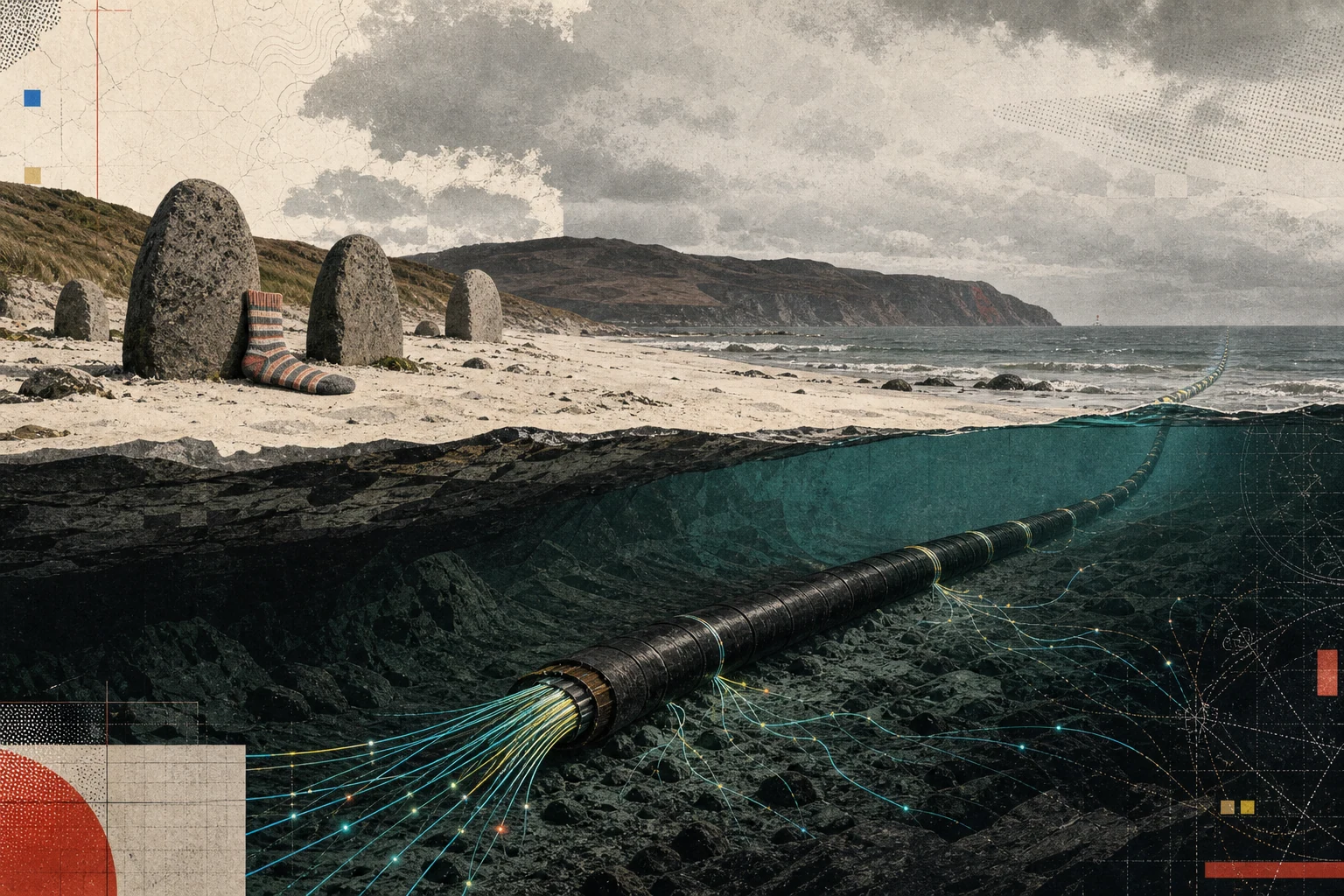
The grave is not a grave. Dobby never existed, and Freshwater West is where the scene of his burial in Harry Potter and the Deathly Hallows was filmed. Over the years, however, visitors have turned that spot on the beach into a spontaneous memorial: inscribed stones, socks, small objects and messages. An imaginary place acquired a geography, a community and, eventually, the power to exert pressure.
Ludlam said the route was changed to avoid it. The account available to us is the project manager's testimony as reported in the press, not a standalone explanation contained in a public planning document. That caveat matters, but it does not weaken the scene: a major subsea infrastructure project found itself negotiating with a memory created by cinema.
At this point, the temptation would be to call Greenlink “an Internet cable” and move on to the larger subject. It would also be wrong.
Greenlink carries electricity. It is a 500-megawatt interconnector made up of two high-voltage direct-current cables accompanied by a fibre-optic cable used to control, monitor and secure the system. It connects the Great Island substation in Ireland's County Wexford to Pembroke in Wales. It entered service in February 2025.
The correction does not spoil the story. It makes it more interesting. Energy and information travel beneath the sea, often through nearby corridors and toward the same sensitive points: beaches, stations, buildings and terrestrial networks. We imagine them as immaterial systems until they have to cross a real place. Then we discover that they have a route, an owner and a need for permits.
The Dobby story therefore asks the right question through the wrong cable: if we really follow the Internet down to the seabed, who owns what we find?
A Phone Is Wireless for Only a Few Metres
Take the most ordinary gesture possible: opening a video on a phone.
The first stretch may be wireless. The signal reaches a Wi-Fi router or a mobile-network antenna. From there, however, the word wireless loses all meaning. The data enters an operator's fibre, crosses routers and terrestrial links, may pass through an Internet exchange, and looks for a path to the server or cache holding the video.
If the content has already been copied somewhere near us, the journey can be short. That is one reason large platforms distribute caches and data centres across many countries: bringing content closer reduces both delay and cost. If the destination is on another continent, however, the packet will most likely end up in a submarine cable.
This is not a single wire stretched between two beaches. A modern system includes pairs of optical fibres, terminal equipment, amplification components along the route, electrical power and devices designed to operate on the seabed for decades. The submerged portion is known as the wet plant. Near the coast, the cable receives stronger protection and may be buried to shield it from anchors and fishing activity. It eventually emerges at a landing station, where the light that crossed the ocean meets equipment and terrestrial networks.
Capacity also requires a distinction. Potential capacity describes how much the system could carry with all the necessary equipment installed. Lit capacity is the portion actually activated. Owners do not always deploy, from day one, everything the cable could support: capacity is expanded in response to demand, available technology and economic convenience.
This detail will matter later. Owning the cable, owning a fibre pair and using a great deal of capacity are not the same thing.
The Seabed Holding Up the Cloud
The words we use for the Internet tend to point skyward. We speak of the cloud, wireless connections, streaming, even the airwaves. Its international infrastructure, by contrast, remains stubbornly terrestrial and maritime.
According to the International Telecommunication Union, submarine cables carry more than 99 per cent of international data exchanges. The wording must remain precise: it does not mean that 99 per cent of every bit produced in the world crosses an ocean. A great deal of traffic stays within a country, a network or even a data centre. It means that when information must travel between continents and international markets, fibre on the seabed is the dominant medium.
At the beginning of 2026, TeleGeography estimated that more than 1.5 million kilometres of cable were in service. The ITU counted more than five hundred active and planned systems. These are large numbers, but what is most surprising is how rarely we notice the work they do.
Failures are not exceptional. More than 170 repairs were reported in 2025, over three a week. The statistically dominant causes remain accidental human activity, especially fishing and anchors, followed by natural events and technical problems. Sabotage is possible and politically significant, but it is not the ordinary explanation for every severed cable.
If more than three repairs a week do not become just as many global crises, it is because a well-designed network does not depend on a single route. Operators distribute capacity across different systems, and traffic is rerouted while a specialised vessel locates the fault, retrieves the damaged section, replaces it and lays it back on the seabed. The resilience of the Internet does not lie in having indestructible cables. It lies in having alternatives before one breaks.
Here we find the first clue about ownership. A route is valuable not only for its capacity, but for the alternatives it creates. Owning or financing a link that differs from the others can confer economic power, but it can also improve the security of the entire ecosystem. Concentration and resilience are not simple opposites; their relationship depends on the terms under which infrastructure is shared.
Satellites Have Not Drained the Oceans
At this point comes the objection that any reader arriving from a headline about Starlink has every right to raise: if the Internet can come down from the sky, why are we giving cables so much importance?
Because a satellite is a different road, not a dematerialised one.
A Starlink terminal communicates by radio with a satellite in low Earth orbit. From there, data can pass to other satellites through laser links and travel thousands of kilometres without immediately returning to the ground. That is what makes it possible to serve ships, aircraft, isolated places and areas far from a ground station. But to reach the public Internet, a cloud service or a network outside Starlink, that traffic must eventually descend to a gateway or point of presence and encounter routers, data centres and terrestrial backbones once again.
The space segment can therefore bypass a specific submarine cable, leap over a region with no fibre, or keep a location connected during an emergency. It does not eliminate the physical ecosystem it finds on the ground. It connects to it from a different direction.
There is no contradiction with the 99 per cent figure. Cables support the bulk of intercontinental exchanges; satellites add coverage, mobility, speed of deployment and redundancy. They are more useful together when resilience is the goal.
In 2024, NATO funded HEIST, short for Hybrid Space/Submarine Architecture Ensuring Infosec of Telecommunications: a project designed to divert part of the communications traffic into space when a submarine link is attacked or accidentally severed. It is a hybrid architecture spanning space and seabed, not a funeral for fibre. Taiwan follows a similar logic, supplementing cables with microwave and satellite links to keep critical services running when the primary routes are unavailable.
Starlink does, however, change the ownership question. It is not a neutral sky to which everyone has equal access. SpaceX operates a chain that includes satellites, laser links, terminals, ground infrastructure and the service itself, within national authorisations and spectrum allocations. The Internet's private geography does not disappear when we look up. It gains orbits, gateways and an even more vertically integrated owner.
An Anchor Can Be an Accident or a Weapon
The fact that most failures have ordinary causes does not make sabotage imaginary. It means we need to discuss it with greater precision than headlines usually allow.
Between November and December 2024, a sequence of damage in the Baltic involved communications links between Finland and Germany and between Lithuania and Sweden, followed by the Estlink 2 power cable and other lines between Finland and Estonia. In January 2025, NATO responded by launching Baltic Sentry, deploying ships, maritime patrol aircraft and uncrewed systems to monitor subsea infrastructure.
The military response is a fact. Attributing individual incidents is a more difficult problem.
The European cable-security plan argues that the concentration of incidents in the Baltic points to a growing risk of deliberate hostile acts and hybrid campaigns. The same document acknowledges, however, that establishing intent is one of the central difficulties. Investigators can find the mark of an anchor on the seabed and reconstruct a ship's route; proving whether the anchor was dragged through negligence, to evade rules or on someone's orders is much harder.
That ambiguity is precisely the advantage of the grey zone. A cable can be damaged without a missile, by a commercial vessel flying a flag of convenience and hidden behind an opaque ownership chain. The effect is concrete, while political responsibility and the threshold for a response remain open to dispute. Automatically blaming Russia or China for every failure is therefore poor analysis; ignoring the possible strategic use of the same dynamic would be equally naive.
The problem is not confined to Europe. The Trans-Pacific Express connects Taiwan, mainland China, South Korea, Japan and the United States. On 3 January 2025, the system was severed north of Taiwan by the anchor of the Shunxin 39, a Cameroon-flagged vessel; Taiwan's authorities referred the evidence to prosecutors. Traffic was moved to other cables and services remained operational. A few weeks later, the Togo-registered cargo ship Hong Tai 58 damaged the Taiwan-Penghu 3 link: its captain was later sentenced to three years in prison.
The Asian cases do not prove the existence of a single coordinator. They show something perhaps more important: when one route connects Taiwan, Korea, Japan, China and the United States within the same system, a local anchor immediately enters regional geopolitics. Taiwan responded by strengthening surveillance, sanctions, new routes and microwave and satellite backups. Once again, resilience does not come from certainty that nobody will attack the cable. It comes from the ability to keep communicating while trying to understand what happened.
Ownership also takes on a different meaning. It is no longer only about who earns money from capacity, but who owns the route data, who can authorise a repair, who shares information with the authorities and who has an interest in financing an alternative path. Geopolitics does not replace the economics of the cable. It makes those economics visible at the worst moments.
Before the Internet, There Was Already an Empire Under the Sea
Optical fibre is modern. The question of who controls oceanic communications is not.
In August 1858, the first transatlantic telegraph cable made it possible to exchange messages between Europe and North America. For the first time, information could cross the Atlantic without waiting for a ship. The link worked for only a few weeks, and unreliably, before falling silent. The durable achievement came in 1866, when the Great Eastern completed a new line.
That story is often told as a triumph of engineering over the sea. It was. It was also a story of capital, private companies, political support and trade routes. Cables cost a fortune, required specialised ships and materials, and promised to cut the travel time of diplomatic, financial and journalistic communications from days to minutes. Not merely a service: a strategic advantage.
Porthcurno, a valley on the Cornish coast, became one of the major landing points in the British telegraph network. A link to India arrived there in 1870. By the late 1920s, according to Historic England, fourteen operational cables terminated at the station. The geography of communications followed the geography of Empire: ports, colonies, markets and controllable nodes.
There is no need to claim that Google is the new British Empire to see the continuity. That would be a historical and political shortcut. The more sober lesson is that international networks have never grown in neutral space. They follow those able to raise capital, build ships, secure landing sites and foresee enough demand to repay the investment.
The telegraph cable connected empires and commercial companies. Fibre connects telecom operators, platforms, cloud providers, banks, governments and billions of users. The technology has changed; the relationship between infrastructure and power remains.
Owning a Cable Means at Least Three Things
Asking “Who owns this cable?” sounds like a land-registry question. It is often the beginning of a small corporate investigation.
The first family is corporate and physical ownership. One entity may finance and own the entire system, or join a consortium and divide costs and decisions with operators from different countries. This is the historical model of the oceanic condominium: the asset is shared, but the participants' rights are not necessarily identical. In the largest systems, ownership may change along the route, so that one company controls only a segment or branch.
The second family concerns use. On the same cable, an operator may control one or more fibre pairs; through an IRU, an indefeasible right of use, it can secure a long-term right without purchasing the infrastructure. Another party may simply buy a great deal of capacity and become the anchor tenant that makes the project financeable. It does not own the cable, but the weight of its demand still gives it economic influence.
The third family appears when the cable comes ashore. Owning the landing station means controlling the land, building, power supply and physical security. Holding operational authority over the equipment, by contrast, means being able to manage the system. The two positions can belong to different companies: the owner of the property is not necessarily the party that activates, monitors or intervenes on the link.
Procedures at the United States Federal Communications Commission show how concrete these distinctions are. Landing licences must identify interests, control of the system and stations on US territory. In some cases, the building belongs to a property or data-centre company while another entity retains operational authority over the cable. In others, consortium members jointly own terminal equipment but rely on different landing parties.
Saying that a company is “in” a cable is therefore not enough. Is it the owner? A co-owner? A major purchaser? The holder of a fibre pair? The landing-station operator? Each answer produces a different kind of power.
This complexity is also why there is no simple percentage capable of telling us how much of the Internet belongs to Google, Meta or a telecom operator. We can count the systems in which they have invested, the fibres, the capacity purchased or the capacity actually used. These are useful measurements, but they are not interchangeable.
From Telecom Consortia to Platform Owners
For much of recent history, telecommunications operators were the natural protagonists of submarine cables. They had international customers, terrestrial networks and regulatory relationships. From the late 1990s onward, private cables built to sell capacity also became widespread. Then the customers changed.
Video, search engines, social networks and cloud services generated volumes of traffic that content providers no longer wanted to manage solely by buying wholesale services. Owning or financing a route meant being able to plan capacity between data centres more effectively, reduce dependencies and build redundancy around the geography of their own services.
TeleGeography identifies the Unity consortium, which entered service in 2010 with Google among its investors, as a symbolic turning point. Since then, Google, Meta, Microsoft and Amazon have taken roles as sole owners, co-owners or major purchasers in a growing number of systems. By August 2026, the list of publicly known investments by content providers exceeded sixty cables.
Another figure describes the force of their demand. In testimony submitted to the United States Congress, TeleGeography estimated that a small number of large content providers use 74 per cent of the world's international telecommunications capacity.
The decisive word is use. They do not necessarily own 74 per cent of the cables, nor do they control 74 per cent of the Internet. The figure says that an enormous portion of lit capacity serves the internal flows and services of a handful of private networks. A company bringing demand of that scale to the table for a new project can influence its financing, route and characteristics without being its sole owner.
The examples reveal different models.
The 2Africa core system, about 45,000 kilometres long, was built by a consortium led by Meta together with operators including Orange, Vodafone, Telecom Egypt, China Mobile International, Bayobab, center3 and WIOCC. Open access and the involvement of local partners are part of the declared model.
Project Waterworth, announced by Meta in 2025, follows a different logic: a global project extending over 50,000 kilometres, designed to connect five continents and support the future growth of digital services and artificial intelligence. It is an announced project, not a network already available.
Amazon Web Services has announced Fastnet, a dedicated cable between Maryland and County Cork expected to enter service in 2028. In August 2026, Google unveiled Americas Connect: three new systems in the Caribbean and the Americas, integrated with investments such as Curie, Nuvem, Sol and Firmina and with the geography of Google Cloud regions.
These are not exotic detours from what these companies do. They are the business. The cloud is not merely software hosted on somebody else's computers; it is a private worldwide network that must move data between those computers. When internal demand becomes large enough, buying capacity from third parties may be less attractive than helping to build the road.
This does not automatically give Big Tech a button with which to switch off the Internet. It does confer something more concrete: the ability to decide where to invest, which data centres to connect directly, which routes to make redundant and which markets to bring closer to their own infrastructure.
The Italian Coast Where the Internet Changes Hands
There is no need to travel to California to observe this geography. We can simply follow BlueMed along the Tyrrhenian Sea.
The system connects Italian and Mediterranean nodes through Genoa, Golfo Aranci, Pomezia and Palermo before continuing toward other countries. It forms part of the broader Blue and Raman project developed with Google and other operators. In the project's presentation documents, Sparkle retains exclusive ownership and management of the BlueMed section; the architecture is described through the concepts of an open cable and an open landing station, intended to enable competitive access to fibres and termination points.
BlueMed landed in Palermo in 2023 and was connected to Sparkle's Sicily Hub. From there, traffic can meet other networks, operators and Internet exchanges. A cable's value does not end when it touches the coast. If anything, that is where it becomes a market.
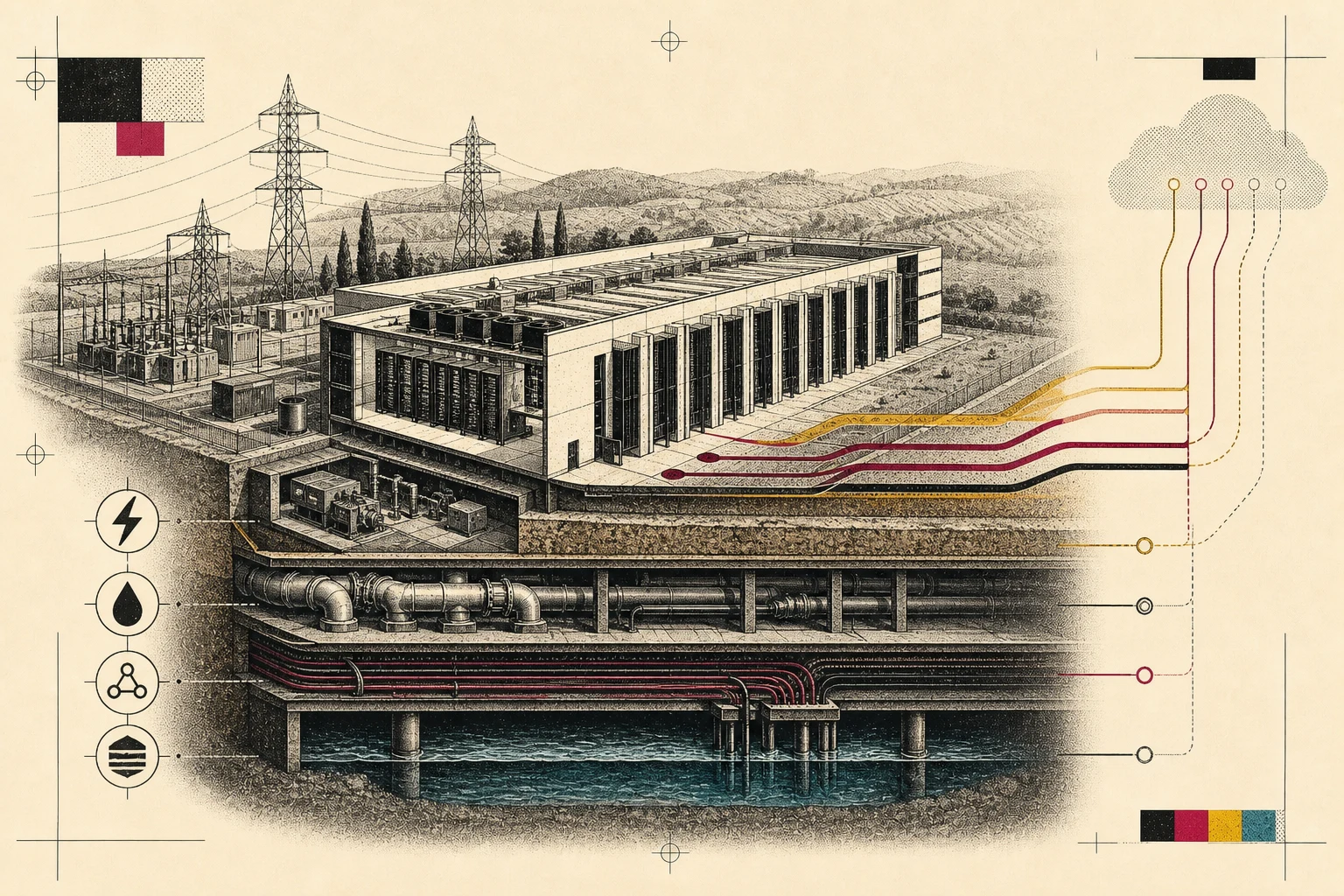
A landing station is not simply a garage in which to park the end of a fibre. It is the point of passage between ocean and land. Its location determines the distance to data centres and major European nodes. Access conditions affect who can interconnect. The availability of alternative terrestrial paths determines whether the landing site opens an ecosystem or creates a bottleneck.
That is why Palermo, Genoa, Marseille or a Welsh beach are not decorative points on a map. They are places where the network enters a jurisdiction, meets a landowner, passes into a building and continues over another infrastructure. We can call it “global” only because a chain of local places agrees to connect.
The Italian case also makes coexistence among different parties visible. Sparkle, Google, other operators, data-centre companies, Internet exchanges and public authorities do not own the same thing. They collaborate along the same corridor while retaining distinct rights and interests. It is less intuitive than a single owner, but much closer to how the Internet actually works.
“Nobody Owns the Internet” Is True, but Not Enough
Ask ICANN who controls the Internet and its institutional answer is clear: no single person or entity. The Internet is a network of networks. Thousands of operators, companies, universities, governments and communities manage autonomous systems and choose how to connect.
That answer is correct. It becomes misleading only when we turn it into “the Internet has no owners.”
At the physical layer, there are cables, antennas, routers, stations, data centres and plots of land with identifiable owners. At the network layer, Autonomous Systems determine routing policies and commercial agreements. At Internet exchanges, operators peer or buy transit. Names and addresses rely on coordination functions performed by ICANN, IANA and regional registries. Standards are developed through open processes such as those of the IETF. Above all this sit cloud services, platforms and applications, each with rules and owners of its own.
None of these layers, by itself, is the Internet. The Internet emerges when they agree to interoperate.
The distinction is almost philosophical, but it has practical consequences. A company can own a cable without controlling the Domain Name System. ICANN can coordinate unique identifiers without owning routers. A government can authorise a landing site without deciding transmission standards. A platform can dominate a service without owning the mobile network we use to reach it.
Power grows when the same entity accumulates positions across several layers: content, cloud, data centres, a private backbone, cables, distributed caches and relationships with access providers. Absolute control is unnecessary. It is enough for leaving its ecosystem to become more expensive, slower or less reliable.
This is the private geography of the Internet: not a world map coloured by a single empire, but an overlap of ownership that produces unequal dependencies.
In Defence of Private Investment
It would be easy to end the argument with an automatic moral: the cables are private, therefore the network has been stolen. That would be a convenient and unhelpful conclusion.
Building a transoceanic system requires enormous capital, years of planning, specialised ships, permits, stations, equipment and enough demand to justify the work. Investments by operators and hyperscalers have added capacity and routes that might otherwise never have existed. A new path can reduce latency for a market, connect a country that previously depended on a handful of systems, and provide an alternative when a cable breaks.
Private ownership also does not necessarily mean exclusive use. An owner can sell or exchange fibres, offer wholesale capacity, or host operators in a neutral landing station. Consortia can distribute costs and rights. The open-access models of 2Africa and Blue/Raman explicitly declare this ambition.
The question is not whether the seabed should belong to states or companies. It is about the conditions. Who can buy access? Are there genuinely alternative routes? Are shares and rights of use knowable? Does the landing station encourage interconnection, or force customers to purchase other services from the same provider? If the owner stops investing, can somebody else step in?
Private infrastructure can support an open network. Shared infrastructure can still create a local monopoly. Ownership is the beginning of the analysis, not the verdict.
The Sea Is Free; the Landing Site Is Not
The United Nations Convention on the Law of the Sea recognises the right of all states to lay cables on the high seas and requires them to punish intentional or negligent damage. Yet the same link crosses different legal regimes before reaching its destination.
On the high seas, freedom to lay cables prevails. On the continental shelf, a coastal state may not arbitrarily prevent installation and maintenance, but those laying a new link must respect its rights and take existing cables into account. In territorial waters, the cable instead enters the sphere of national sovereignty. On the beach, coastal, environmental and planning permissions are required. The seabed has no single worldwide land registry.
Ownership and jurisdiction therefore do not coincide. A consortium may bring together companies from many countries while the landing licence is held by a national entity; the land may belong to one company, the station to another and the equipment may be operated by a third. If the cable is damaged, jurisdiction and the ability to prosecute the responsible party also depend on the location of the incident, the ship's flag, the nationality of the people involved and the evidence the state can gather.
Even repairs must pass through sovereignty. The right to lay a cable does not amount to immediate permission for a ship to enter port, take technicians aboard, load replacement cable and work in a state's waters. Customs, security, port regulations and environmental permits turn a line on a map into a sequence of public decisions.
The Convention even reaches a detail that seems written for this story. Article 115 provides that someone who sacrifices an anchor, a net or other fishing gear to avoid damaging a cable may be indemnified by the cable owner, provided that every reasonable precaution was taken. The law of the sea even contemplates the anchor that is better lost than dragged.
To govern this fragmentation, the European Union has included not only incidents and capacity in its risk mapping, but also ownership, landing points, installation and repair capability. Knowing that a cable exists is not enough: we need to know what it depends on, where it changes jurisdiction and which steps can slow its restoration.
The ITU and the International Cable Protection Committee insist on geographic diversity and faster repair procedures. A country connected by a single system does not have the same bargaining power as a hub served by many routes. A cable that can be repaired in a few days is not equivalent to one left idle for weeks while waiting for a ship or a permit. Even two separate connections provide little redundancy if they share the same landing site or vulnerable corridor.
There is only one conclusion: cables must be treated as infrastructure of public significance even when the capital is private. That does not mean nationalising every strand of fibre. It means understanding dependencies, making ownership and landing conditions transparent, preparing repairs and alternative paths, and preventing any single corridor from becoming irreplaceable. The goal is not to make every metre of fibre visible, but to make the conditions that keep the network open verifiable.
Then there is territory in its least abstract sense. Beaches have ecosystems, archaeological remains, economic activity, memories and communities. The horizontal directional drilling Greenlink used beneath Freshwater West and its dunes was intended precisely to reduce the visible impact of installation. The cable disappears, but the process by which it was decided should not disappear with it.
The Geography Dobby Made Visible
Let us return to Freshwater West.
Fans leave stones and socks for an imaginary character. A project manager discovers that the memory has enough substance to generate hundreds of phone calls and, according to his account, to enter the route of a 500-megawatt link. Nearby lie the remains of Bronze Age burials, while cables beneath the beach hold two electricity grids together.
It is a funny scene, but not a frivolous one. It shows how selective our ideas of reality are. We regard a community created around a film as immaterial until it changes a project. We regard the Internet as immaterial until a cable has to find a beach.
There is no single key with which one owner can switch off the entire network. There are owners of cables, shares, fibres, capacity, stations, buildings, data centres and platforms. There are operators that connect networks, bodies that coordinate identifiers and standards, states that authorise landing sites, and communities that live alongside infrastructure.
Saying that the Internet belongs to nobody remains an important defence of its open architecture. But it must not become an excuse for ignoring its material form.
The Internet does not belong to any one person. Almost all the places through which it must pass, however, belong to someone. The difference between an open network and a merely private one is decided there: in the conditions under which those passages are built, shared and made replaceable.
Bibliography and Documentation
Primary and Institutional Sources
- Greenlink. “Greenlink Interconnector” and “Greenlink FAQs.” Official project documentation, accessed 23 August 2026. Electrical nature of the system, capacity, composition, landing sites and installation technique.
- International Advisory Body on Submarine Cable Resilience (ITU and International Cable Protection Committee). “Report of the Working Groups 2026.” ITU, 2026. Recommendations on repairs, risk and geographic diversity.
- International Telecommunication Union. “Submarine Cable Resilience.” Backgrounder updated April 2026. Data on international traffic, systems, repairs and causes of failures.
- United Nations. “United Nations Convention on the Law of the Sea.” Articles 79, 87 and 112–115. Installation on the continental shelf and the high seas, liability for damage and indemnification for sacrificed anchors or gear.
- European Commission. “Submarine Cable Security Toolbox and Cable Projects of European Interest.” 5 February 2026, corrected version 16 March 2026. Mapping of ownership, landing sites and dependencies.
- Federal Communications Commission. “Review of Submarine Cable Landing License Rules and Procedures.” FCC 24-119, 2024. Ownership, control and regulation of landing stations.
- ICANN. “About ICANN.” Institutional documentation accessed 23 August 2026. Coordination of identifiers and the distributed nature of the Internet.
- Internet Society. “How It Works.” Institutional documentation accessed 23 August 2026. The Internet as a network of networks founded on open standards.
- NATO. “NATO-Funded Project to Reroute Internet to Space in Case of Disruption to Critical Infrastructure.” 6 August 2024. The HEIST project and its hybrid cable-and-satellite architecture.
- NATO. “NATO Launches ‘Baltic Sentry’ to Increase Critical Infrastructure Security.” 14 January 2025. Response to damage in the Baltic.
- European Commission and High Representative. “EU Action Plan on Cable Security.” 21 February 2025. Prevention, detection, response and the difficulty of attributing intent.
- Ministry of Digital Affairs, Taiwan. “Response to Chunghwa Telecom's Subsea Cable Disruption on January 3, 2025.” 6 January 2025. Traffic rerouting and satellite and microwave backups.
Technical Documentation and Research
- ITU-T. “G Supplement 41: Design Guidelines for Optical Fibre Submarine Cable Systems.” July 2024. Design, reliability, failures and repairs of submarine optical systems.
- TeleGeography. “Submarine Cable FAQs.” Updated 2026. Ownership models, capacity, global length and the operation of the ecosystem.
- Tim Stronge. “Written Congressional Testimony.” TeleGeography, 2025. Investments, ownership and the share of capacity used by content providers.
- TeleGeography. “A Refreshed List of Content Providers' Submarine Cable Holdings.” Updated August 2026. Publicly declared investments by Google, Meta, Microsoft and Amazon.
- Starlink. “Technology.” Technical documentation accessed 24 August 2026. Inter-satellite laser links, terminals and constellation architecture.
- NTT Communications. “New Cable Route Links Japan to Trans-Pacific Express.” 25 December 2009. TPE route, connected countries and consortium.
History and Context
- Science Museum. “Sending Messages Across the Atlantic.” 15 August 2014. The 1858 connection and the durable cable laid in 1866.
- Historic England. “Eastern House at Porthcurno Telegraph Station.” National Heritage List for England. Porthcurno's role in the British telegraph network.
Analysis and Editorial Coverage
- Helena Horton. “Harry Potter Fans Force Relocation of £430m Undersea Cable to Avoid Dobby's ‘Grave’.” The Guardian, 10 August 2026. Simon Ludlam's testimony and the origin of the opening scene.
- Brian Quigley. “Introducing Americas Connect.” Google Cloud, 11 August 2026. The new Alisios, Canoa and OlaLuz systems and their integration with Google's network.
- Meta Engineering. “Announcing the Completion of the Core 2Africa System.” 17 November 2025. Consortium, scale and access model of 2Africa.
- Meta. “Project Waterworth.” 14 February 2025. Presentation of the global project extending over 50,000 kilometres.
- Amazon Web Services. “AWS Announces Fastnet.” 2025. Project for a dedicated link between the United States and Ireland.
- Italian Ministry of Foreign Affairs and International Cooperation / Sparkle. “Blue and Raman Submarine Cable Systems in Collaboration with Google.” 30 July 2021. Project structure and ownership of the BlueMed section.
- Sparkle. “With BlueMed Palermo Confirms Itself as Key Internet Hub in the Mediterranean.” 11 May 2023. Landing in Palermo and connection to the Sicily Hub.
- Ministry of Digital Affairs, Taiwan. “2025 Report on the Analysis of Causes of Damage to Taiwan's Submarine Communication Cables and Improvement Measures.” 7 April 2026. Causes, court cases and resilience measures.