As of August 21, 2026, Terna's grid connection queue contained 531 requests attributed to data centers, totaling 95.38 gigawatts. That figure is now comparable to the roughly 120 gigawatts installed across Italy's entire electricity system. The queue has grown at extraordinary speed: 68.5 gigawatts in November 2025 and almost 80 in January 2026. For another point of comparison, the Data Center Observatory at Politecnico di Milano estimated 414 megawatts of installed IT capacity in the Milan area, less than half of one percent of the national queue.
Ninety-five gigawatts of servers are not about to switch on in Italy. There are not as many gigawatts of buildings ready, customers waiting and transformers already ordered. A connection request can represent a serious project, an immature option, a duplicate reservation or a way to occupy a place in line. As of August 21, only 15 applications, amounting to 1.88 gigawatts, had reached an advanced stage of the process.
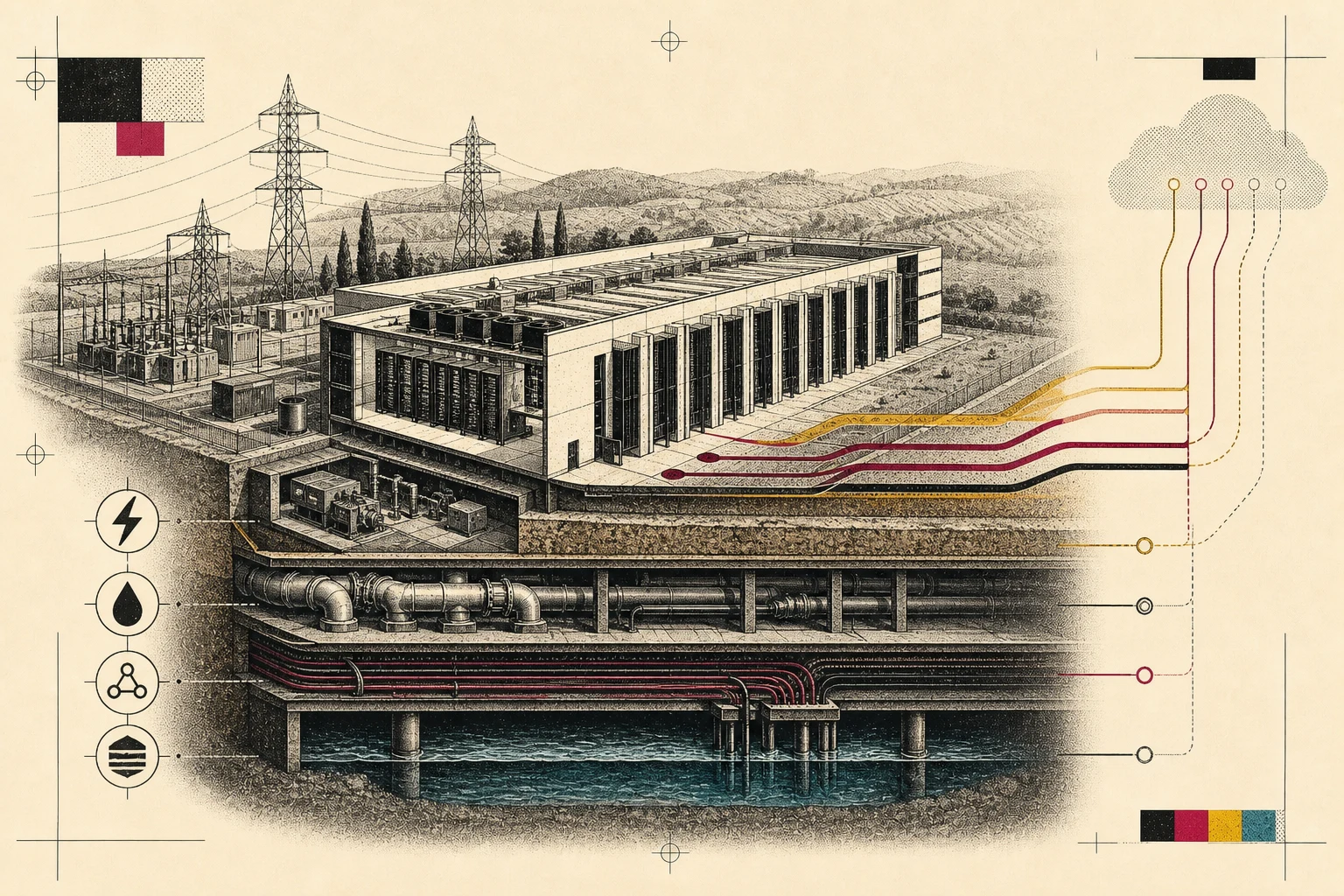
The disproportion still tells us something real. The cloud has stopped being an innocent metaphor and has arrived at the electricity grid with an industrial demand. It asks for land, continuous power, fiber, transformers, generators, batteries, water or alternative cooling systems. It asks for permits and, often, public money to train workers, build infrastructure or migrate services.
Italy wants that demand. The government has drafted a strategy to attract foreign data center investment. Parliament has introduced a single procedure intended to complete ordinary authorizations within ten months. Lombardy has passed a law governing location, land, water, energy and heat recovery. Actual investment recorded by the Politecnico Observatory reached €7.1 billion between 2023 and 2025. For 2026 to 2028, 83 projects worth a potential €25.4 billion have been announced.
This is a recognizable industrial policy: give the digital economy an Italian home. But a home is not the same as what it contains. A data center may be in Italy, the service may be American, the software proprietary, the chips supplied through Asian and US value chains, and the keys managed by someone other than the data owner. Meanwhile, the most stable margin may follow the cloud contract rather than the electricity meter in the municipality hosting the building.
The question, then, is not merely how many data centers Italy will build. It is how much power and value will remain here after the country supplies energy, water, land and rules.
The Cloud Files a Grid Connection Request
A data center is not a warehouse full of computers. It is a machine made of at least three overlapping systems.
The first is property and industry: land, buildings, substations, uninterruptible power supplies, fire suppression, cooling and physical security. The second is computing: racks, servers, networking equipment, storage, processors and AI accelerators. The third is the service: virtual machines, databases, identities, development tools, analytics platforms, models and applications sold to customers.
Each system can have a different owner. A fund may own the land. A colocation operator may manage the building. A hyperscaler may rent a hall and install its own servers. An Italian company may buy capacity from that cloud without knowing which rack executes a specific workload. The data owner, key manager and software provider may be different entities again.
This is why the origin of a data center cannot be read from the sign above its door. Calling a facility Italian because it stands in Settimo Milanese is like deciding the nationality of a television network by consulting the land registry for its studio. Location matters: it determines jurisdiction, latency, grid works, local taxes and environmental impact. On its own, however, it does not tell us who decides on updates, who can interrupt the service, how much it costs to leave or where the revenue ends up.
Artificial intelligence has made the issue more visible because it increases compute density and focuses attention on GPUs and energy. But data centers were already supporting email, payments, archives, streaming, business software and public services. The generative AI boom did not invent dependence. It made dependence large enough to appear in electricity-grid plans.
Italy Courts Capital
The strategy published by the Ministry of Enterprises and Made in Italy lists advantages that genuinely exist. Submarine cables cross the country. Italy sits at the center of the Mediterranean, has industrial sites in need of redevelopment, technical universities, a network of companies and still-growing digital demand. Milan is already an important European node and can provide interconnection, customers and skills.
The new national single procedure attempts to address one of investors' recurring complaints: fragmented authorization across too many authorities and unpredictable timelines. Lombardy's law adds a territorial grammar, favoring brownfield sites, encouraging heat recovery, requiring higher contributions when agricultural land is used, and assessing water and energy resources. The Regional Council approved the bill on May 26, 2026. It was enacted as Regional Law no. 11 of June 3, 2026, and published in the regional official bulletin on June 5. The two dates describe different stages of the same process.
None of this amounts to surrendering to hyperscalers. A state may reasonably decide that attracting infrastructure serves its interests. Proximity to computing capacity reduces latency, expands interconnection options and gives companies resources they could hardly build alone. A campus can reclaim an industrial site, fund civil works, purchase energy, employ maintenance staff and attract suppliers.
The problem begins when the announced investment is treated as a sufficient measure of public benefit. Of the potential €25.4 billion expected for 2026 to 2028, the Observatory attributes 72 percent to new international operators. This does not mean that 72 percent of Italian data centers will be foreign-owned, or that 72 percent of profits will leave the country. It does mean that the expansion is being driven mainly by capital and organizations whose centers of decision-making are elsewhere.
Employment requires the same caution. A report produced by Pb7 Research for the Italian Data Center Association estimated 1,235 direct employees in colocation and hyperscale facilities in 2024, together with 13,735 indirect and 6,830 induced jobs. These are significant figures, but they describe different kinds of work. A construction site can employ thousands for a few years. Operating a highly automated facility requires a smaller and more specialized permanent workforce. Vantage, for example, associated its Italian program with around 4,000 construction jobs spread over eight years and roughly 250 permanent roles.
There is nothing surprising about this. Power stations, automated factories and submarine cables show the same relationship between a construction peak and ongoing operations. It becomes misleading only when the two quantities are added together to create a single employment promise.
Following One Euro into the Building
To understand who gains from the boom, it helps to follow one euro, even though no public dataset currently allows us to reconstruct its entire journey.
During construction, that euro pays for land, design, remediation, concrete, systems, transformers, security and labor. One part may remain with Italian companies and workers, while another purchases components made elsewhere. During operation it pays for electricity, connectivity, maintenance, security, taxes and technical staff. These are recurring flows tied to the territory.
Then comes the layer the customer actually sees. Customers do not buy square meters or kilowatts. They buy compute, storage, databases, AI tools, identity, analytics and support. Here value does not depend on physical capital alone. It depends on the catalog, proprietary software, economies of scale, the commercial relationship and the cost of moving an application elsewhere.
Construction, operation and platform layers have different lifetimes and margins. Concrete is paid for once. A managed database generates subscription revenue as long as the application remains built around its interfaces. Training creates skills, but certification tied to a single provider can also strengthen that provider's ecosystem. Energy is purchased in Italy, while intellectual property may generate royalties and profits in another country.
This is where the intuition that the United States will extract more value than Italy becomes plausible, though it cannot yet be converted into a percentage. According to data cited by the European Parliament, AWS, Microsoft Azure and Google Cloud together control around 69 percent of Europe's cloud infrastructure market. That figure concerns European cloud services, not the ownership of Italian buildings or the final destination of every euro of profit. It does show where contractual power is concentrated in the most recurring and difficult-to-replace layer.
A hyperscaler can buy chips at a scale beyond the reach of a domestic operator, distribute services across many regions, integrate backbones, cloud and AI, and offer hundreds of ready-made components. The more proprietary components a customer adopts, the more leaving becomes a rewriting project rather than a relocation. A technical advantage turns into commercial rent.
Italy is not giving away every euro. In a substantial portion of the international-operator-led expansion, however, it supplies the physical foundation of a value chain whose upper layers it controls only weakly. The distinction matters. The first claim would be propaganda. The second is an industrial-policy problem.
Milan Is Not All of Lombardy
Geographic concentration creates another misunderstanding. Within the Observatory's scope, Milan accounted for 414 megawatts of IT capacity and 68 percent of Italy's total. But the market does not stop at the municipal boundary. It follows high-voltage power, fiber, available land and proximity to customers, expanding into the rest of Lombardy.
One municipality may collect fees and host the campus while a neighboring municipality receives a new power line, construction traffic or noise. A brownfield project avoids consuming undeveloped land, but it does not eliminate pressure on the grid. One project may demonstrate access to sufficient water and energy. Ten projects assessed separately may saturate the same substation or water basin.
The correct scale is therefore not the data center gate. It is the territorial system that enables the facility to operate. Without cumulative assessment, every project presents its own impact as marginal, and the total appears only when new transmission lines, new power plants or restrictions on other users become necessary.
Terna's requests make this advance competition visible. They are not certain future consumption, but they still create planning work, use administrative capacity and can influence expectations about land values. According to a reconstruction by Tom's Hardware based on applicant type, only 10 percent of requests come from data center operators or dedicated funds. Another 30 percent comes from engineering firms, while the remaining 60 percent is linked to property, logistics or private applicants without a declared industrial project.
The applicant's identity is not enough to establish that a project is fictitious. A property developer may prepare a site for a future customer, and an engineering company may act on behalf of an operator. But the figures make it plausible that part of the queue functions as a market for options and placeholders. Before accelerating permits, authorities need a way to rank maturity: customer, financing, site, additional energy capacity and credible timelines.
The National Strategic Hub and Sovereignty by Contract
The National Strategic Hub, or Polo Strategico Nazionale, is supposed to be Italy's answer to this problem. Its name promises three things: a national perimeter, a strategic function and a public capacity to decide. Inside the structure, the promise becomes far less linear.
PSN is a joint-stock company owned by TIM at 45 percent, Leonardo at 25 percent, CDP Equity at 20 percent and Sogei at 10 percent. Describing it as an ordinary private company would be inaccurate. The Ministry of Economy and Finance is a shareholder in Leonardo, CDP Equity belongs to CDP, and Sogei is wholly public. But PSN is not an infrastructure directly owned and operated by the state either. On its transparency page, PSN specifies that Sogei's stake does not give the Ministry of Economy and Finance control or dominant influence.
That ownership picture is accurate, but it may change. In July 2026, Corriere Comunicazioni and Adnkronos reported talks about transferring Sogei's 10 percent stake to Leonardo, which would take Leonardo to 35 percent. In the background there is also reported interest by Poste Italiane in CDP Equity's 20 percent stake, along with Poste's increased weight in TIM following its public exchange and acquisition offer. If that transaction also took place, the Poste group would influence 65 percent of PSN through the stakes currently held by TIM and CDP Equity. These are negotiations and governance scenarios, not an ownership structure that has already been finalized. That is precisely why they matter: they show that control over the concession holder for public infrastructure can be reshaped by corporate transactions outside the contract with public administrations.
The Presidency of the Council of Ministers granted the company a concession lasting up to thirteen years. Contracts with individual administrations may last ten years. The agreement allows services to be performed by the concession holder's shareholders and provides for subcontracting within the applicable rules. At the end of the concession, part of the infrastructure may be transferred to the granting authority or a successor operator, but property, patents and systems protected by intellectual property do not automatically become public.
The arrangement is also supported by public spending. Italy's National Recovery and Resilience Plan allocated €900 million to help central and healthcare administrations migrate to PSN services. By the end of 2025, the company reported more than 600 participating administrations and an order backlog of about €3.8 billion. There is nothing abnormal about a concession generating revenue. That is its business model. This is exactly why it is essential to understand how much operational and contractual capacity remains with the state that finances the demand.
The decisive passage appears in the company's own 2025 integrated report. PSN states that its service contract with TIM, Leonardo and Sogei “outsources a large part of the activities.” Its risk map also recognizes high supplier concentration and dependence, possible technological lock-in, and incomplete oversight of contractual obligations and the application of penalties.
This is not an accusation made by an opponent. It is how the concession holder describes its own operating model and the risks it must manage.
The stack remains hybrid as well. Secure Public Cloud uses Microsoft Azure, Google Cloud, AWS and Oracle. PSN says that workloads remain in Italian regions, operations are performed in Italy, and primary keys belonging to public administrations are managed by the Hub. These are concrete safeguards. A key held outside the cloud provider can reduce that provider's ability to read the data. Separate backups and domestic regions improve continuity and control.
But encrypting a service does not mean owning its software. The roadmap, updates, interfaces, formats and end of support may still depend on the hyperscaler. If a proprietary database becomes indispensable, the key protects its contents but does not make replacing the engine affordable. Cryptographic sovereignty mitigates an industrial dependence. It does not erase it.
From Public Administrations to the Armed Forces
The issue becomes more sensitive when state services move into PSN. The national strategy calls for the Hub to host critical and strategic data and services from central administrations, healthcare bodies and local government.
In 2024, the Ministry of Defense signed a ten-year contract involving the Network Operations Command, the Army, Navy, Air Force and General Secretariat of Defense. The Ministry's National Recovery and Resilience Plan page describes it as the first adoption of external management for unclassified digital services.
That adjective is essential. Official sources mention portals, e-learning, document systems, a healthcare component and limited business-continuity functions. They describe non-mission-critical services and do not justify claims that PSN hosts weapon systems, classified data or operational military command.
The limited perimeter does not make the choice irrelevant. A unified document system, healthcare services and portals for all branches of the armed forces are critical administrative infrastructure. Moving them from internally managed data centers to a concession holder means transferring staff, procedures, operational knowledge and responsibility along a corporate chain. That may be rational, but it is more than replacing old servers with new ones.
The stated benefit is consolidation. Many public data centers surveyed before the Cloud Italia Strategy did not meet adequate standards. Four facilities across two regions, common controls, specialized staff, qualification by the National Cybersecurity Agency, backups and continuity procedures may be safer than dozens of fragile, undersized server rooms maintained inconsistently.
Concentration changes the shape of risk, however. It reduces the number of weak points but increases the value and potential impact of those that remain. A local error affects one office. An error in a shared layer can cross many administrations. A specialist provider may defend the system better, while becoming a systemic dependency at the same time. This wider blast radius is an architectural inference, not a statistic proving that PSN is already less reliable than the data centers it replaces.
PSN's 2024 financial statements report security incidents caused by internal factors that made some services unavailable and, in at least one case, required activation of the business-continuity plan. The company says it responded effectively and began improvements. These were not necessarily attacks, and they are not described as data breaches. In the following integrated report, PSN records zero cyberattacks and data breaches in 2025. In the same year, the National Cybersecurity Agency renewed qualifications for the infrastructure and the main services it examined. The picture does not prove an infrastructure out of control. It proves that centralization does not eliminate failure and instead turns it into a national design problem.
The right question is not whether PSN is safe or unsafe in the abstract. It is whether the state retains enough capacity to oversee the concession holder, audit shareholder-operators, understand the stack, enforce penalties and rebuild services elsewhere. If the answer depends on the same organizations that provide infrastructure, operations and technology, sovereignty risks becoming the national management of a dependence that remains industrially external.
Eight Questions Instead of a Flag
The word sovereignty invites shortcuts. Put the servers inside national borders, hire Italian technicians or attach a flag to the service. A more serious test requires at least eight questions.
Where are the servers and every copy located? Which jurisdiction reaches the companies, staff and data? Who controls identities, keys, logs and updates? Who owns the building, hardware and capital? Who can modify firmware, orchestration and software? Can the customer leave without rewriting the service? Where do salaries, taxes, profits, research and intellectual property remain? Can public authority measure, condition and, when necessary, refuse?
PSN passes some tests and leaves others open. Italian location, control of keys, qualification by the National Cybersecurity Agency and golden-power rules are not cosmetic details. At the same time, a company not directly controlled by the state, which outsources much of its operations to its own shareholders and incorporates technology stacks from non-European companies, does not achieve the autonomy its name suggests.
The same method applies to commercial campuses. A foreign-owned building can produce substantial local value if it purchases additional energy, develops skills, pays taxes properly and hosts replaceable operators. An Italian-owned building can produce little if it depends on hardware, software and customers controlled elsewhere. Nationality is one variable. Autonomy is a relationship among many variables.
The Electricity Bill Has an Address
Italian data centers consumed an estimated 5.8 terawatt-hours in 2024, according to the Energy & Strategy Group at Politecnico di Milano, about 1.9 percent of national electricity demand. In projections for 2035, the share could rise to between 7 and 13 percent.
These are estimates, not Terna measurements or prophecies. They depend on how many projects are built, their efficiency, GPU density and actual demand. The grid also cannot be understood through annual totals alone. A facility needs continuous power at the node where it stands. A country may have enough electricity overall and insufficient capacity at the requested substation.
Data centers therefore compete with other necessary transitions: electrifying transport and heating, replacing fuels in industry and closing fossil-fuel plants. A renewable power-purchase agreement may finance new generation, but an annual guarantee of origin does not automatically create clean power in every hour and at the same grid node. If a project needs new transmission lines, the public needs to know who pays and which users will benefit.
AI workloads may provide flexibility. Some training jobs can be shifted in time or between regions. But not every computation can be postponed, and the main product of a data center remains availability. Flexibility cannot be counted as though it were already a contracted service before it has been measured.
Water Cannot Be Counted Per Prompt
The debate over water consumption has produced dramatic comparisons that travel poorly from one facility to another. Water use depends on climate, season, rack density, cooling design and the boundary chosen for the calculation. One facility may consume more water on site to reduce electricity used by compressors. Another may almost eliminate evaporation while increasing electricity demand. Power generation has its own water footprint as well.
European data center reporting rules require metrics such as energy-use effectiveness, water use, recovered heat and the renewable share. This is progress, but an aggregated public database is not enough for a territory assessing a specific campus. A municipality needs to know seasonal consumption, potable and non-potable water use, limits during drought weeks, noise, emergency generators and cumulative impact with other projects.
Heat recovery is a good example of the gap between a brochure and infrastructure. Data center heat can warm buildings, greenhouses or district networks, but it requires nearby users, pipes, compatible temperatures and demand at the same time. Without those conditions, technical readiness remains a promise without a recipient.
Sustainability should not be a certificate hanging at the gate. It is a verifiable balance among resources absorbed, infrastructure added and benefits returned. If a territory gives energy and land to a highly automated facility, it has a right to know what it will receive after construction ends.
In Defense of Foreign Investment
There is a strong counterargument. Italy currently lacks the capital, hardware, software and scale needed to meet all demand for cloud and advanced computing on its own. Waiting for a perfectly national ecosystem would probably mean remaining peripheral and buying the same services from foreign regions.
Microsoft has announced €4.3 billion over two years to expand ItalyNorth and support training. It reports renewable power-purchase agreements, rainwater collection and limited use of evaporative cooling. Even if these claims are treated as corporate statements to be verified site by site, the investment can improve capacity, skills and resilience.
Fully owning an ecosystem that is too small is not automatically better than retaining a significant share of a global one. Italian companies need reliable tools now. Public administrations need to replace data centers that no longer meet minimum standards. International operators can bring technology, customers and practices that would take years to reproduce.
But this argument justifies cooperation, not the absence of conditions. Dependence can be accepted during a transition only if it remains visible, measurable and reversible. If public incentives finance migration toward services that are too costly to leave, the subsidy is not buying sovereignty. It is buying future demand for the provider.
PSN could have been the place where the state built its own expertise while purchasing technology from the market. Its model instead risks layering three dependencies: on the concession holder, on the shareholders that perform much of its operations, and on the hyperscalers that supply parts of the stack. Security qualifications reduce immediate technical risk. They do not resolve industrial and democratic risk.
Attracting Capital Is Not Enough
An industrial policy for data centers does not have to choose between closing the gates and offering investors anything they request. It must decide which outcomes the territory purchases with its resources.
Connection requests should be ranked by maturity, with guarantees that discourage purely speculative reservations. Permitting should assess grid, water, fiber, heat, land and additional renewable generation together. Environmental data should be public for each site and comparable over time. Grid expansion should follow clear rules about costs and beneficiaries.
Employment commitments should distinguish construction work from permanent jobs. Supply-chain commitments should measure procurement, research and intellectual property, not just the number of registered suppliers. Cloud procurement should reward tested portability, open formats, replaceable software and internal expertise within public administrations. An exit plan cannot be an appendix written by the supplier. It must be tested, funded and exercised regularly.
For PSN, an even simpler question is necessary: who genuinely represents the state's interest when the concession holder, shareholder-operators and technology suppliers have converging financial incentives? Golden power, the National Cybersecurity Agency, contract managers and penalties are important tools. They work only if the public sector retains people capable of using them, access to operational data and practical alternatives.
With its proposed Cloud and AI Development Act, Europe wants to expand computing capacity quickly and establish common sovereignty criteria. The two goals must advance together. Tripling the number of buildings without changing dependence and control would create more European capacity for platforms still governed elsewhere.
Italy can welcome data centers. It can even use foreign capital to accelerate a necessary modernization. But it should stop confusing the residence of servers with ownership of the digital future.
Ninety-five gigawatts of requests are not ninety-five gigawatts of sovereignty. An address in Italy does not yet make the building ours, and a key held here is not enough if we cannot change the lock, the operating system and the owner of the property. Sovereignty begins when we know what depends on whom, how much replacing it costs and how much value remains in the place that supplies energy, water, expertise and rules.
As long as those answers remain mainly in the hands of concession holders and their suppliers, the data center will be in Italy. The decision, much less so.
Bibliography and Documentation
Primary and Institutional Sources
- Italian Ministry of Enterprises and Made in Italy. “Strategy to Attract Foreign Industrial Investment in Data Centers to Italy.” November 2025.
- Terna. “2025 Development Plan for the National Electricity Grid.” 2025.
- Italian Republic. “Law no. 49 of April 10, 2026” and coordinated text of Decree-Law no. 21 of February 20, 2026, Article 8.
- Lombardy Region. “Regional Law no. 11 of June 3, 2026. Provisions on the Establishment of Data Centers.” June 2026.
- Regional Council of Lombardy. “Bill no. 86: Legislative Process and Session of May 26, 2026.” May 2026.
- European Commission. “Commission Delegated Regulation (EU) 2024/1364.” March 14, 2024.
- European Commission. “Proposal for a Cloud and AI Development Act.” COM(2026) 502, June 3, 2026.
- Department for Digital Transformation. “Polo Strategico Nazionale.” Updated in 2026.
- Department for Digital Transformation and Polo Strategico Nazionale. “Concession Agreement for the Development and Management of the National Strategic Hub.” August 24, 2022.
- Italian Ministry of Defense. “Agreement Signed Between the Ministry of Defense and Polo Strategico Nazionale.” June 5, 2024.
- Italian Ministry of Defense. “Investment 1.1 Digital Infrastructure: Migration to the National Strategic Hub.”
- Polo Strategico Nazionale. “Transparent Company.”
- Polo Strategico Nazionale. “Secure Public Cloud.”
- Polo Strategico Nazionale. “2024 Financial Statements.” 2025.
- Polo Strategico Nazionale. “2025 Integrated Report.” March 19, 2026.
Technical Documentation and Research
- Data Center Observatory, Politecnico di Milano. “From Noise to Value: Italy as a New European Data Center Hub.” January 2026.
- Energy & Strategy Group, Politecnico di Milano. “Digitalization and Decarbonization Report 2025.” January 2026.
- Vermeulen, Peter; Pb7 Research; Italian Data Center Association. “Status of Data Centers in Italy.” June 2025.
- European Parliament. “Report on European Technological Sovereignty and Digital Infrastructure.” 2025.
- European Parliament. “European Software and Cyber Dependencies.” December 2025.
- International Energy Agency. “Energy and AI.” 2025.
Analysis and Editorial Coverage
- Vecchio, Alessandro. “Italy Invaded by Data Centers.” Guerre di Rete, July 30, 2026.
- Tom's Hardware Italia. “Data Centers Clog Italy's Electricity Grid with Requests, Almost All of Them Fake.” August 25, 2026.
- Fortune Italia. “Data Centers, Energy Request Boom: 95 GW Awaiting Connection in Italy.” August 24, 2026.
- Corriere Comunicazioni. “Polo Strategico Nazionale, Leonardo Targets Sogei's 10% Stake.” July 7, 2026.
- Adnkronos. “Cloud, National Strategic Hub: Leonardo Expected to Move for Sogei Stake.” July 6, 2026.
- Khalili, Joel. “The AI Race Is Pressuring Utilities to Squeeze More From Europe's Power Grids.” WIRED, March 23, 2026.
- Taft, Molly. “You're Thinking About AI and Water All Wrong.” WIRED, December 12, 2025.