The Heat Inside the Room
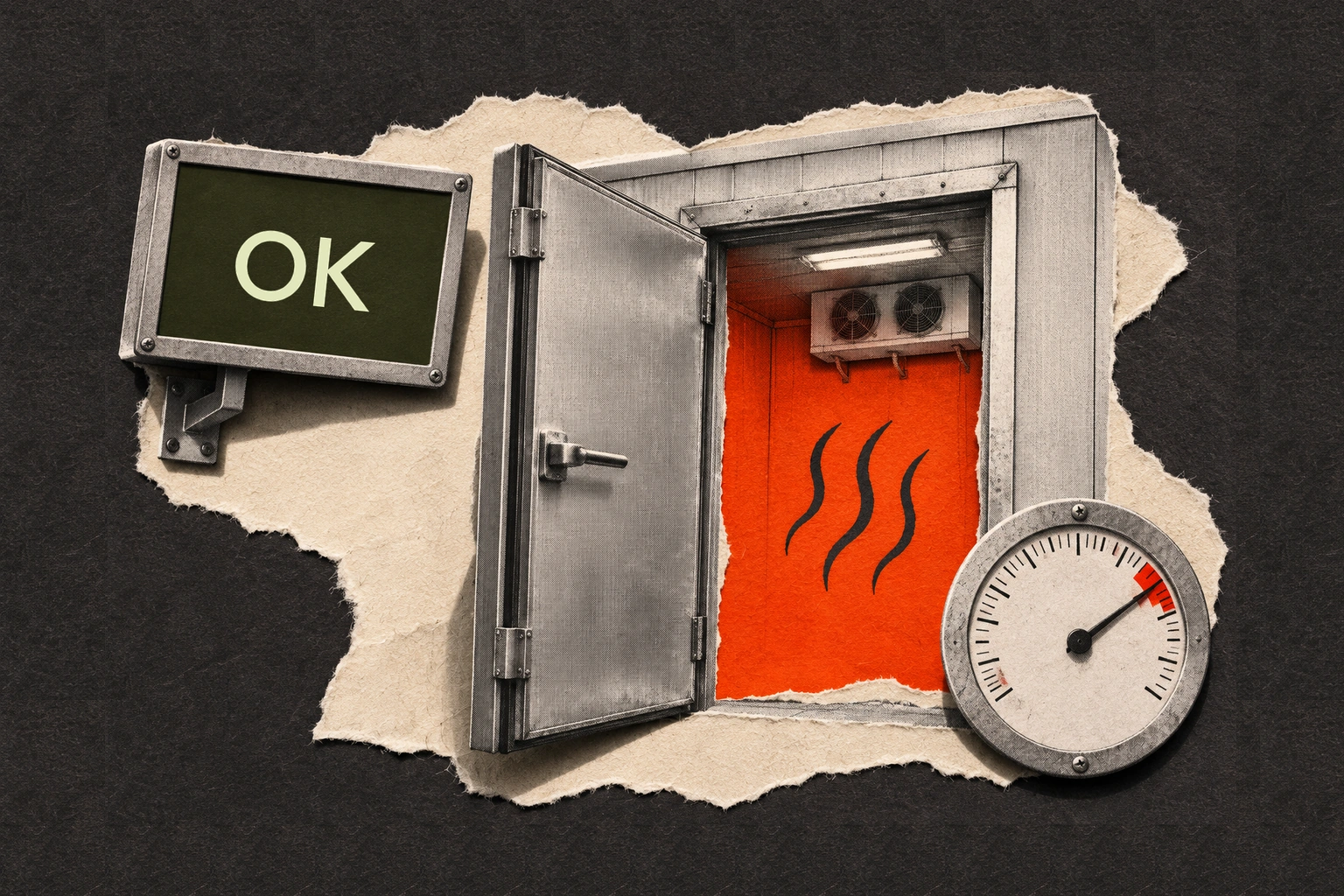
On Monday 2 November, in Finale Ligure, the employees of two companies, Gallo SS and Gallo Logistic, opened the doors of the cold rooms and did not find the usual wall of freezing air, but heat. Yet on the controllers the values looked normal: the screen showed ordinary figures and confirmed, with bureaucratic stubbornness, that the cold chain was intact. The machine, or rather its screen, said everything was fine. The room said the opposite.
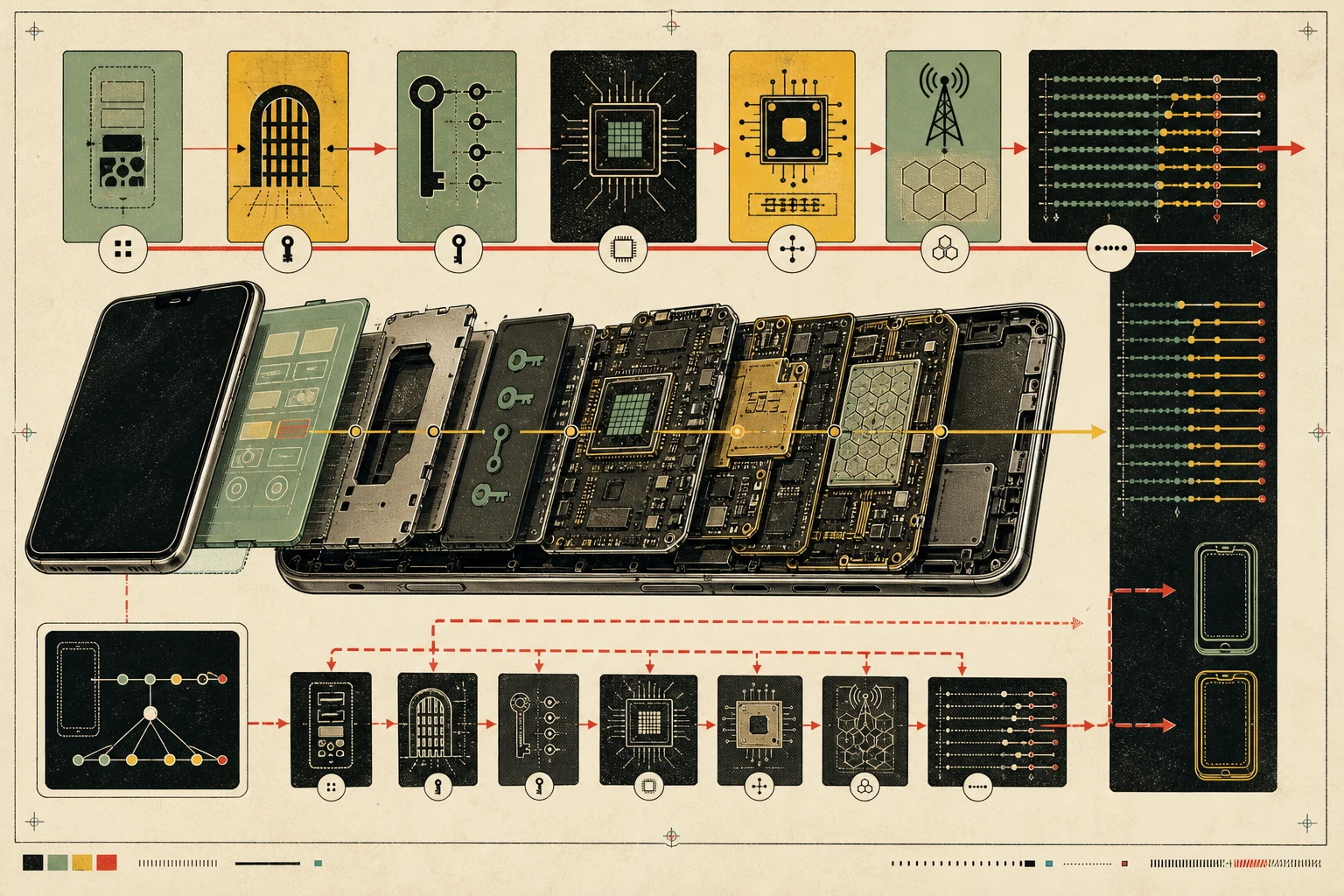
To understand how a screen can lie, you have to look behind the glass. What we call a controller is not a thermometer and not a simple switch: it is a small computer that runs a cold room or a refrigerated display case. It decides when to start the compressors, keeps an eye on the temperature, sends alarm notifications if it rises and controls a function as invisible as it is delicate, defrosting.
As it works, a system builds up frost and ice on the heat exchanger, the radiator that draws heat out of the room. If the ice stays, the system stops cooling, and so, at regular intervals, the machine has to do exactly the opposite: heat up, with electric heating elements or with hot gas. It has to do so within tight time limits: in Finale Ligure the cycles lasted twenty minutes, three times a day. All of this can also be set remotely, because these devices can have remote access for monitoring and maintenance, and it is convenient: whoever looks after them does not have to rush to the site at every anomaly.
According to GenovaToday's reconstruction, those cycles were stretched to 256 minutes, four hours and sixteen, while alarms and controls appeared to be blocked. To stop everything the systems were cut off from the power supply and from the Internet and, the paper wrote on 5 November, were being checked by hand, every half hour. Genoa's District Anti-Mafia Directorate has opened a case against persons unknown for unauthorised access and damage; the postal police, who handle cybercrime, are investigating.
The Interfaces Left Open
The offensive against the refrigerated display cases came in two distinct waves. The first incidents appeared on 11 October 2026, then spread, in the night between 1 and 2 November, to several member states of the European Union. In France, in the night between 11 and 12 October, more than seven hundred commercial sites recorded equipment failures, with fires and spoiled goods worth tens of millions of euros, according to the toll released by the French government. The November shock hit an even wider map. About forty Delhaize supermarkets across Belgium and Luxembourg and fifteen Carrefour stores in Belgium reported tampering, as the companies themselves said.
There was time to take cover, but the defences arrived late. The Belgian company Sabcobel said it had worked all night to disconnect the systems and that it had begun to secure its customers after the French attack. In two shops on the Swedish island of Öland, in Böda and Köpingsvik, more than nine tonnes of food were thrown away and sent for incineration; the manager of the ICA in Köpingsvik said he had asked for protection after the French cases without anyone stepping in in time; temperatures went above fifty degrees and the fan covers melted. In Palermo, at a Conad store, the alarm did not go off during the night, the area manager said, and the anomaly appeared in the morning on looking at the display, with the settings gone from sub-zero values to plus fifty degrees. The Swedish chain Coop said the updates had been scheduled for Wednesday, two days after the attack.
Many controllers had their door wide open onto the public network. Refrigeration controllers run compressors, defrost cycles and alarms, and end up connected to the Internet for service reasons: Danfoss, in a commercial note, states that remote maintenance cuts unnecessary technician callouts by 15-30% and saves compiling temperature logs by hand. A survey by the company Forescout counted almost thirteen thousand refrigeration services exposed online on about six thousand public addresses. The devices, apparently, were often opened with factory credentials, the user name “Supervisor” and the password “12345”. In addition, in eighty per cent of the Danfoss StoreView controllers analysed by Forescout the firmware was stuck at versions prior to the fix for known vulnerabilities, and for the AK-SM 800 model the manufacturer's support had ended in May 2021. If a device is out of support, warns the French computer-incident response centre CERT-FR, restoring the factory settings is not enough to protect it, because an exposed device can be compromised again.
The authorities' warnings describe a fragility that cannot be fixed with a patch. Palazzo Chigi, the seat of the Italian government, after the summit of 3 November, counted only a few commercial units hit in Italy, confirming the presence of obsolete devices with exposed interfaces and no case having emerged of a health risk from thawing. Andrea Quacivi, director general of Italy's National Cybersecurity Agency, the ACN, pointed to the heart of the problem in software that can no longer be updated and in the possibility of operating the systems from a distance. The agency prescribed taking the control panels off the Internet, separating operational networks from office ones and accessing only through virtual private networks and multi-factor authentication. On 13 November the German federal authority BSI reported new vulnerabilities in the Danfoss AK-SM 800A controllers up to version 5.3.2, and at 13.25 corrected its notice, admitting that version 5.4.0, released in November, might also be vulnerable.
The Blood Service's Cold Rooms
The same controllers work where an error of a few degrees does not spoil food but destroys a therapy. In the night of 2 November the intruders reached the refrigeration equipment of the Établissement français du sang, the public service that keeps the stocks for French hospitals. The intrusion touched three regional sites through the connection of an external supplier, according to the service's statement. In the cold rooms were stored donor samples and bags of plasma for transfusions and for the production of medicines. From the remote controls came the order to move the setting from thirty degrees below zero to one hundred and ten, Le Canard enchaîné reported. It was a value set on the controller, not the temperature reached by the biological material. No bag was lost and no impact on patients' health has been detected, the service declared.
The protection held because monitoring did not run through a single channel. The rental company Coolworld Rentals confirmed the involvement of a limited number of devices and of an external component in the remote monitoring programme. The service's deputy director Sophie Le Cam told the broadcaster RTL that the internal alarm system works independently of the supplier. During the night a technician on shift noticed the temperature in the rooms rising, Le Canard enchaîné reported again, attributing it to the service. In Besançon control was lost for only a few minutes and the continuous temperature monitoring set the on-call team in motion, France 3 said, citing the regional managers. According to the Ministry of Health the remote accesses have been neutralised. The Paris prosecutor's office has entrusted the investigation to the domestic security services and to the cybercrime police, specifying that it cannot confirm a link with the supermarket fridges.
The threat can touch any facility that entrusts delicate substances to industrial remote control. The alert notices of the French chambers of commerce remind us that devices of this family can monitor the cold rooms of pharmacies, analysis laboratories, mortuaries and industry. Security expert Josh Corman warned that the next targets could be heat-sensitive medicines and laboratory materials. On 4 November the National Cybersecurity Agency extended its calls for checks to any sector that uses connected refrigeration. In remotely run systems, whoever is watching trusts what they see on the screen. If the code tampers with the numbers or switches off the alarm notifications, the fault may be discovered when the damage is already done.
The Code That Broke the Centrifuges
That a screen can lie while a machine breaks is not an invention of these days. In 2010 Stuxnet was discovered. The target, according to the analyses by Symantec and by the Institute for Science and International Security, was the Natanz plant in Iran, where centrifuges enriched uranium, and the sabotage worked on speed: passing through the industrial controllers that commanded the motors and the frequency converters that made them spin, the code changed their running speed, taking them now above working speed, now almost to zero, and caused mechanical stress and breakage. According to the institute's estimate, about a thousand centrifuges were damaged between the end of 2009 and the beginning of 2010.
The point is the object in the middle: the programmable controller, a Siemens S7-300, a standard box sold all over the world. Siemens was already documenting in 2008 the integration of that family of controllers into a building automation system, aimed also at the food and pharmaceutical industries, hospitals, airports, tunnels. Common components, then, and a specific target: the code could infect other machines, but to sabotage it looked for a precise configuration, and before striking it observed for about thirteen days.
To succeed, the code had to deceive whoever was watching. According to a technical summary from 2012 by the cyber defence centre in Tallinn accredited by NATO, the malware hid the sabotage by replaying to the operators reassuring data recorded earlier: whoever was monitoring the plant could see normal values.
That a command could destroy a real machine had already been proved in the laboratory. On 4 March 2007, at the Idaho National Laboratory, in a controlled test, a diesel generator was destroyed in about three minutes: it was disconnected from the grid and reconnected out of sync, using the settings of the device that protected its circuit breaker. The documents of the US Department of Homeland Security, published in 2014, say that no additional software was introduced; according to Wired's account the command was sent remotely from the laboratory's offices. The video was released by CNN in September 2007. Stuxnet did it in the field: a command sent to a standard component, and a real machine that breaks. Cinema had imagined it long before. In 1993 the director Rachel Talalay made Ghost in the Machine, released in Italy as Killer Machine, a film in which household appliances become weapons.
Voting on a Screen
A screen that confirms what we cannot verify has a precedent at the ballot box. In 2006, in the Netherlands, a group of experts wanted to check what a machine that seemed to work could do. People now voted by pressing a button, on the Nedap ES3B, used, according to the group's study, by about 90% of Dutch voters: the voter pressed the button, the screen confirmed, and local administrations saw in the electronic count a way of reducing errors. But a closed box asks you to believe that what appears on the glass matches what ends up in the memory.
The group was called “Wij vertrouwen stemcomputers niet”, that is, “We do not trust voting computers”; among the experts was Rop Gonggrijp. They needed a real machine, and the manufacturer had not given its consent: one municipality lent them one, another sold them two. Together with members of the Chaos Computer Club, the German hackers' association, the experts spent about a month analysing them. The result was demonstration software capable of falsifying the results. To install it you needed physical access to the machine before the vote, to swap its memory chips: less than five minutes in the 2006 demonstration, sixty seconds in the Chaos Computer Club's in 2007.
Then there was confidentiality. Three units were analysed and the radio emissions of all three could be received from a few metres away; those of one, from up to 25 metres. The signal changed when an accented character appeared on the screen, as in the name of the party Christen Democratisch Appèl, the CDA: so, receiving it from a few metres away, you could tell when someone chose that party.
On 1 October 2007 the Amsterdam court annulled the approval of the Nedap machines. On 16 May 2008 the government decided to go back to paper and red pencil, and the nationwide return began with the European elections of 2009. In the 2026 voting instructions the ballot is still paper.
On a paper ballot the pencil mark coincides with the voter's will and stays there, recountable by anyone with two eyes. In the machine, between the voter's hand and the data in the memory there is a space nobody sees: the screen can confirm one vote while the memory records another.
Alarms Without Danger
The same week showed the exact reverse of the deception: setting off the siren when there is no danger. Thirty-five commercial flights received bomb threats over three days between 3 and 6 November, according to the figures released by Eurocontrol, the European organisation for the safety of air navigation, the most recent figure still approximate. On the morning of 5 November the Aer Lingus flight EI402 from Dublin to Rome was diverted to the French military base of Évreux-Fauville, escorted by two fighter jets, with one hundred and fifty-one passengers and six crew members transferred afterwards to Paris by bus. The same day the Finnair flight from Helsinki to Rome was escorted all the way to landing at Fiumicino. Ground searches found no explosive device.
Nobody has yet put a certain name to whoever pressed those buttons. The Irish government considers a coordinated campaign probable, but acknowledges that those responsible remain unknown. Ireland's chief of staff, Rossa Mulcahy, warned that it is too early to link these threats to the intrusions into the fridges. In Italy the Ministry of the Interior, in the assessment of the security committee of 10 November, indicated that the attacks on the systems and the unfounded alarms share an identical aim of destabilisation. The investigations have not yet identified the perpetrators or established a common guiding hand.
What It Means to Defend
What is formal, in a week like this, is one official accusation, and it concerns the French fridges. On 9 November the French foreign minister, Jean-Noël Barrot, declared that the October attack on the supermarkets, about seven hundred points of sale, is the work of Iran's Revolutionary Guards, and announced sanctions at European level. The accusation concerns October, not November or the flights. Reuters told the story of the attacks in the context of the war with Iran that began in February. For the rest there are claims and hypotheses: the group NoName057(16) claimed the attacks in a video that, according to Il Post, shows no evidence to prove them; the ACN urges caution and the European agency ENISA, in its statement of 4 November, attributes nothing.
The Defence Minister, Guido Crosetto, interviewed by Corriere della Sera on 9 November, issued an appeal to government, Parliament, the judiciary, the bureaucracy, trade unions, businesses and universities on preventing hybrid war and asked for a cyber force to be set up. Whoever it was, they found devices with interfaces exposed on the Internet, in many cases not updated or no longer updatable.
When we talk about European defence we think of tanks and fighter jets, and the numbers are large. The ReArm Europe plan, later Readiness 2030, speaks of 800 billion euros potentially mobilisable over four years: they are not spent. SAFE, the European loan instrument, is worth up to 150 billion and includes the protection of critical infrastructure and cyber; in the Commission's September review there are 18 approved plans and over 12 billion disbursed.
Funds and rules come after the devices already installed. The Cyber Resilience Act, the European regulation on products with digital components, requires manufacturers from 11 September 2026 to report actively exploited vulnerabilities and serious incidents, with an early warning within 24 hours of becoming aware and notification within 72; the main requirements will apply from 11 December 2027, and for controllers already placed on the market before that date there is no automatic obligation to make them updatable. A device out of support is a device its manufacturer has stopped updating, and whoever keeps it in a cold room is left with the flaw.
Defending a connected device means first of all knowing what is there, who manages its code and who can touch it remotely, and then having a check that does not depend on what the screen tells you. It is what the ACN asks for, in its bulletin on the cold chain, when it recommends checking temperatures and alarms with independent instruments too.
A command that arrives from afar passes through someone: whoever built the device, whoever installed it, whoever manages it remotely. At the blood service the attack came through a supplier.
This is why a strategic infrastructure is not bought like a household appliance. When what depends on a device is a blood cold room or a laboratory, the profit of whoever sells and maintains it comes second to the ability, for whoever uses it, to know what is inside it, to update it and to check it. A machine's vulnerability does not arise only when someone forces it: it arises when we give up being able to check it without its permission.
According to the French blood service, its internal alarm worked without going through the supplier; in Dutch elections the ballot is paper and anyone can recount it. A check is worth something when it does not go through what the machine under check says: the medium is secondary, and an independent verification can be paper or technological.
In Finale Ligure it took someone opening the door of the cold room and noticing that it was warm inside. On the glass of the controller the numbers kept saying that everything was fine.
Bibliografia e documentazione
- Reuters (Raphael Satter, Gabriel Stargardter), “French officials suspect Iran is behind refrigerator hacks, sources say”, 9 November 2026. The French government's accusation against Iran's Revolutionary Guards for the October attacks, in the updated text of the wire, read in a partial syndicated copy.
- Al Jazeera (with AFP and Associated Press), “France accuses Iran of cyberattack on supermarket fridges”, 9 November 2026. Minister Barrot's statement and the sanctions announced.
- CERT-FR, “Incident de sécurité ciblant les contrôleurs à distance des installations de réfrigération”, CERTFR-2026-ALE-012, 12 October 2026, updated on the 13th and the 16th. The devices involved and the limit of the factory reset.
- Agenzia per la cybersicurezza nazionale (CSIRT Italia), “Misure urgenti di verifica e mitigazione per operatori della distribuzione alimentare e della filiera del freddo”, BL01/261013/CSIRT-ITA, 13 October 2026, reissued on 3 and 4 November; “Sicurezza dei sistemi a supporto della catena del freddo e interfacce di management di sistemi connessi: richiamo urgente alle misure di verifica e mitigazione”, BL02/261104/CSIRT-ITA, 4 November 2026. The cold-chain measures and the risk of altered data.
- Presidenza del Consiglio dei ministri, “Attacchi hacker in Europa ai sistemi di refrigerazione commerciale, nota di Palazzo Chigi”, 3 November 2026. The meeting at Palazzo Chigi.
- ENISA and European Commission, “Joint statement on cyber incidents in refrigeration systems across the EU”, 4 November 2026. The dates of the two waves; no attribution.
- Reuters (Marie Mannes, Helen Reid, Louise Rasmussen), “New cyberattack on supermarket fridges sweeps across Europe”, 3 November 2026. The chains hit.
- French diplomacy, “Declaration of attribution to Iran of cyber attacks against France”, website of French diplomacy, 11 November 2026. The scale of the French wave of October: more than seven hundred sites and damage of tens of millions of euros.
- BBC News (James Gregory, Shiona McCallum), “Shop freezers in seven European countries hit by cyber-attack”, 2 November 2026. The shops hit in Belgium, Luxembourg, Sweden, Ireland and the Netherlands, with the figures declared by the companies.
- Markus Dahlberg, “Polisen om hackerattacken mot frysar: ‘Svårutrett’”, SVT, 4 November 2026. The Coop shops hit in Sweden and the updates scheduled.
- William Frykfeldt, Hanna Nilsson, “Kritiken från handlaren efter frysattacken: ‘Måste höra av sig’”, SVT, 5 November 2026. The nine tonnes of food from the two Öland shops.
- Euronews (Jonathan Benton), “Hacker sondano i sistemi di refrigerazione europei prima degli attacchi a supermercati e banche del sangue”, 7 November 2026. The factory credentials.
- Sai Molige (Forescout Research), “Cold Chain, Open Control: Exposed Refrigeration Systems Reveal Global Risk”, Forescout, 22 October 2026. The devices exposed on the Internet, the outdated firmware and the end of support.
- Danfoss, “Smart Store” document, AC315364430341en-000101, August 2019. Remote maintenance and temperature logs.
- Il Post, “Ci sono davvero hacker filorussi dietro gli attacchi ai frigoriferi dei supermercati?”, 6 November 2026. The Italian cases and the claim of responsibility.
- Tgcom24, “Attacchi hacker nei supermercati europei, congelatori a 50 gradi: si segue la pista filorussa”, 3 November 2026. The reports in Sicily and Emilia-Romagna; the trail indicated in the headline is not adopted as an attribution.
- Manfredi Esposito, “Hacker manomettono i freezer dei supermercati: in Sicilia merce buttata”, LiveSicilia, 3 November 2026. The Conad stores hit and the account of the missed alarm in Palermo.
- Il Post, “Una settimana di attacchi hacker e allarmi bomba in Italia e in Europa, in ordine”, 9 November 2026. The summary of the week.
- ANSA, “L'Agenzia per la cybersicurezza: ‘Gli attacchi hacker ai frigo favoriti da software non aggiornati’”, 5 November 2026. The hearing of the ACN's director general: software that cannot be updated and remote control.
- Bundesamt für Sicherheit in der Informationstechnik (BSI), “Angriffe auf Kühlgeräte: Weitere Schwachstellen in Danfoss Controller AK-SM800A”, 13 November 2026. The new vulnerabilities and the correction on version 5.4.0.
- Francesco Li Noce, GenovaToday, “Attacco hacker alle celle frigorifere di due aziende liguri: indaga la Dda di Genova”, 5 November 2026. The reconstruction of Finale Ligure.
- La Croix, “Une cyberattaque a touché des chambres froides de l'Établissement français du sang”, 4 November 2026, with the service's statement of 3 November read in excerpt. The statements of the service and of the ministry.
- Fanny Ruz-Guindos and Louise Colvert, “Les hackers ont du sang sur les mains”, Le Canard enchaîné, no. 5530, 3 November 2026. The command to 110 degrees and the technician on shift.
- Lisa Imperatrice, “Après les supermarchés, une cyberattaque menace les réserves de plasma de l'Établissement français du sang”, Numerama, 4 November 2026. The attack on the blood service's cold rooms.
- Antoine Comte (with AFP), “Cyberattaque des chambres froides de l'Établissement français du sang : une enquête ouverte, le parquet de Paris saisit la DGSI et l'Office anti-cybercriminalité”, France 3 Bourgogne-Franche-Comté, 12 November 2026. The control lost for a few minutes in Besançon and the Paris investigation.
- Jenna McLaughlin, “A new cold war: hackers target fridges across the globe”, NPR, 3 November 2026. Josh Corman's warning on medicines and laboratory materials.
- Danfoss, “Refrigeration controllers”, 19 August 2015. The functions of a controller and defrosting.
- Elodie Carsalade, CCI Nice Côte d'Azur, “Cyberattaque des installations frigorifiques : alerte ANSSI”, 14 October 2026, with updates; CCI Hauts-de-France, “Cybersécurité : vigilance sur certains équipements de réfrigération connectés”; accessed on 9 November 2026. The sectors where devices of this kind can be found.
- Nicolas Falliere, Liam O Murchu, Eric Chien (Symantec), “W32.Stuxnet Dossier”, version 1.4, February 2011. The technical analysis of the malware.
- David Albright, Paul Brannan, Christina Walrond (Institute for Science and International Security), “Stuxnet Malware and Natanz: Update of ISIS December 22, 2010 Report”, 15 February 2011. The estimate of the centrifuges damaged.
- Marco De Falco, “Stuxnet Facts Report”, NATO Cooperative Cyber Defence Centre of Excellence, 2012. The replay of reassuring recorded data.
- Siemens, “DESIGO S7: industrial building automation”, 2008, and the “SIMATIC S7-300” product page, accessed on 9 November 2026. The use of the controller in buildings.
- US Department of Homeland Security, FOIA collection 14-F-00304 on the Aurora test of 4 March 2007, with “Aurora Project Review” and “Aurora Vulnerability”, released in 2014. The damage to the generator and the absence of additional software.
- Andy Greenberg, “How 30 Lines of Code Blew Up a 27-Ton Generator”, Wired, 23 October 2020. The remote command.
- Jeanne Meserve, “Mouse click could plunge city into darkness, experts say”, CNN, September 2007. The video of the test.
- American Film Institute, entry for Ghost in the Machine; Cinematografo, entry for Killer Machine; both undated, accessed on 9 November 2026. Kayti Burt, “Talalay's Terrors! The Director Breaks Down Her 5 Scariest Scenes”, Den of Geek, 15 October 2020. The direction, the Italian title and the plot.
- Rop Gonggrijp and Willem-Jan Hengeveld, “Studying the Nedap/Groenendaal ES3B voting computer: a computer security perspective”, EVT 2007. The software, the memory chips and the radio emissions.
- Wij vertrouwen stemcomputers niet, “English” page of the campaign, Internet Archive copy of 20 June 2021 accessed on 9 November 2026; National Democratic Institute, “Netherlands: Opposition to Electronic Voting”, 17 December 2013; Ben Goldsmith and Holly Ruthrauff, “Case Study Report on Electronic Voting in the Netherlands”, NDI/IFES, 2013, p. 260; Chaos Computer Club, “Amsterdam wählt auf Papier”, 30 October 2006. The history of the group, the chronology and the advantage that local administrations saw in electronic counting.
- Kiesraad, “Committee to assess electronic voting”, 26 September 2013; Government of the Netherlands, “What do I need to vote in the municipal elections?”, 2026 instructions. The return to paper.
- ANSA, “Eurocontrol, ‘allarmi bomba su 35 voli europei in tre giornate’”, 7 November 2026; ANSA, “Ondata di allarmi bomba sui voli in Europa, caos e jet in azione”, 5 November 2026. The flight counts and the diversions.
- Franceinfo (with AFP), “Ce que l'on sait des alertes à la bombe qui ont visé une vingtaine de vols européens et forcé un avion à atterrir en urgence en France”, 5 November 2026. The flight diverted to Évreux, the passengers and the means mobilised.
- Paul Reynolds, “Gardaí sweep RTÉ headquarters in Dublin after bomb threat”, RTÉ, 6 November 2026. Ireland.
- Ministero dell'Interno, “Piantedosi ha presieduto al Viminale il Comitato nazionale per l'ordine e la sicurezza pubblica”, 10 November 2026. The committee's assessment of the attacks and the unfounded alarms.
- Monica Guerzoni, “Hacker, è sfida epocale Lo Stato resti unito e decida il piano per sopravvivere”, Corriere della Sera, 9 November 2026. The appeal on hybrid war.
- European Commission, “Future of European defence”, page with a declared update of 19 November 2025, and “Protecting what matters” (September 2026 review); Council of the European Union, Regulation (EU) 2025/1106, 27 May 2025. The European defence funds.
- European Parliament and Council, Regulation (EU) 2024/2847 (Cyber Resilience Act); European Commission, “Cyber Resilience Act - Reporting obligations”, page updated on 11 September 2026. The European rules on products with digital components.